
Books
BTS: How Elections Are Really Won In India
Krrishna Rout
Nov 30, 2025, 07:00 AM | Updated Dec 03, 2025, 02:31 PM IST
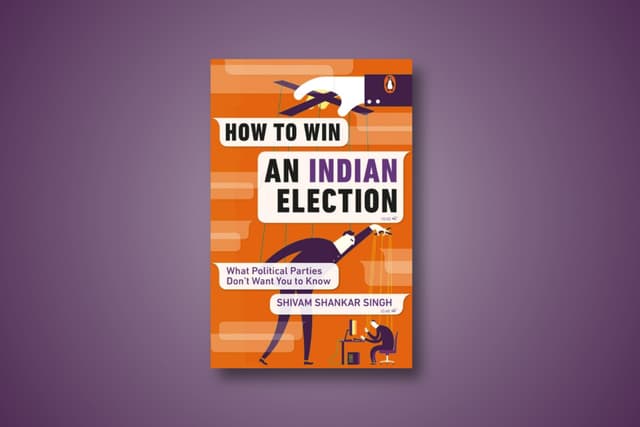
How to Win an Indian Election: What Political Parties Don’t Want You to Know. Shivam Shankar Singh. Pages: 240. Price: Rs 299.
"The key to any good democracy is a well-informed electorate." - Thomas Jefferson
Shivam Shankar Singh's How to Win an Indian Election gives the readers an insider's view of elections and politics with an emphasis on what goes into running a successful campaign. He is a political consultant and has also been a part of event management under IPAC (Indian Political Action Committee); his experience of having conducted the analysis for several elections since the 2014 general elections enriches the text.
Singh discusses in the book political discourse with hands-on learning about electoral strategies and claims of democracy being upheld. The book comprises seven chapters with key themes being voter manipulation, agenda propagation, data misuse, political consultancy, et cetera.
Singh, at the core of it, addresses the question of how a political party wins an election in India by taking the readers through different stages prior to the actual polling day, but lacks in providing any major insights. His inspiration to write comes from the fact that all other occupations have explainers, YouTube videos, and exam preparation tactics to convey the methods and approaches; however, with how complex and uncertain politics is, he thought there needs to be a book to provide an inside look into this occupation, making his text a guideline for those who want to enter politics.
With regard to the composition of the book, Singh tackles the nuances of the text through his anecdotal and journalistic writing style. The reader finds a sense of comfort in reading the text as the author is not an overachieving political scientist, newspaper editor, or academician to whom the readers cannot relate. It is the essence of his youth and learnings that connect with the readers.
He makes mistakes, breaks a few rules to quench his inquisitiveness, and hence, the readers, through a sense of belonging, can find solace in his writing. Nonetheless, his tone is openly partisan against the Bharatiya Janata Party (BJP), whom he critiques incessantly, along with occasional jibes at other parties. Though his argument is well substantiated, his sources at certain points are questionable, such as quoting data from BuzzFeed and Google searches.
New-Age Politics of the 2000s
Since Singh is a new-age author, his book draws on contemporary examples that speak to the young voters and readers. Such as him listening to news on an iPad or Facebook posts, joining WhatsApp groups for election updates, along with his concerns of forgetting shuddh Hindi during his stay abroad, are just a few of the many references one can find in the text.
Since he is a comparatively new joinee in the field of politics, his retrospective analysis is that of events of the 21st century, 2010 onwards. Such writing brings a new fervour to the domain of books dedicated to politics, which are predominantly written on the Emergency, the Congress era, or the BJP, based on the developments post-1947.
His book revives memories of the campaigning, India Against Corruption (IAC) movement, and elections, which the Generation Z (group of people born in the late 1990s to early 2000s) in particular can identify with, as they took place in their formative years. Mentions of the then-widely used catchphrases, such as 'chappan inch ki chaati' (fifty-six inch chest), 'acche din aane wale hain' (Good days are coming), which, as rhetoric, are particularly attractive and used alongside accessible language, make the book enticing.
With regard to the politics of the early 21st century, he attributes the revolution in terms of governance as well as technology used during elections to the gust of young professionals who supported Arvind Kejriwal and Narendra Modi during their struggle for India Against Corruption. Though the Aam Aadmi Party (AAP) and the BJP observe polarisation in terms of ideology, it was their combined force that took down Congress from the centre.
The author credits his joining of the BJP in 2013—and his official joining as a political consultant later in 2016—to this new-age politics, which made use of social media advertising, rallies, 3D holograms, and the hope of a new leader, in our current Prime Minister Narendra Modi, to break India free from the dark clouds of the United Progressive Alliance (UPA) government.
Singh's Professional Trajectory
The author, in his initial years, fresh back from abroad, knew that he needed money to continue his quest in politics. He enrolled in the Legislative Assistants to Members of Parliament (LAMP) fellowship offered by PRS Legislative Research in 2015, so that he could sustain himself through the stipend that he received.
While working under a Member of Parliament (MP) owing to the LAMP fellowship, he unveils several loopholes in the functioning of the parliament, such as the selection procedure of the parliamentary questions to the ministers, issuance of whips by political parties which prevent important issues from being discussed, the downside of anti-defection which prevents the MPs from voting against what their party leader wants, et cetera.
The revelatory aspect comes in when the author, along with his partners, is driven to address one of these loopholes regarding the selection procedure of parliamentary questions. The three of them dived deep to unveil not just a conclusion about the selection oddity but also the names of MPs who benefited from this flaw. Soon enough, their discovery became a viral post and acted as the realisation point for the author about his interest in data analytics.
The transition, however, from his will to work on data analytics to pre-election event management was a swift one under IPAC, as data tasks were menial and IPAC gave more focus on election groundwork. It is under chapter two, 'The Political Consultants', that we see the author's tedious yet fulfilling efforts, from being the go-to person for everyone at IPAC about making leti (solution of flour and water used to stick posters) to hiring autos fitted with a sound system to play the campaign song.
Upon reading the section, one realises that politics and campaigning are both empirical and normative in their approach, as the leaders are well aware of the 'what is?'—the ground reality; however, they aim for the 'what ought to be', so that they can prepare and promote accordingly.
Singh, in the initial chapters, provides an overview of the working and success of the former elections that he was a part of as the consultancy team; however, it is during the North-East elections, particularly in Manipur and Tripura, that he becomes the epicentre of power and implements his learnings from experience.
The Manipur elections can be looked into closely from the parties involved, categories of voters, data analysis, and advertisement tactics that he provides. Hence, making one realise that politics as a field of work is an all-encompassing occupation which requires an understanding of psychology, economics, statistics, geography, et cetera, along with a hint of clairvoyance.
The Star Strategist: Prashant Kishor
The author, post his tenure at PRS, joined IPAC under Prashant Kishor. Kishor was a man Singh looked up to throughout his work years. He is seen as a towering figure in Indian politics across the book, first as a star political consultant whose strategies to win the elections never fail, whether it was for 2015 Nitish Kumar's Bihar elections or Narendra Modi's 2014 general elections.
Kishor, due to his proven excellence, also took up the leadership of Citizens for Accountable Governance (CAG) under the directives of the BJP; however, he remained an unsung warrior because his contribution was not rewarded with a political position, which led to the dissolution of CAG and Kishor leaving the BJP to eventually form IPAC.
Prashant Kishor could create such a persona for the leader he was assigned to that it could overturn the results of the political setup. Hence, in no time, IPAC became the largest political consultancy group. While working under him, the author realised that decisions and actions which might be seemingly spontaneous are rather 'pre-decided and well-crafted', like a film script where the actors are the politicians and party karyakartas who work together to fool the audience.
Therefore, the reader realises that the next time they find a politician giving a 'candid' interview or expressing concern about the safety of those climbing electricity-carrying poles to listen to their speeches, it is to be understood that it is scripted. Kishor had the experience working with both the major national parties, the BJP and the Congress; however, it was not long before he dissociated himself from them due to rifts.
Vile or Volition: Manipulating Thoughts
In essence, it is through the book the readers learn that the politicians and parties have a minimal role in their victory; it is, in fact, the workers in the background, ranging from professionals like political scientists to labourers, who hold the reins of planning and execution, respectively. The consultancy firms and individuals do the dirty work for the parties, while the politicians savour the victory.
As each step is well-crafted, one realises that there are no accidents prior to the elections. Every social media post, poster, jingle, slogan, and news channel one views is being shown for a reason, and that is to shape the voter's rationality. The information and agenda are slyly inculcated into one's subconscious so that they end up believing that their vote is of their own volition, whereas in reality it is not.
Election campaigning is thus not just restricted to the manipulation of mindset by preparing a 100-point chargesheet against the opposition, as seen in the case of Manipur elections under Singh, but also the manipulation of emotions.
Consultancy firms or those deployed by the politicians for advertisement primarily make use of the voters' digital footprints to analyse their status, likes, and dislikes, and then target them accordingly, which subtly shapes their opinion. As the author accurately says, "One of the biggest components of politics is marketing". Politics is no less than an entrepreneurship where one needs to sell their party and the face of their party to the voters. Grassroots-level campaigning is the most effective means of doing so.
The author mentions first-hand information about changes in voting preference owing to such marketing tactics. One such tactic involves the reshaping of the politician's public persona and how the voters view them, as was seen in the case of Amarinder Singh as a candidate for the Punjab elections.
IPAC took charge to transform his image from 'Maharaja' Amarinder Singh to 'Captain' Amarinder Singh to portray his accountability and accessibility, further supported by his campaign, 'halke vich captain' (Captain in the Constituency). The transition from a laid-back figure to a dedicated one was immaculate and foolproof, which helped in convincing the voters.
Critique and Questions
While Singh's book incorporates the tools and trajectory in the winning of an election, certain aspects remain underdeveloped and beyond the scope of the book.
Such as repeated mentions of the United States (US) and his will to pursue a future there, especially seen under chapter one. This constant mention of the well-paid job that he could have had and the lifestyle he could have enjoyed there weakens his argument about his unwavering interest in Indian politics. The book, hence, at times, rather than inspiring the young readers to join politics for a better change, demotivates them.
As a reader, one feels that it is not right for the author to showcase a comparison of one's passion with the monetary benefits of others; otherwise, it kills the essence of it.
In addition, one can note that the author gives overwhelming importance to the educational background of an individual, which seems quite irrelevant in the field of politics. One's educational qualification has only a little to do with their electoral victory and popularity in the constituency.
This is exactly why the constitution does not specify any minimum educational requirements to become an MP, as no degree can inculcate a true understanding and execution of the people's will. Hence, when Singh measures Prem Das Rai's—MP from the Sikkim Democratic Fund—capability from his educational background about being from IIT and IIM, it is unjustified.
To substantiate one's stance, it can be said that even though Arvind Kejriwal, the former CM of Delhi, was an IIT graduate and an ex-Indian Revenue Services (IRS) officer, Delhi remained corrupt, excessively polluted, and unsafe, which resulted in him being taken down in the 2025 elections. Therefore, being a good student does not guarantee being a good politician.
With regard to the author's critique of the BJP, he makes a strong claim that the target advertisement by political parties through bombarding messages and party agenda, as well as divisive comments through social media by categorising voters into groups, is only being done in India. However, no critical analysis of the other countries' campaigning system is conducted by the author; he rather explicitly states that, "This would allow for targeted messaging and micro-targeting in a way that hasn't happened in any other country in the world".
Therefore, for the readers to be convinced of his statement, a structured comparative analysis across countries with evidence would have been helpful.
Lastly, a vital concern which remains unaddressed is that if the speeches and actions in politics are staged, the opposition is unnecessarily shown as plebeian, party objectives and achievements are glorified, the media is rigged, then, amongst the sea of things mentioned by the author which are fake, several questions arise, like: what is real? How should the citizens decide on their vote? What shall be the parameters of judgement?
The author does point out the problems with the system; however, he is unable to provide a solution. Without a solution, the system will continue to perpetuate, and complaining about it would not make a difference.
The Corrupt and the Rigid
Hence, one can state that though the author attempts to do justice to the book, his partisan views act as a blockage in providing a genuine neutral commentary, which is reflected across the pages. Regardless, a chapter that single-handedly adds a sense of reasoned analysis of politics to the book is chapter seven, 'Experiments', which refers to the experiments in politics that break away from the usual.
Singh delves into these exceptions and provides a judgement about those who attempt to take the lesser-used path and where they end up. In this case, he discusses the coming of honest and well-educated politicians to the forefront to form parties, which sometimes fail to gain ground and other times do take off with gusto but end up becoming part of the same old system they criticised.
To conclude, a reader's takeaway is knowing that for the politicians, the end goal is to win elections by hook or by crook; the responsibility towards citizens and goodwill becomes a selective afterthought. Therefore, one should remain informed and vote wisely.
 Join our