
Ideas
The Unfinished War Of Ideas: How Indian 'Intellectuals' Built And Kept Naxalism Alive
Aditya Chauhan
Nov 18, 2025, 02:02 PM | Updated 02:03 PM IST
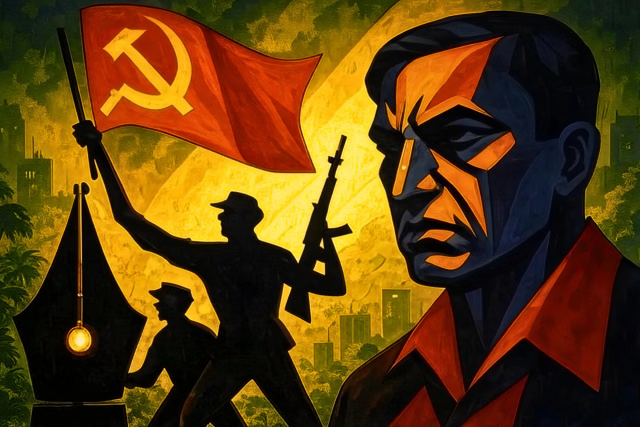
On 18th November, 2025, security forces gunned down Madvi Hidma, a top Maoist commander, in an encounter in Andhra Pradesh. Earlier this year, another top Maoist leader and general secretary of Communist Party of India (Maoist) Nambala Keshava Rao alias Basavaraju was shot down in the hinterlands of Chhattisgarh.
While the Central Government takes steps to fulfil its vow to completely eradicate naxalism by March 2026, this terse observation on the maoist movement by Nobel Laureate V. S. Naipaul from decades ago still rings true:
But the movement's stated aims had stirred the best young men in India. The best left the universities and went far away, to fight for the landless and the oppressed and for justice. They went to a battle they knew little about. They knew the solutions better than they knew the problems, better than they knew the country.
The role of India's educated elite in facilitating, romanticising and sustaining the Naxalite insurgency represents one of the most overlooked yet critical dimensions of India's internal security challenge. This, of course, should not minimise the success of our security forces in erasing the footprints of the Maoist insurgency throughout the decade. The statistics are indeed remarkable.
From 2004 and 2014, there has been a 53 per cent decline in Naxal activity between 2014 and 2024, a reduction in Naxal affected districts from 128 to 18, a 73 per cent drop in security personnel deaths and a 70 per cent reduction in civilian casualties. By October 2025, the number of districts affected by naxalism has been reduced to a mere three.
However, the effective decimation of the Naxalite movement remains incomplete as long as its intellectual foundations remain untouched. To fully eradicate naxalism, the ideological roots that have nurtured generations of revolutionaries must be systematically dismantled.
The Global Intellectual Foundations of Revolutionary Violence
The ideology that would eventually crystallise as Indian Naxalism did not emerge in isolation from rural West Bengal or Andhra Pradesh. Rather, it drew sustenance from a broader current of Western intellectual thought that became fashionable among Europe's radical intelligentsia in the 1960s.
In order to understand how intellectuals enabled naxalism, we first need to look into the international intellectual ecosystem that made revolutionary violence appear romantic, justified and progressive. Like many modern sociological evils, the maoist movement was enthusiastically championed by the intellectual stream of France aligned with post modernist thought. The post modernists played a pivotal role in creating and legitimising a romanticised vision of Maoist revolution that would eventually inspire Indian intellectuals.
Jean Paul Sartre, the preeminent philosopher of existentialism, became one of Maoism's most visible supporters. Sartre went beyond mere intellectual sympathy; he assumed the titular editorship of Maoist newspapers, publicly distributed banned Maoist publications on Paris boulevards and joined French Maoist militants in protest actions.
His partner and an equally influential philosopher, Simone de Beauvoir, saw her endorsement further amplify Maoism's appeal. In her autobiography All Said and Done, she wrote: "Despite several reservations especially, my lack of blind faith in Mao's China I sympathize with the Maoists. They present themselves as revolutionary socialists."
Michel Foucault took his involvement even further. He joined the Groupe d'Information sur les Prisons (GIP), a prisoner advocacy network that functioned as a support group for detained Maoists in France. Foucault adopted the Maoist method of social investigation to study French prison conditions, arguing that intellectuals had a duty not merely to conduct academic studies but to immerse themselves among the masses and learn directly through what Maoists called "social practice" or praxis.
Within Foucault's theoretical framework, the dichotomy between bourgeois academic study and revolutionary action dissolved; the intellectual was called upon to become a revolutionary activist. This philosophical move would prove enormously influential for how a generation of intellectuals came to understand their political responsibilities.
Equally important was the work of another French philosopher, Frantz Fanon, whose monograph The Wretched of the Earth became the intellectual manifesto justifying revolutionary violence. Fanon argued that "this same violence will be vindicated and appropriated when, taking history into their own hands, the colonized swarm into the forbidden cities."
More fundamentally, Fanon believed that society could only be changed through violence and that violence represented a personal cathartic experience. Individuals could only find true expression and release through violent action. In Fanon's framework, revolutionary violence was not merely a tactical necessity but a form of liberation and self realisation.
The late 1960s saw the rise of the "New Left", a movement that rejected both Western capitalism and Soviet style communism. Thinkers like Herbert Marcuse argued that man in Western capitalist society was enslaved just as thoroughly as his counterpart in totalitarian states, and that violence was a legitimate instrument of emancipation against institutionalised state violence.
In this intellectual milieu, revolutionary violence became aestheticised and morally justified. The romantic figure of Che Guevara, young, handsome, heroic even in (or because of) failure, became the ideal representation of revolutionary commitment. When Guevara died in a Bolivian ravine in 1967, the same year the Naxalbari uprising commenced in West Bengal, it seemed to confirm that heroic failure was more potent than worldly success.
Indian intellectuals absorbed and adapted these European frameworks, filtering them through the specific context of Indian postcolonial grievances. The sophisticated theoretical apparatus that justified violence as liberation became available to educated Indians seeking to understand their own societies. Marxist Leninist theory, combined with postcolonial critique and existentialist philosophy, created a powerful intellectual brew that made revolutionary commitment appear not merely politically necessary but morally imperative and philosophically justified.
The Indian Synthesiser: Charu Mazumdar's Theory of Annihilation
It is perhaps a case of tragicomic irony that the hearts and minds of the youth of India in the 1960s were stirred by the works of a frail heart patient, Charu Mazumdar. Mazumdar would become the founding ideologue of the Naxalite movement, emerging as the synthesiser of European Marxist Leninist thought, Maoist doctrine and anarcho communist impulses adapted to Indian conditions. Mazumdar's ideological project was rooted in a particular diagnosis of Indian postcolonial society.
Drawing on Leninist analysis, Mazumdar argued that Indian independence was incomplete and fraudulent and that the country remained semi colonial and semi feudal, dominated by a comprador bourgeoisie serving imperialist interests. This interpretation, while presented as rigorous Marxist analysis in academic circles, represented a fundamental misreading of the Indian historical trajectory.
The product of this synthesised interpretation was what he termed the "Theory of Annihilation". This theory attempted to justify the use of violence against the Indian state by positing the necessity of eliminating "class enemies" who, according to Naxal doctrine, represented the feudal and comprador bourgeois order that had supposedly persisted in independent India despite formal decolonisation. This theory possessed tremendous appeal to educated intellectuals who could deploy sophisticated Marxist terminology to criticise state led development while positioning themselves as inheritors of the radical anti colonial tradition.
Charu Mazumdar recognised early on that students and urban intellectuals possessed the theoretical sophistication necessary to elaborate the ideological framework for a revolution that would otherwise remain confined to peasant grievances and tribal aspirations. Strategy and tactics documents recovered by Indian authorities reveal that the Maoists deliberately targeted "intellectuals and students" which they described as "reliable motive forces in the revolution".
Mazumdar's "Eight Documents", composed during the initial phase of the Naxalite movement, became the canonical texts that mobilised urban intellectuals. These documents declared an "annihilation line", effectively authorising the assassination of "class enemies" who were not only landlords but police officers, teachers, businessmen and political workers. The theoretical apparatus justified indiscriminate violence as revolutionary necessity. In this framework, intellectuals could position themselves as brilliant revolutionaries, copying universal laws of historical materialism to India's particular conditions, directing and commanding the violent actions of peasant and worker foot soldiers.
Interestingly, even Mao Zedong himself recognised the danger of blind ideological copying. In 1967, just months after the rebellion in Naxalbari, a four member delegation of Indian Maoists including the young revolutionary Kanu Sanyal and Khokan Majumdar (born Abdul Hamid) travelled clandestinely to Beijing via Nepal and Tibet to seek guidance from Mao Zedong.
After three months of ideological and military training in operating machine guns, automated rifles, grenade lobbing, mine planting and explosives manufacturing, Mao delivered a stark warning to the Indian revolutionaries. Chiner chairman amader chairman ("China's Chairman is our Chairman"), a slogan the Indian Maoists had adopted, deeply upset Mao. He declared it wrong and politically immature, instructing them instead: "Forget everything you have learnt here in China. Once back in Naxalbari, formulate your own revolutionary strategies, keeping in mind the ground realities over there."
The delegation returned to India carrying not only military training but also Mao's implicit critique: that India's intellectuals were mechanically copying a foreign revolutionary model without adapting it to local conditions. This warning proved tragically prescient.
When the delegation reported Mao's criticism to Charu Mazumdar, who had invested tremendous intellectual and emotional energy in positioning the Naxalbari movement as ideologically close to the Chinese experience, he went into depression. His health deteriorated overnight. One of the delegates, seeking to console him, presented Mazumdar with a cigar that Mao had given him as a memento, but even this gesture could not dispel the ideological crisis that Mao's criticism had created.
V. S. Naipaul captured this tragedy of intellectual mimicry:
Naxalism was an intellectual tragedy, a tragedy of idealism, ignorance, and mimicry: middle class India, after the Gandhian upheaval, incapable of generating ideas and institutions of its own, needing constantly in the modern world to be inducted into the art, science, and ideas of other civilisations, not always understanding the consequences, and this time borrowing something deadly, somebody else’s idea of revolution.
Subaltern Studies: Intellectual Frameworks That Legitimised Insurgency
Indian historian Ranajit Guha was one such example. He was the doyen of subaltern historiography and founder of the Subaltern Studies school of thought. In an interview, he stated: "Later, I became something of a Naxal intellectual. I still consider myself to have been inspired by Charu Mazumdar's ideas which, I think, contain a lot of validity."
Ranajit Guha undertook a fundamental reorientation of how Indian history was understood and interpreted. By centring the experiences and agency of subordinated classes like peasants, workers and tribals, who had been marginalised in both colonial and nationalist historiography, Subaltern Studies made an important intellectual contribution to postcolonial scholarship. Guha's insistence that subaltern classes possessed their own political consciousness and agency, independent of elite direction, challenged elitist assumptions embedded in both colonial and nationalist historical narratives.
However, the implications of Subaltern Studies thought for radical politics proved deeply ambiguous and ultimately problematic. The theoretical framework that emphasised subaltern agency and autonomous resistance was appropriated to provide intellectual legitimacy to contemporary Maoist movements. If subalterns possessed autonomous political consciousness and agency, and if that consciousness expressed itself through violent insurgency, then such insurgency could be interpreted as the authentic expression of subaltern will rather than as manipulation by urban intellectuals.
The broader postcolonial studies project, while making important contributions to understanding the legacies of colonialism and non Western perspectives on global politics, also created intellectual frameworks within which radical and revolutionary movements could be romanticised as authentic expressions of postcolonial resistance. The "Third Worldism" articulated by postcolonial theorists, while sometimes critical of both Western imperialism and Soviet communism, nonetheless created a narrative structure in which movements challenging state authority in the Global South could be portrayed as inherently progressive and liberatory.
Postcolonial theory's emphasis on decentring elite narratives and recognising the agency of marginalised groups is often mobilised to dismiss state criticisms of insurgent movements as merely expressions of elite power seeking to suppress subaltern resistance. The theoretical framework that celebrated anti colonial struggles and emphasised the ways that Western power had distorted and subordinated non Western societies is often adapted to celebrate contemporary insurgencies as continuations of the anti colonial struggle.
This intellectual manoeuvre allowed theorists to position contemporary Maoist movements as inheritors of the anti colonial legacy, thereby clothing armed insurgency in the moral authority of the independence movement.
The Romanticisation of Maoism and Its Most Visible Intellectual Champion
In contemporary times, no figure better exemplifies how intellectuals enabled and romanticised Naxalism than Arundhati Roy, the internationally celebrated novelist. Over a series of high profile publications, a 2010 two part essay series for The Guardian, the 2009 essay "Mr. Chidambaram's War" in Outlook Magazine and her 2011 book Walking with the Comrades with Penguin, she constructed a sympathetic narrative of Maoist insurgency that would fundamentally reshape how educated Indians and international audiences understood the conflict.
In The Guardian essays, she famously described Maoists as "Gandhi, but with guns", a characterisation that transformed armed insurgents into liberation heroes. She chronicled her experiences in the Dandakaranya forest, including encounters with a child named Mangtu, whom she subtly framed as a victim of state persecution rather than addressing how Naxalites themselves recruit and deploy innocent children for combat purposes.
Her central rhetorical strategy was to reframe the Maoist movement as a legitimate resistance against state oppression while employing the language of human rights advocacy and tribal rights protection. Her core argument held that Maoists had "granted the tribal adivasis a semblance of dignity" through their organisational activities in Central India. She called Operation Green Hunt, security forces’ operations against Naxals, a "front for the economic pillage of the forests and the destruction of the livelihood and habitat of some of India’s most vulnerable citizens".
In this formulation, Maoists became not exploiters but liberators, providing weapons and organisational structure to impoverished adivasis, offering them means of "survival" and, implicitly, emancipation. Yet this argument inverts reality in a troubling way. Rather than recognising adivasis as possessing their own agency and capacity for democratic organisation within Indian institutions, Roy positioned them as passive recipients of Maoist benevolence. Crucially, she obscured the fact that these "gifts" of dignity came attached to obligations to fight in Maoist armies, converting adivasis from political agents into foot soldiers in someone else's ideological war.
The most damaging aspect of Roy's work was her systematic creation of false equivalence between legitimate state counterinsurgency operations and state oppression of civilians. By focusing exclusively on state violence while minimising or ignoring Maoist violence, she constructed a narrative wherein the state bore sole responsibility for the conflict. This framing conveniently bypassed inconvenient truths: that Maoists had murdered thousands of civilians, security personnel and officials; that they had coerced tribals into armed organisations through violence and intimidation; that they had engaged in systematic extortion and predation against the very rural populations they claimed to liberate.
What made Roy's intellectual intervention so consequential was the extraordinary power of her cultural authority. As a Booker Prize winning author with international literary prestige, Roy possessed a form of cultural capital that lent automatic legitimacy to her claims. Her work appeared in prestigious publications such as The Guardian, Outlook Magazine, BBC and The New York Times. When such an intellectually prominent figure argued that Maoists represented authentic tribal interests, this narrative filtered into policy discussions, shaped international opinion and influenced the worldviews of students and young intellectuals encountering these ideas for the first time.
The result has been a propaganda victory for the Maoists: their insurgency was now being defended not by radical militants but by celebrated intellectuals and prestigious international organisations speaking the language of universal human rights.
The Evolution and Contemporary Operation of Urban Naxalism
After the decimation of the first phase of Naxalism in West Bengal in the early 1970s, the movement regrouped, reformed and eventually emerged with new strategic frameworks that placed particular emphasis on urban areas and white collar intellectuals. The 2004 merger of two major Naxal factions and subsequent policy documents, particularly the Strategy and Tactics of Indian Revolution (STIR) of 2004 and the Urban Perspective: Our Work in Urban Areas (UPUA) of 2007, reveal the deliberate targeting of urban intellectuals and professionals.
In these documents, the Maoists acknowledged the critical role that urban intellectuals could play in sustaining their movement. They recognised that in cities, counterinsurgency state forces are very strong, making direct armed confrontation inadvisable. Instead, they emphasised the development of front organisations, the cultivation of underground networks, the provision of financial support to the rural insurgency and the ideological indoctrination of new cadres. Most crucially, they identified intellectuals, defined as academics, students, journalists, lawyers, human rights activists and cultural workers, as essential to this urban strategy.
The documents are explicit about the function of urban intellectuals: to provide the "financial backbone" to the ultras, to generate funds and grants in urban areas, to offer legal assistance to arrested cadres, to manage the party's propaganda and disinformation machinery and to recruit "professional revolutionaries" who could serve as cadres operating in cities. The Maoists recognised that without sustained intellectual support, their urban bases could not survive. Without an ecosystem of sympathetic academics, journalists and activists providing legitimacy and resources, the movement would remain confined to forests and the poorest rural areas.
By the 2010s, the term "Urban Naxal" had emerged to describe intellectuals and professionals who, while not carrying weapons in forests, provided ideological, financial, legal and organisational support to the armed movement. These included academics who wrote sympathetically of Maoist movements, journalists who portrayed the insurgency as a legitimate response to state oppression, lawyers who provided legal assistance to arrested cadres, NGO workers who raised funds and provided logistics and cultural workers who romanticised revolutionary violence through art, film and literature.
What made Urban Naxalism particularly dangerous, from the state's perspective, was its invisibility and its respectability. A naxalite wielding a rifle was immediately identifiable as an armed combatant. An academic writing sympathetically about tribal resistance or an activist organising protests against development projects could operate entirely within legitimate democratic space while simultaneously advancing revolutionary objectives.
The Ministry of Home Affairs, in an affidavit filed before the Supreme Court in 2013, acknowledged that "it is these ideologues who have kept the Maoist movement alive and are in many ways more dangerous than the cadres of the People's Liberation Guerilla Army". These networks include academics, journalists, lawyers, human rights activists, NGO workers, cultural figures and students organised through multiple layers of organisations.
At the outermost layer, these networks appear as legitimate civil society organisations engaged in human rights advocacy, environmental protection, caste activism or development work. At deeper levels, they function as recruitment grounds for Maoist cadres and as logistics networks providing financial, legal and organisational support to the insurgency.
The Unfinished Intellectual Battle
The complete eradication of naxalism therefore requires not merely military victories against armed cadres in forests but also intellectual victories against the ideas that sustain the movement.
Until intellectuals are compelled to acknowledge the gap between revolutionary theory and practice, until academic institutions cease to function as recruitment grounds for insurgent movements, until international intellectual circles cease to provide legitimacy and resources to insurgent networks, until we remove the ideological foundations of naxalism, the roots of the movement will continue to nourish the tree of violence.
Only then can India truly claim to have eradicated the illness that Naipaul diagnosed fifty years ago and that continues to afflict the nation today.
Aditya Chauhan works as a Policy Consultant. He tweets at @sirfaditya (www.x.com/sirfaditya)
 Join our