
News Brief
India-EU Seal Historic 'Mother Of All' Trade Deals After 19-Year Wait
Swarajya Staff
Jan 27, 2026, 06:00 PM | Updated 06:00 PM IST
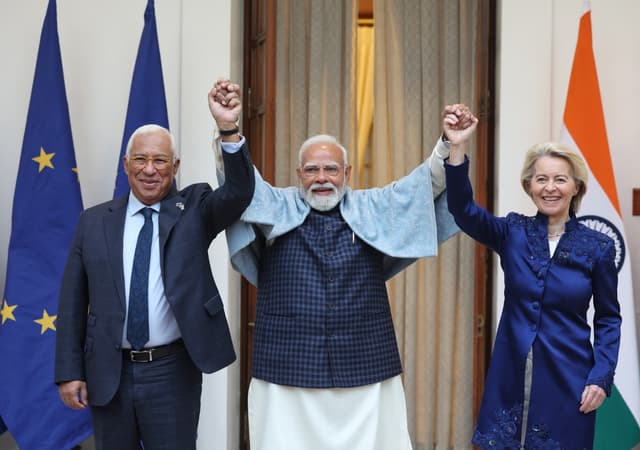
After nearly two decades of stop-start negotiations, India and the European Union have finally sealed what Prime Minister Narendra Modi called "India's biggest and most historic free trade agreement." The landmark deal, announced at the 16th India-EU Summit in New Delhi, eliminates tariffs on 96.6% of EU goods entering India and 99.3% of Indian exports to Europe—covering a combined market of 1.9 billion consumers and 25% of global GDP.
"This is not just a trade agreement. This is a new blueprint for shared prosperity," PM Modi declared. European Commission President Ursula von der Leyen echoed the sentiment, calling it the "mother of all deals" that creates "a free trade zone of two billion people."
A marathon negotiation finally crosses the finish line
The India-EU FTA journey began in June 2007 but collapsed after 15 inconclusive rounds by 2013, stalled over disagreements on automobiles, dairy, and professional mobility. Negotiations were relaunched in June 2022 by Commerce Minister Piyush Goyal and EU Trade Commissioner Valdis Dombrovskis, with both sides committing to monthly negotiating rounds through 2025.
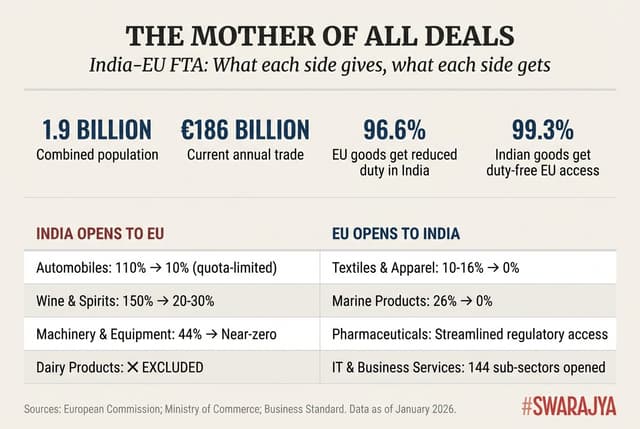
The breakthrough came amid mounting global trade pressures. With India facing 50% tariffs under the Trump administration and both parties seeking alternatives to US-China dependency, the strategic calculus shifted decisively. "We have done FTA deals with seven developed countries so far. This one will be the mother of all," Goyal said in mid-January, adding, "The good part is that we don't compete with each other."
Current bilateral trade stands at €186 billion annually—€120 billion in goods and €66 billion in services. The EU is India's largest trading partner, accounting for 11.5% of total trade, while India ranks as the EU's ninth-largest partner. The agreement is expected to push this figure beyond $250 billion within a decade, potentially creating 2-3 million new jobs.
Indian exporters to gain duty-free access worth billions
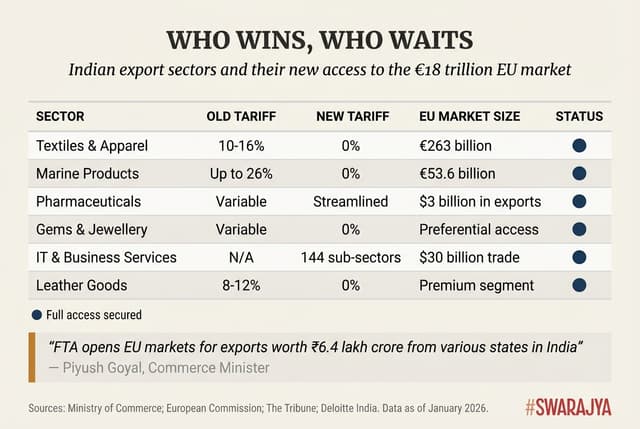
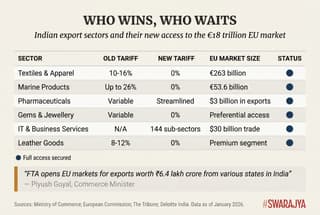
The deal delivers immediate wins for India's labour-intensive sectors. Textiles and apparel—currently facing 10-16% EU tariffs that disadvantaged Indian exporters against Bangladesh and Vietnam—will receive immediate zero-duty access, opening Europe's €263 billion textile market. This alone could transform manufacturing hubs across Tamil Nadu, Gujarat, and Uttar Pradesh.
Marine products stand to gain significantly, with tariffs of up to 26% eliminated entirely, providing access to the EU's €53.6 billion seafood market. Coastal states like Andhra Pradesh, Kerala, and Gujarat are expected to see shrimp and fish exports surge beyond the current $1 billion mark.
For pharmaceuticals, India's $3 billion in generic drug exports to Europe will benefit from streamlined regulatory pathways, reinforcing the country's position as the world's pharmacy. Gems and jewellery, leather goods, and IT services—collectively worth over $40 billion in annual exports—all gain preferential access under the agreement.
The EU, meanwhile, secured its long-sought opening in India's protected markets. Automobile tariffs will drop from a prohibitive 110% to just 10% under a quota system allowing 250,000 vehicles annually—a boon for BMW, Mercedes, and Volkswagen. European wine and spirits will see duties slashed from 150% to 20-30%, while machinery tariffs (currently up to 44%) will be largely eliminated.
Services breakthrough unlocks professional mobility
Perhaps the most significant achievement for India lies in services. Indian IT and business process companies will gain access to 144 EU sub-sectors, cementing the country's $30 billion services export relationship with Europe. The agreement establishes a comprehensive mobility framework for skilled professionals—addressing India's long-standing Mode 4 demands—including provisions for intra-corporate transferees, business visitors, and their families.
A framework for social security agreements will prevent the double-contribution burden that has long frustrated Indian professionals working in Europe. The deal also secures access for practitioners of Indian traditional medicine to work in EU nations where such practices are unregulated.
The Digital Trade chapter ensures secure, predictable cross-border data flows crucial for India's tech sector, integrating rules from the WTO Electronic Commerce Joint Initiative—significant given India is not a member.
Dairy excluded, autos protected through calibrated approach
Not everything came easy. Dairy products—a politically sensitive sector for Indian farmers—were entirely excluded from the agreement. "This was a red line for India," trade sources confirmed, with milk and cheese imports remaining protected.
The automobile sector represents a carefully negotiated compromise. While premium European cars will eventually face just 10% duties, the mass-market segment under ₹25 lakh remains shielded through limited quotas. Indian auto stocks initially fell 4% on the announcement, reflecting industry concerns about competition, though analysts note the phased approach provides adjustment time.
The EU's Carbon Border Adjustment Mechanism (CBAM)—its carbon tax on steel, aluminium, and cement—proved a late sticking point. India secured an MFN assurance: any CBAM flexibilities offered to other countries will automatically apply to Indian exporters, with a technical working group established to help Indian companies navigate carbon compliance.
What comes next
The agreement now enters a 5-6 month legal vetting period before formal signing in early 2027. European Parliament ratification—potentially taking another year—remains the final hurdle before implementation.
"Over the next decade, current trade of $135 billion is expected to cross $250 billion," predicted Gulzar Didwania of Deloitte India. "India will add another $50 billion in exports in the next five years."
For India, the deal represents both economic opportunity and strategic insurance—a pragmatic partnership forged in an increasingly uncertain global trade landscape.
 Join our