
News Brief
India Targets 3-Nanometre Chip Production By 2032 As Part Of Ambitious Semiconductor Self-Reliance Drive
Swarajya News Staff
Jan 27, 2026, 05:07 PM | Updated 05:07 PM IST
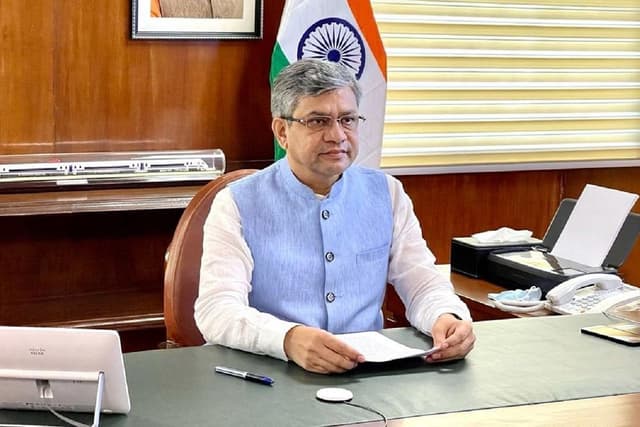
India aims to manufacture advanced 3-nanometre semiconductor chips by 2032, Union Minister Ashwini Vaishnaw announced today (27 January).
The technology node, used in modern smartphones and high-performance computers, represents a significant leap in India's semiconductor capabilities as the nation pursues technological self-reliance.
Speaking about the government's strategy, Vaishnaw revealed plans to focus on six major chip categories under the second phase of the Design-Linked Incentive Scheme.
These include compute, radio frequency, networking, power, sensor, and memory chips.
The comprehensive approach seeks to develop India's complete semiconductor design ecosystem.
The minister stated that by 2029, these efforts would enable companies in the country to have major control over developing 70-75 per cent of technology products.
The six chip categories cover practically all applications required domestically, with every sector requiring a combination or permutation of these types.
India's semiconductor journey has gained significant momentum since the launch of the India Semiconductor Mission in 2022.
Four plants—CG Semi, Kaynes Technology, Micron Technology, and Tata Electronics' Assam facility—are expected to commence commercial production in 2026.
The initiative comes as the global semiconductor industry expands rapidly, driven by demand from artificial intelligence, electric vehicles, and consumer electronics.
With manufacturing, design, and talent ecosystems taking shape, India positions itself to emerge as a major global semiconductor hub by 2032, marking a transformative shift from import dependence to technological sovereignty in this critical sector.
 Join our