
News Brief
PM Modi Opens Lok Sabha Discussion Marking 150 Years Of Vande Mataram
Arjun Brij
Dec 08, 2025, 02:15 PM | Updated 02:15 PM IST
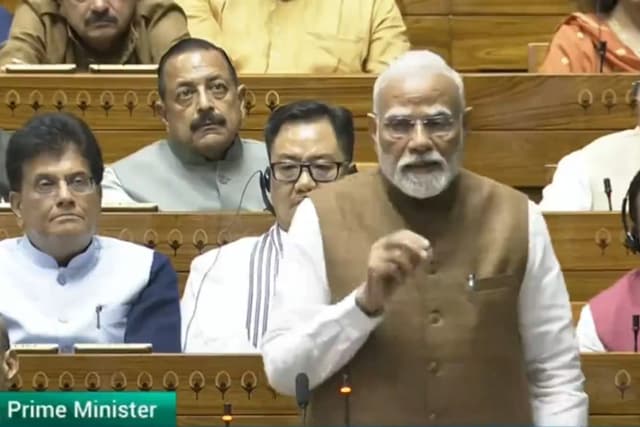
Prime Minister Narendra Modi on Monday (8 December) used a special Lok Sabha discussion marking 150 years of Vande Mataram to launch a sharp critique of the Congress, drawing a direct connection between the national song’s centenary and the Emergency imposed by Indira Gandhi.
He argued that the moment’s significance is heightened by recent national commemorations — 75 years of the Constitution, the 150th birth anniversaries of Sardar Vallabhbhai Patel and Birsa Munda, and the 350th martyrdom year of Guru Teg Bahadur.
Modi described Vande Mataram as a spiritual and cultural force that galvanised India’s freedom struggle. He said that when prior milestones of the song were observed, the country was passing through defining political upheavals.
Recalling its centenary, he stated, “When 'Vande Mataram' celebrated its 100th anniversary, the country was entangled in the Emergency… when it celebrated its 100th anniversary, the Constitution was strangled…”
Contrasting that disquieting past with the present, he said that celebrating its 150th year freely in Parliament symbolised how far India had travelled since those years of authoritarianism.
He added, “Now, at 150 years, it is a good opportunity to restore the glory of 'Vande Mataram'… which won us freedom in 1947.”
The Prime Minister also targeted former Prime Minister Jawaharlal Nehru, alleging that he had followed Muhammad Ali Jinnah in opposing Vande Mataram on the grounds that it could “irritate Muslims”.
Modi situated this criticism within a broader narrative of how the national song became both an inspiration and a point of contention during the freedom movement and the early years of independent India.
Reiterating the song’s historical and cultural resonance, Modi said “we are sitting here because lakhs of people chanted Vande Mataram and fought for independence”.
He noted that when Bankim Chandra Chatterjee penned the poem in 1875, it instantly became the voice of the freedom movement and its moral compass.
The Prime Minister said “Vande Mataram was not merely a mantra for political independence. It was far greater than that,” linking it to ancient traditions that regard the land as a mother worthy of devotion and sacrifice.
He recalled that the British saw the song as a threat, eventually banning its printing and public circulation.
Modi said its rise represented not just patriotic fervour but a cultural and spiritual unity that countered colonial oppression, particularly at a time when the British were implementing “divide and rule” strategies in Bengal.
Please click here to add Swarajya as your preferred and trusted news source on Google
Also Read: Metro Line 8 To Link Mumbai’s Two Airports As Navi Mumbai Alignment Finalised
Arjun Brij is an Editorial Associate at Swarajya. He tweets at @arjun_brij
 Join our