
Politics
How Education Ministry Lost The Plot On UGC Equity Regulations
Swarajya Staff
Jan 27, 2026, 06:52 PM | Updated 06:52 PM IST
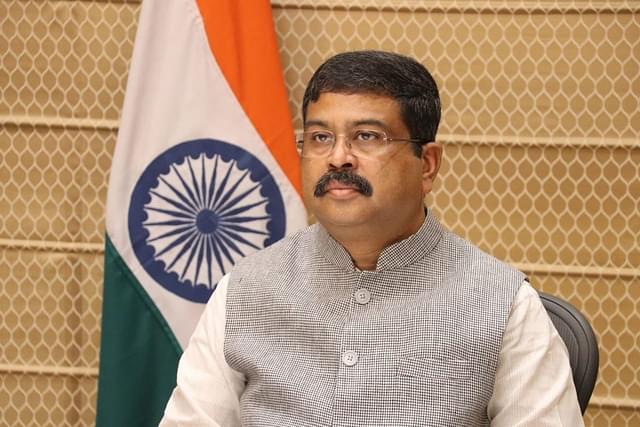
Union Education Minister Dharmendra Pradhan spoke to the media on the issue of the UGC Equity regulations for the first time on 27 January 2026. Pradhan sought to assure the people that no one will be harassed and no one will be allowed to misuse the UGC guidelines for 'equity'.
That however does little to repel the widespread fears of their misuse against the 'General Castes' simply because the notification released on 13 January is clear that only the students belonging to the SC, ST and OBC communities can claim they were subjected to "caste-based discrimination".
For the Education Ministry and the UGC, the guidelines represent a major lapse of judgment and the biggest controversy related to their department since 2014.
Dharmendra Pradhan also added in his remarks that the current system has arisen out of a process overseen by the Supreme Court itself. However, the current guidelines were not inevitable. In fact, the UGC itself had come up with a different draft of the guidelines in February 2025.
The case
The UGC Equity Regulations 2026 trace their origins to the deaths of two students, Rohith Vemula in 2016 and Payal Tadvi in 2019. In both cases, the families of the deceased alleged that they committed suicide after being subjected to caste-based discrimination.
In August 2019, Radhika Vemula and Abeda Salim Tadvi—the mothers of Rohith and Payal—filed a Public Interest Litigation (PIL) in the Supreme Court of India asking that educational institutions put in place anti-discrimination measures.
The petition was represented by Senior Advocate Indira Jaising along with advocates Prasanna S. and Disha Wadekar.
According to reports sympathetic to the petitioners, the PIL did not demand entirely new regulations; instead, it sought strict enforcement of the existing University Grants Commission (Promotion of Equity in Higher Educational Institutions) Regulations, 2012. Those rules required universities to establish Equal Opportunity Cells to handle complaints of discrimination, particularly against Scheduled Castes (SC) and Scheduled Tribes (ST) students.
The petitioners highlighted alleged caste bias in admissions, evaluations, hostel allotments, and campus life, coupled with what they claimed was the near-total failure to implement the 2012 framework—no meaningful monitoring, sparse Equal Opportunity Cells, and zero integration with accreditation bodies like NAAC.
The Supreme Court issued notices in 2019, but the matter languished until January 2025, when Justices Surya Kant and Ujjal Bhuyan rebuked the UGC for non-compliance and demanded data on cells, complaints, and actions. In response, the UGC indicated it was drafting updated regulations.
The 2025 guidelines
By February 2025, it released the University Grants Commission (Promotion of Equity in Higher Education Institutions) Regulations, 2025 draft for public consultation.
This document stands out as a balanced and pragmatic effort in accommodating the concerns of petitioners while not allowing caste identities and divisions to become the dominant motif of Indian educational institutions.
Far from a radical overhaul some feared, the draft struck a careful balance between strengthening protections and preserving institutional autonomy, fairness, and due process for all parties.
The February 2025 draft retained the core focus on caste-based discrimination against SC/ST students, aligning directly with the PIL's emphasis without expanding into unrelated categories in a sweeping manner.
It modernized language by defining discrimination as “unfair, differential, or biased treatment” based on caste or tribe identity. While critics decried this as vaguer than the 2012 rules' detailed list of prohibited acts (such as breaching quotas, biased grading, or segregation in messes), the streamlined phrasing actually allowed flexibility for institutions to interpret and apply the rule contextually, reducing the risk of overly legalistic paralysis.
A particularly sensible feature was the introduction of penalties for demonstrably false or malicious complaints. The draft stated that anyone filing a false claim of discrimination could face a fine determined by the Equity Committee.
This provision was not punitive toward genuine victims but a necessary safeguard against abuse—a common concern in grievance mechanisms worldwide. In environments where personal rivalries, academic competition, or factionalism can colour perceptions, such a deterrent helps preserve credibility and prevents the system from being weaponised, ensuring resources remain focused on real instances of bias.
The draft's approach to 'equity committee' composition, though criticized, reflected pragmatic realism. Equity Committees were to be chaired by the head of the institution (a standard governance practice to ensure accountability at the top) and include roughly ten members, with at least one from an SC or ST background.
The structure encouraged broad stakeholder inclusion—faculty, students, and administrative staff—fostering collective responsibility rather than adversarial silos.
Importantly, the draft avoided the temptation to impose one-sided penalties on alleged perpetrators without due inquiry. It emphasized procedural fairness: complaints would be investigated by the committee, with opportunities for both sides to present evidence.
This mirrored principles of natural justice enshrined in Indian law, preventing hasty punishments that could ruin careers or reputations on unproven allegations.
The absence of automatic severe sanctions (suspension, expulsion, or criminal referral) for every complaint reflected a measured approach—prioritizing resolution, mediation, and reform over retribution.
The draft encouraged awareness programs, sensitization workshops, and annual reporting on equity measures, laying groundwork for cultural change without micromanaging campuses. It also preserved institutional discretion in handling sensitive matters, recognising that universities vary widely in size, location, and culture.
By not imposing rigid, uniform structures (such as mandatory half-SC/ST/OBC committees or automatic appeals to national commissions at every stage), the draft avoided overburdening smaller institutions while still creating enforceable obligations.
Overall, the February 2025 draft represented a mature response to a sensitive issue. It accommodated the PIL's demands for stronger mechanisms without discarding principles of equality before the law. It protected vulnerable students while incorporating checks against misuse, ensuring the system would command legitimacy across communities. In a polarized discourse, this draft managed to be preventive without being punitive, inclusive without being exclusionary, and forward-looking without being utopian.
Many observers, even among critics, acknowledged that—with refinements based on the 391 public suggestions received—it could have become a model for anti-discrimination policy in education.
Yet this promise unraveled dramatically.
Off the rails
The petitioners protested the February 2025 draft and in a September 15, 2025, Supreme Court hearing, Indira Jaising pressed for ten core reforms, including: grievance committees with substantial marginalized representation and grant withdrawal for non-compliance. The bench set an eight-week deadline for finalisation, warning it would examine any major omissions.
When the final UGC (Promotion of Equity in Higher Education Institutions) Regulations, 2026 were gazetted on January 13, 2026, the shift was stark.
It incorporated several of Jaising's points—bans on discrimination with debarment powers (Section 11), explicit anti-segregation clauses (Section 7(d)), diverse Equity Committee representation including OBCs/PwDs/women (Section 5(7)), confidentiality and anti-retaliation safeguards, institutional head duties (Section 4(3)), mandatory counseling (Section 7(f)), and proactive Equity Squads and Ambassadors—while abandoning the 2025 draft's balance.
Crucially, the final version narrowed “caste-based discrimination” to acts solely against SCs, STs, and OBCs, creating asymmetric protections. General category individuals lack equivalent safeguards against potential misuse. The draft's safeguard against false complaints vanished entirely. This one-sided tilt risks encouraging vexatious claims, undermining due process, and alienating large sections of the academic community.
Nationwide outrage ensued, with critics labeling the rules divisive and constitutionally suspect for violating equal treatment.
The February 2025 draft showed the Education Ministry and UGC could craft sensible, non-discriminatory policy. The post-September pivot—whether through capitulation, pressure, or internal missteps—produced a framework that prioritizes selective enforcement over universal fairness.
What began as a necessary reform has become a cautionary tale of lost opportunity, turning equity into division. True justice in education demands protections that bind everyone equally—not instruments that erode the very principle they claim to uphold.
 Join our