Culture
Make India Aesthetic Again
Girish Avadhany
Mar 15, 2026, 06:59 AM | Updated Mar 11, 2026, 01:30 PM IST
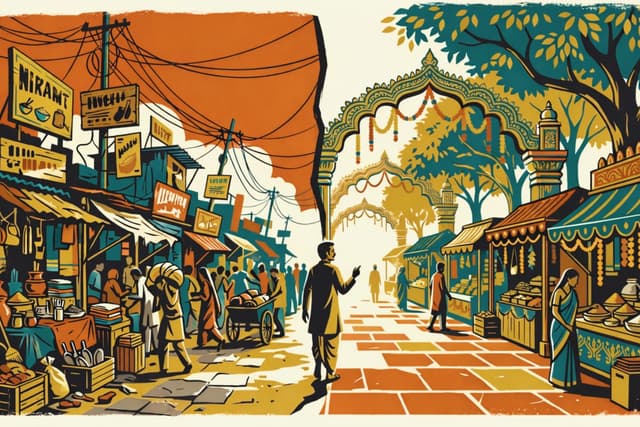
One way to understand a society is to see what it mocks. In contemporary India, refinement is often treated with suspicion. A well-arranged restaurant, a quiet public space, or careful manners are quickly dismissed as pretentious, westernised or artificial. Meanwhile, the chaotic, the improvised and the visibly unpolished are celebrated as "authentic." Somewhere along the way, disorder began to pass for cultural honesty.
There is a familiar ritual in contemporary India: an eager repudiation of refinement dressed up as authenticity. We valorise the messy, the vernacular and the immediately accessible as if those qualities alone make something culturally "true." The result is a peculiar cultural posture, a proud sub-culturisation of the non-aesthetic, where sophistication, etiquette and certain registers of taste are dismissed as colonial affectation rather than seen as civic tools that any civilisation can and should own.
The sociologist Pierre Bourdieu gives us a useful starting point. In Distinction he showed that taste is neither pure nor merely personal: it is produced in social fields as a marker of habitus and position. When a large portion of a society begins to equate "authenticity" with disorder or the absence of polish, the social meaning of taste reorganises around those qualities.
The gesture "Arre, asli khaana toh thele pe milta hai… five-star mein kya taste hota hai?" or "Yeh sab fancy hotel ka khana bas dikhawa hai, asli taste toh gali mein milta hai" becomes itself a badge of belonging, a subculture that signals rejection of perceived elite norms.
But Bourdieu would remind us that rejecting a set of practices does not abolish social hierarchies; it only moves the boundary markers. The problem is not that people enjoy street food; of course they should. It is that the defence of the vernacular is turned into a fossilised identity that refuses engagement with other registers of refinement, registers that can enrich public life.
Walter Benjamin's idea of the "aura," the unique presence of a work in time and space, also helps explain the earnestness behind the cult of the unpolished. Benjamin wrote about how mechanical reproduction changes our relationship to objects and experience. In an era of massification, proximity to the "real" matters because a street vendor's chaat feels singular in a way that a homogenised hotel buffet does not.
But the aura argument can be used selectively to sanctify the sloppy while excusing the absence of civic design, public courtesy and aesthetic labour. There is a difference between revering lived textures and weaponising them as an alibi for neglect.
Historical and cultural precedents make it clear that India already possesses deep traditions of elegance, courtcraft and ritualised taste that are simply reinterpreted or forgotten. One of the most striking features of Hindu civilisation is that aesthetics was always treated as a disciplined science of experience.
The theory of rasa articulated by Bharata Muni in the Natya Shastra laid out a detailed aesthetic grammar for performance and artistic creation. It identified specific emotional states: Shringara (love), Vira (heroism), Karuna (compassion), Adbhuta (wonder), Hasya (laughter), Raudra (fury), Bhayanaka (fear), Bibhatsa (disgust), and later Shanta (tranquillity). It prescribed precise methods to evoke them through costume, gesture (mudras), facial expression (abhinaya), music and stage design.
Classical dancers were trained to control minute eye movements and hand gestures; musicians organised ragas according to time of day and season; poets structured verses to produce aesthetic relish (rasanubhava). Aesthetic sophistication was institutionalised. The cultivated individual in classical India was expected to recognise proportion, emotional nuance and artistic discipline, much in the same way that a scholar recognises intellectual rigour.
The refined sensibility of pre-modern Indian urban life is visible even in the observations of foreign travellers who encountered it firsthand. Writing about the capital of Vijayanagara during the reign of Krishnadevaraya, the Portuguese traveller Domingo Paes described a city whose prosperity expressed itself through remarkable spatial order and aesthetic abundance. He noted a broad, beautiful street lined with fine houses, where merchants dealt in rubies, diamonds, emeralds, pearls and textiles, and where evening fairs offered horses, citrus fruits, grapes and every kind of garden produce.
What Paes encountered was a civilisation comfortable with displaying prosperity through cultivated urban life. The image of a broad street lined with merchants dealing in gems, textiles and horticultural produce suggests a city that valued visual order, public sociability and aesthetic pleasure in everyday commerce. Markets were more than places of transaction; they were stages on which refinement, abundance and civic pride were performed.
Such descriptions complicate the modern claim that sophistication or elegance sits uneasily within Indian cultural life. Vijayanagara's public spaces reveal a society in which prosperity, beauty and disciplined urban form were understood as natural companions rather than opposing ideals.
Coming back to contemporary India, where does sub-culturisation show up today? In dress, where jeans become a grudging national uniform and sartorial cultivation is derided as "pretentious."
In public behaviour, where queuing, waiting one's turn and civil speech are dismissed as "foreign manners" instead of trained public habits. In architecture and urban design, where heritage and craft are celebrated as nostalgia while clean public spaces, tree-lined promenades and well-lit bazaars are seen as expensive, "western" luxuries rather than public goods. In food culture, where the attitude that street food is inherently superior to restaurant food too often becomes a way of refusing standards of hygiene, presentation and innovation that can make the vernacular safer and more beautiful without robbing it of flavour.
The costs are real. First, the rhetoric of automatic authenticity allows low standards to persist in public life. If refinement is framed as betrayal, there is no civic incentive to invest in sanitation, lighting, courteous public services or interior design in public institutions.
Second, the binary of authenticity versus sophistication impoverishes taste. Sophistication need not be elitist; it can be learned craft: the careful cut of a kurta, the choreography of hosting a guest, the calibrated mise en place of a neighbourhood eatery that prizes presentation as much as spice.
Third, this posture stunts cultural confidence. When civility is only valid when it appears "indigenous" in a narrow, nostalgic sense, innovation and synthesis become suspect rather than celebrated.
There are hopeful counter-examples. Indian designers and restorers are creating boutique hotels in haveli typologies, marrying traditional motifs with contemporary comfort. Contemporary Indian fashion houses translate classical textiles and embroidery into tailored, urban garments that look neither colonial nor coarse.
Cities like Mysore and parts of Jaipur show how disciplined urban design, with careful pavements, street furniture and market zoning, can both preserve local character and raise everyday aesthetics. These are by no means capitulations to western taste; they are instances of cultural reclamation, using craft, etiquette and polish to make public and private life more dignified.
What would a more honest, productive posture look like? First, we must stop treating manners and taste as ideological property. Etiquette (table manners, public courtesy, the grammar of address) is social technology; it can be taught and adapted without becoming mimicry.
Second, education must include civic aesthetics: basic training in public behaviour, design literacy for city dwellers, and vocational valorisation of crafts that underpin refinement.
Third, cultural criticism must be less performatively oppositional. Celebrating the vernacular should not require denouncing all forms of polish. We should judge objects and practices by the quality they produce in human life (light, ease, safety, beauty) and not by ideological purity.
Civilisations reveal their confidence in small gestures.
In young Indians who debate the merits of a Kashmiri wazwan or a Chettinad curry while also discovering ramen bars and Mediterranean kitchens. In readers who move effortlessly between Kalidasa, Rabindranath Tagore and Gabriel Garcia Marquez. In people who enjoy the humble elegance of a well-draped sari, a tailored bandhgala or a linen shirt chosen with care. In neighbourhoods where cafes host discussions, bookstores draw curious readers and streets become places people want to walk through rather than merely pass.
Taste grows through such habits. When curiosity, elegance and aesthetic care enter everyday life without apology, a civilisation rediscovers its sense of grace.
In the end, the task is to widen our sense of what counts as Indian. A civilisation that once cultivated elegance in craft, discipline in art, and care in everyday conduct already possesses the resources for a richer cultural life. Recovering those instincts would allow taste, civility and aesthetic attention to return naturally to public and private spaces.
As Matthew Arnold described it, culture is the effort to acquaint ourselves with the best which has been thought and said in the world. A society confident in its inheritance should feel no hesitation in that pursuit, for it is through such cultivation that authenticity deepens into something more durable than mere habit.
 Join our