Politics
₹86,000 Crore Sits Unspent With Indian Cities Every Year. Your State Government Knows Why.
Adithi Gurkar
Mar 16, 2026, 07:59 AM | Updated Mar 14, 2026, 01:17 AM IST

Prabhat Kumar's parents live in peri-urban Bihar. One day, without warning or preparation, their settlement was absorbed into a municipal corporation. No new roads appeared. No water supply improved. No street lights were installed. The only thing that changed was the tax bill.
"My parents live in a peri urban area in Bihar. Suddenly one day we got to know, now we are part of the municipal corporation," Kumar recalls. "But does that change our lived realities? Not at all."
Even after two to three years, the infrastructure and services failed to improve. The family now pays property taxes for the privilege of living in a "city" that exists only on paper, a settlement still figuring out how to provide administrative capacity, how many staff it needs, where to transfer its assets. Kumar does not tell this story as a personal complaint. He tells it as a diagnosis. His village is India's urban governance in miniature: declared, unfunded, and abandoned to improvise.
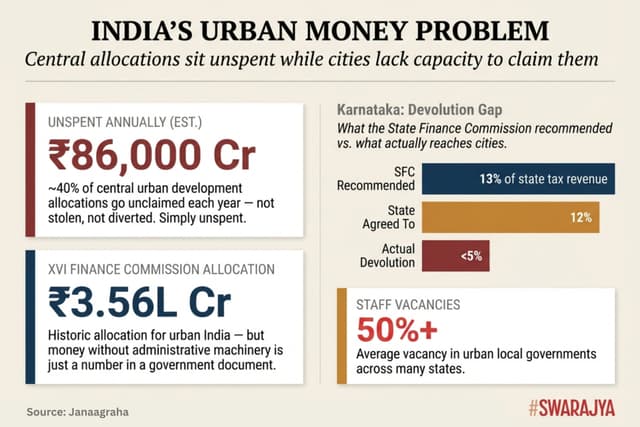
The XVI Finance Commission has placed ₹3.56 lakh crore on the table for urban India. The allocation is historic. But Kumar and his colleague Apula Singh, from Janaagraha, are focused on a grimmer number: ₹86,000 crore.
That is roughly what the central government earmarks annually for urban development through various schemes. Latest reports indicate 40 per cent remains unspent. Not diverted. Not stolen. Simply unspent, because urban local governments cannot summon the administrative capacity to claim it.
Average staff vacancies in urban local governments exceed 50 per cent in many states. Entire departments, electrical, horticulture, accounting, town planning, operate without personnel. The area that transitions from rural to urban does not get time to prepare or plan for generating resources.
"This is a huge crisis, particularly if we are aiming to be a developed nation in the next 22 years or so," Kumar says.
The capacity crisis did not emerge in a vacuum. It deepened steadily, shaped by choices state governments made.
Local governments are a state subject. This single constitutional fact explains nearly everything wrong with urban India. States decide whether cities have sufficient financial resources. States control human resources. States set the rules of the game. The Union can allocate. The Finance Commission can design. But states determine whether any of it reaches the ground.
Consider Karnataka. The state's Fourth State Finance Commission recommended that 13 per cent of state tax revenue be devolved to urban local governments. The state government disagreed, agreeing only to 12 per cent. In practice? Actual devolution is less than 5 per cent.
This is the pattern across India. State Finance Commission recommendations are ignored. Constitutional mandates are quietly dishonoured. Cities are left scrambling while state capitals hold purse strings tight. Many states still delay urban elections; without elected councils, cities cannot even formally claim grants.
The XVI Finance Commission tried to address the pass-through problem. A new State Performance Grant requires states to channel 20 per cent of basic Finance Commission grants directly to local governments. A separate mandate requires states to publish an annexure alongside their budgets detailing every rupee transferred to each local government.
"At least there will be public scrutiny and public accountability," Kumar observes. "People would start calling out states if the local governments are not getting what they should."
The transparency requirement is significant precisely because it is new. Currently, citizens have no systematic way to know whether their state government is honouring State Finance Commission recommendations or quietly compressing its own transfers to urban local governments.
Whether states comply depends on operational guidelines yet to be issued. "What is included in this component? How do you calculate this number itself?" Kumar asks.
The Commission also created an "Urbanisation Premium", ₹10,000 crore to incentivise the planned transition of peri-urban settlements into municipal areas, precisely to prevent the chaos Kumar's family experienced. The money comes with conditions: states must formulate rural-urban transition policies, prepare three-year plans, and involve public consultations. Whether states will actually create these policies or simply reward the usual ad hoc mergers with better optics remains the test.
What makes all of this sting is the comparison to rural India.
Kumar's observation cuts deep: "Sometimes we think that villages are kind of backward, but in terms of the processes and systems, I feel cities have to learn a lot from villages."
Rural India has egramswaraj.gov.in, a public dashboard showing every panchayati raj grant-funded project complete with geo-location, contractor details, and photographs. "I can see what are the projects that are happening in my neighborhood, my ward, my zone, and then people also start taking interest in it," Kumar says. Urban citizens have nothing equivalent. CityFinance.in tracks compliance and financial data but not actual on-ground projects.
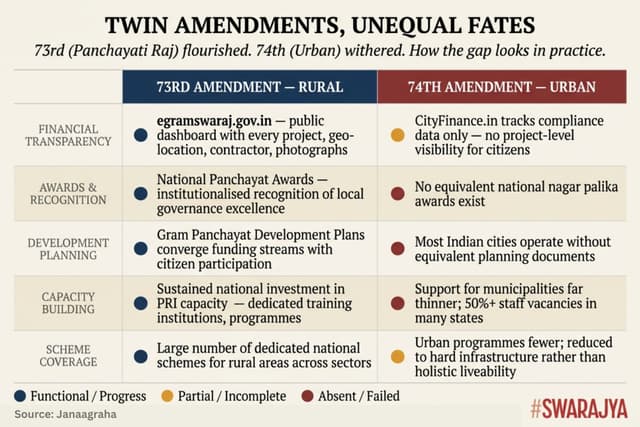
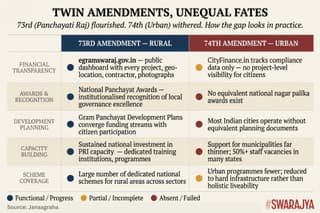
The 73rd and 74th Constitutional Amendments are called twins. "One has flourished while the other withered," Kumar puts it bluntly. "The 73rd Amendment has gone far ahead."
There are national panchayat awards. No national nagar palika awards. Rural governance has been imagined as a place where people live and thrive. Urban governance has been reduced to hard infrastructure. The number of schemes for rural areas dwarfs urban programmes. The capacity building invested in panchayati raj institutions far exceeds support for municipalities. Rural areas prepare gram panchayat development plans that converge funding streams with citizen participation. Most Indian cities operate without equivalent planning documents.
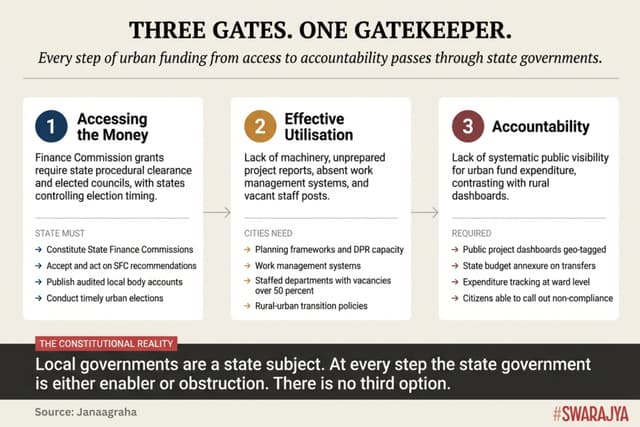
Kumar frames the implementation challenge as three steps, each gatekept by states. First: accessing the money, which requires states to constitute finance commissions, accept recommendations, publish audited accounts, and conduct timely elections. Second: effective utilisation, which requires cities to have planning frameworks, work management systems, and capacity to prepare detailed project reports. Third: accountability, meaning public dashboards showing project-level expenditure.
At every step, the state government is either enabler or obstruction. There is no third option.
Three decades after the 74th Amendment promised urban self-governance, India's cities remain wards of their state capitals, dependent for resources, authority, and permission to act. The XVI Finance Commission has placed the largest urban allocation in history on the table. But money without machinery is just a number in a government document.
The Commission did its part. The question, the only question that matters, is whether state governments will do theirs. Or whether, five years from now, we will be counting the unspent crores again.
Adithi Gurkar is a staff writer at Swarajya. She is a lawyer with an interest in the intersection of law, politics, and public policy.
 Join our