Economy
The PM Internship Pilot Revealed Why Both Interns And Employers Walk Away — And What Would Make Them Stay
Diksha Yadav
Mar 13, 2026, 10:19 AM | Updated Mar 14, 2026, 03:40 PM IST

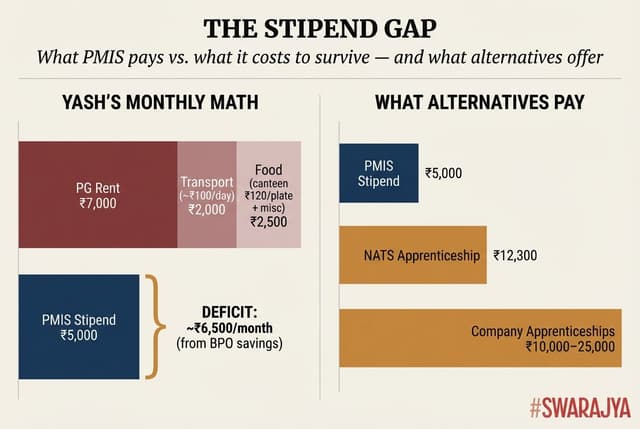
Yash Padwalkar, a software engineering graduate from Solapur, Maharashtra, joined Tech Mahindra in Pune under the PM Internship Scheme in its first round. His monthly stipend was ₹5,000. His rent in a shared PG ten kilometres from the office was ₹7,000. Transport cost roughly ₹100 a day. He was dipping into savings from part-time BPO work to cover the gap — a finite reserve, depleting every month, with no certainty of a job at the end.
Padwalkar stayed. He completed twelve months. He was offered a permanent position. He is one of 95.
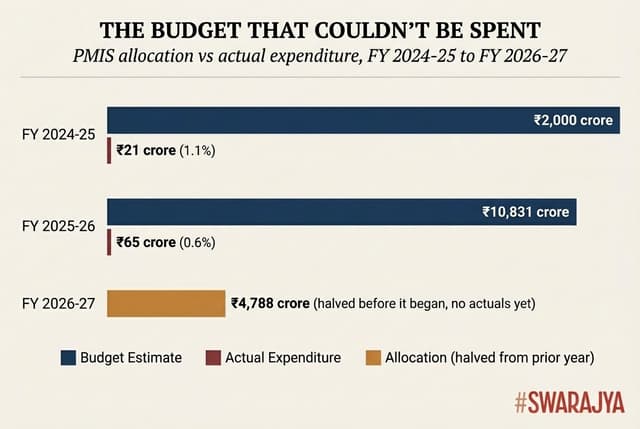
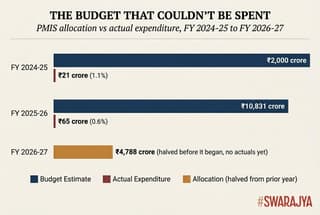
The PM Internship Scheme received over 10.76 lakh applications across two rounds with over four lakh unique applicants, spent ₹86 crore of the ₹12,831 crore allocated to it as on December 31, 2025 and produced exactly 95 job offers — from a programme designed to generate one crore internships over five years, two lakh a year, connecting India’s willing youth with India’s willing employers, backed by the largest skilling budget the country has ever committed. The machinery and money exist. The demand, as every credible labour market survey confirms, also exists on both sides. Yet the gap between ambition and outcome remains stark.
The answer is not that the scheme was misconceived. The answer is that the system connecting youth to employers — the matchmaking architecture, the stipend structure, the duration framework, the eligibility walls, the certification void — is under strain at nearly every point.
The PM Internship Scheme illustrates what happens when a government correctly diagnoses a crisis, budgets generously for the solution, but builds delivery infrastructure that struggles to retain willing participants on either side.
Start from those 95 jobs and work backwards.
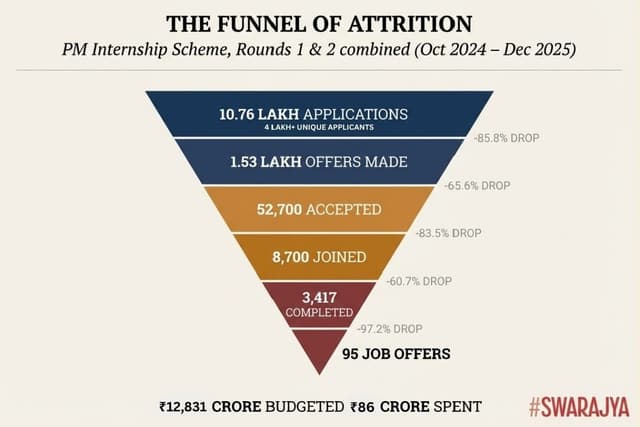
Muthoot Finance extended 32 offers to its completers. Tech Mahindra offered 20. Manappuram Finance 14, IDFC First Bank 7, Dr. Reddy's 5, ONGC 1. These 95 offers came from the 3,417 interns who actually completed the full 12 months -- out of roughly 8,700 who had joined by mid-2025, out of 52,700 who accepted offers, out of 1.53 lakh offers made across two rounds, out of over 10.76 lakh applications from nearly four lakh unique candidates.
We find each stage of the funnel losing applicants/aspirants.
In Round 1, launched in October 2024 as a pilot, 280 companies posted over 1.27 lakh opportunities across 745 districts. The response was a five-fold oversubscription: over 6.21 lakh applications from over 1.81 lakh candidates. Companies made 82,077 offers. Only about 28,141 were accepted -- a 34 per cent acceptance rate.
Round 2, beginning January 2025, expanded to 327 companies and over 1.18 lakh opportunities, drawing over 4.55 lakh applications from over 2.14 lakh candidates. Over 71,000 offers were made; roughly 24,600 were accepted -- an acceptance rate that held steady at around 34 per cent despite improvements to the portal, because the core intermediation model remained unchanged.
Sources from a Maharatna PSU told Swarajya that initially more than 30 students applied and were given the offer, but only about four joined. Three left within days. The low stipend could be the major reason -- surviving in metro cities on ₹5,000 a month is difficult.
"The student has very little motivation to show up. The stipend is very low, and he also sees colleagues and other interns who joined through the apprenticeship programme -- earning more. Some leave midway when they find a better opportunity to earn. A student even expressed: 'What will happen if I don't show up? I lose nothing,'" a source at an automobile manufacturing firm told Swarajya.
"We provided free lunch to students. Most who completed the internship under PMIS were locals. Very few were from nearby states. We also run our own apprenticeship programme, which pays between ₹10,000 and ₹20,000."
Why did they leave?
PMIS offers a monthly stipend of ₹5,000 -- ₹4,500 from the government, ₹500 from the company's CSR funds -- plus a one-time grant of ₹6,000 and insurance coverage. The scheme was conceived to reach India's less-privileged youth: those without family connections to corporate India, without the financial cushion to work unpaid, without access to the informal networks through which upper-middle-class graduates secure internships. These are young people under pressure to earn early, to contribute to household expenses, or at minimum to stop being a financial burden on their families.
At ₹5,000 per month, the scheme asks its target beneficiaries to subsidise their own skilling. But prohibitive living costs deter them away. Consider rent in a shared room in a tier-two city: ₹2,000--4,000. Food: ₹2,000--3,000. Transport: ₹500--1,000. The arithmetic does not work.
Padwalkar knew this arithmetic before he joined. He chose Pune over Mumbai — the other posting he was offered — because it was closer to Solapur and marginally cheaper. The hope that the internship might lead to a permanent job kept him going. He told Swarajya:
"I come from a humble background. I had to convince my parents to let me join this internship because the stipend was too little to relocate and survive on. I found a PG 10 kilometres from the office that cost ₹7,000 a month with breakfast and dinner. The travel to work cost around ₹100 a day. Most mornings I had to skip breakfast to reach the office on time for my nine-hour shift. I was putting in savings I had kept from part-time jobs at a BPO to meet my expenses."
His total monthly expense exceeded ₹10,000. His stipend covered less than half.
"My home is over three hours from the office. I had to relocate, but we cannot find affordable stays near the office, so we end up somewhere far and then travelling itself becomes a challenge with this money. We hope that we are offered a job, so we have to be punctual, give 100 per cent and put across a good impression. We don't want to show up late."
For a scheme designed to provide geographic mobility to young Indians from non-metropolitan backgrounds, the stipend makes geographic mobility economically impossible.
"Of the close to 40 students who applied to join us, 90 per cent did. And of those who joined, only 50 per cent completed the internship. One major reason was the stipend. Factories are generally located on the outskirts of a city, and travel alone -- bus, metro, auto, five days a week --- would eat up that money. Since the scheme focuses on students from humble backgrounds, the responsibility to earn and contribute at home is also enormous. We had students tell us that their parents did not want them to join a ₹5,000 internship and insisted they find a real job instead," sources at the automobile manufacturing company told Swarajya.
The problem is compounded by a perverse internal comparison. Most of India's top 500 companies already run apprenticeship and internship programmes -- some under the PM National Apprenticeship Promotion Scheme or the National Apprenticeship Training Scheme -- that typically pay ₹10,000--₹25,000 per month. When a PMIS intern earning ₹5,000 sits alongside a company-hired apprentice or intern earning three to five times more for comparable work, the psychological and economic impact is not necessarily pleasant.
An agricultural engineering graduate from Durg, Chhattisgarh, who was offered an internship at Bharat Petroleum Corporation Ltd under PMIS in the second round made exactly this calculation. He did not join. "The stipend was very low and the office was 30 kms away from my city," he told Swarajya. He was also not sure if, post-internship, the certificate would be valuable enough to land him a good job. "I joined the apprenticeship under the National Apprenticeship Training Scheme instead in Southern Region Farm Machinery Training and Testing Institute (SRFMTTI) at Anantapur, Andhra Pradesh, with a stipend of ₹12,300. In my opinion, this is a better choice for students with an engineering background."
The market, in other words, has already priced PMIS -- and found it wanting. A scheme that pays less than half of what the same companies offer through their own training programmes will not attract candidates who have alternatives. And the candidates PMIS was designed for -- those under the most economic pressure -- are precisely the ones who can least afford to accept a below-market offer.
"We received over 70 applications from across the country, from Uttarakhand to the southern states, but only three local candidates actually joined and will be completing their 12 months here. For ₹5,000 a month, relocating for a year and managing rent, food, and transport is simply not viable," a source at a chemical manufacturing firm told Swarajya. "A few companies did top up an additional ₹5,000-₹10,000 from their end, but we chose not to -- as we already run our own apprenticeship programme, and besides that, students regularly come to us for two-to-four-month internships anyway."
Pull back one layer further. Before the question of why interns leave is the question of why they never showed up in the first place. Two out of three offers were rejected. The matching system is why.
The government too has acknowledged the issues through their feedbacks from companies and students. A mismatch between opportunities offered and actual participation, long duration, fund under-utilisation, gender imbalance (72 per cent male, 28 per cent female), and a lack of alignment between candidate interests and roles offered.
However there's also structural design flaw at the scheme's heart: the government inserted itself as a matchmaker between students and companies, and the matchmaker got it wrong.
Under the current architecture, the MCA portal uses AI tools to match candidates' data with companies' needs and locations. The student applies; the algorithm decides. While applying, students do not have clarity over what skills or work they will be trained for and at what location. It is only when they receive the offer that they learn the what and the where.
In Round 1, the portal did not even display companies' names and work locations before candidates applied. Two out of three offers were rejected. In Round 2, names and geo-tags were added, but the acceptance rate barely moved -- holding at roughly 34 per cent -- because the core intermediation model remained unchanged.
Compare this with how private sector hiring actually works. Companies post roles with detailed descriptions. Candidates apply to specific positions. There is a conversation, a mutual assessment of what the company needs and what the candidate seeks to learn. The absence of this direct mediation from the beginning is one of the major reasons the market has punished PMIS with a roughly 66 per cent rejection rate.
There is a deeper question still: even for those who stay, what do they walk away with?
The 12-month uniform duration ignores operational reality. A TeamLease EdTech survey of 932 companies found that 73 per cent prefer internship durations of one to six months. Retail skills can be meaningfully acquired in three months. Basic IT support in six. Advanced manufacturing may genuinely require ten to twelve. A rigid 12-month mandate discourages both companies and interns -- companies because they do not need year-long trainees for quarter-long tasks, interns because the opportunity cost of a year at ₹5,000 is prohibitive.
Not everyone agrees the target demographic itself is right. "The age bracket of 21 to 24 is also a reason why this scheme may not have worked as imagined," the automobile firm source said. "That is the age when you are looking for a job and have the hunger to earn more -- you are constantly trying to figure out how to achieve your goals. At that age, giving one year to an internship where you are not sure if it will help you find a good job can feel like a distraction. If the age bracket were brought down to 18-19, students at that age would be more curious and dedicated to learning, prioritising acquiring skills over stipend."
Padwalkar's close friend, who joined Tech Mahindra with him under PMIS, left within two months. The stipend was too low, and his interests diverged from the work he was assigned. He started looking for other opportunities and eventually got an offer from Wipro as a full-time employee. He took it. He left for a better offer -- which, given the stipend differential, was not hard to find.
When a PMIS intern does complete their tenure -- and only 3,417 have -- they walk away with a certificate that mentions the internship was completed at a given company between certain dates.
They do not receive any NSQF-aligned credential. There are no standardised documentation of skills acquired, tasks trained on, or competencies demonstrated. The portal does include a quarterly progress report where supervisors rate interns on behavioural parameters -- punctuality, teamwork, flexibility, communication -- on a five-star scale. But these are basic behavioural assessments, not evidence of technical competence. They tell a future employer that the intern showed up on time. They do not tell them what the intern learned to do and how well.
TeamLease EdTech CEO Shantanu Rooj has described a "structural reset" in recruitment, in which hiring decisions are driven primarily by internships and real-world project experience. Freshers with internship exposure advance rapidly; those relying solely on academic credentials face significantly longer job searches. But PMIS produces no portable, verifiable proof of that experience. A certificate of completion is not enough. A nationally-recognised qualification aligned to the National Skills Qualifications Framework, a formal recommendation documenting specific competencies -- these are the artefacts that convert training into career assets.
"The government should clearly define 10 to 15 skills, of which companies should train students in at least two, three or four," the automobile firm source recommended. "In the initial one to two months, students should get a general sense of everything they can learn. Then give them the opportunity to choose what they want to specialise in over the following eight to ten months. At the end, there should be a grading or rating system -- which skills the student specialised in, and a rating for each. There should be a proper 12-month plan for students on what they are going to learn each month."
The portal itself, despite AI-powered matching and Aadhaar eKYC, lacks basic transparency features. Interns have no personalised dashboard showing performance metrics, beyond the stipend confirmation and the quarterly behavioural report. For a first-generation corporate entrant -- and MCA officials acknowledged that many candidates were building their first CVs and encountering professional environments for the first time -- this opacity is not a minor UX gap. A visible record of progress and documented skill milestones could be the difference between an intern who stays motivated through month eight and one who quietly walks away in month four.
"Students also need clarity on Plan B -- awareness and counselling on the scope of the skills they are learning, what jobs are available, where, at what salaries. After they finish, is there an opportunity for jobs in that sector? Will they get any preference if they performed well? Simply put: will they get a job post-internship. This Plan B would be a bigger motivator than the stipend," the automobile firm source added. "Train less, but train well should be the mantra."
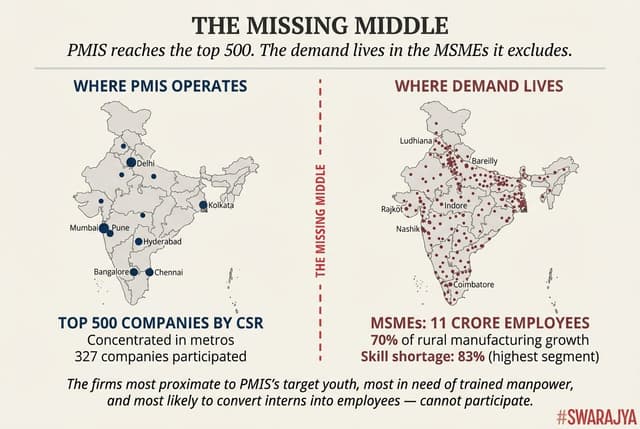
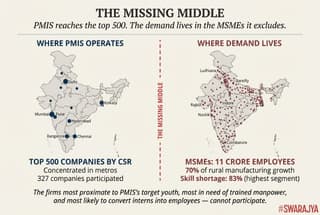
There is a structural exclusion that compounds every other problem. The restriction to India's top 500 companies by CSR expenditure shuts out the sector that most needs trained youth, is most geographically distributed, and is most willing to convert interns into employees: Micro, Small, and Medium Enterprises.
MSMEs employ roughly 11 crore people and account for approximately 70 per cent of manufacturing growth in rural areas. They operate in district towns and semi-urban clusters -- precisely where PMIS's target youth live. The MSME owner in Indore who needs trained CNC operators, the small IT services firm in Coimbatore looking for junior developers, the food processing unit in Bareilly that needs quality inspectors -- none of them can participate. Yet ManpowerGroup's 2025 data shows that mid-size firms of 50-249 employees report the highest skill shortage at 83 per cent, even above large corporates. The demand is most acute where the scheme does not reach.
The Parliamentary Committee recommended "broader engagement with SMEs, startups, and regional stakeholders." The MCA has reportedly proposed expanding beyond the top 500 in its note to the Expenditure Finance Committee. There has been one early sign of movement: ICAI has proposed that CA firms -- over one lakh nationwide, most operating in tier-two and tier-three towns -- be allowed to take PMIS interns by waiving the CSR eligibility requirement, with firms funding stipends from their own vocational training budgets. The MCA is expected to notify these changes soon, alongside the parallel Corporate Mitra programme announced in Budget 2026-27 to train graduates as compliance paraprofessionals for MSMEs. If it works, it becomes the template for the broader MSME expansion the scheme desperately needs.
The fiscal trail also confirms what the participation data suggests. The government did not run out of money. It ran out of the ability to deliver it.
There is a wider strategic cost to this delivery failure that extends beyond PMIS itself. India's flagship industrial programmes -- Make in India, the Production-Linked Incentive schemes across 14 sectors, the semiconductor fabrication push -- all presuppose a steady pipeline of industry-ready youth who can operate the factories, manage the supply chains, and staff the service centres that these policies are designed to attract. PMIS was meant to be one of the instruments feeding that pipeline. Get this scheme right, and India does not just solve a skilling problem -- it unlocks the workforce that Make in India was always counting on.
ManpowerGroup's 2025 Global Talent Shortage Survey, based on responses from 3,150 employers across India, found that 80 per cent of Indian employers report difficulty finding the skilled talent they need -- six points above the global average of 74 per cent.
The shortage spans every industry: IT at 84 per cent, Energy and Utilities at 81 per cent, Healthcare and Life Sciences at 81 per cent, Consumer Goods at 78 per cent.
It spans every company size, from micro-enterprises with fewer than 10 employees to mid-size firms. It spans every region: South India at 85 per cent, East at 80 per cent, North at 79 per cent, West at 77 per cent.
The skills in sharpest shortage are precisely the ones that structured internship programmes could address. IT and Data skills lead at 42 per cent -- the highest in the world. But the most dramatic year-on-year surges are in practical, hands-on domains: Operations and Logistics demand jumped 15 percentage points, Manufacturing and Production rose 9 points, Front Office and Customer-Facing roles surged 14 points. These are not roles requiring IIT degrees. They require exposure, training, and supervised practice -- exactly what an internship is designed to provide.
The supply side is also equally receptive. The TeamLease EdTech Career Outlook Report for the first half of 2026, surveying 1,051 employers, found that 73 per cent intend to hire freshers in January--June 2026. Retail hiring intent stands at 91 per cent, E-commerce and Technology Start-ups at 90 per cent, Manufacturing at 85 per cent.
And the most in-demand entry-level roles -- Dark Store Assistant, Inventory Management Assistant, Digital Sales Associate, Junior Web Developer, Battery Assembly Technician -- are all positions where structured internship training could produce job-ready candidates within months.
India's employers are explicitly saying: give us candidates who have done internships, have the required skills and we will hire them. The PM Internship Scheme was designed to be that pipeline. The market demand is unambiguous on both sides.
Nevertheless it’s not all bad news. Where companies took the internship seriously, PMIS has delivered exactly what it promised.
A physics graduate at an ONGC facility in Jorhat, Assam, learned seismic data analysis using industrial software -- skills no classroom would have taught him. ONGC, the largest PSU participant, absorbed 841 interns across its facilities; NTPC took 685. Indian Oil took 344. HDFC Bank engaged 490 from the private sector. PSUs accounted for 58 per cent of all intern joinings.
Padwalkar's own experience at Tech Mahindra, despite the financial hardship, illustrates what becomes possible when a company invests in its interns.
"I got a laptop with bag for the first time, I was so happy," he told Swarajya. "In college I always borrowed a laptop from my friends for learning, coding and all the work. During the internship, I was learning AI, data, and things I was genuinely interested in. My manager was excellent -- he tested us monthly to make sure we were actually progressing, not just sitting through sessions, and would even cover small day-to-day expenses during office hours out of his own pocket. For someone starting their first internship/job, that kindness made a real difference."
Padwalkar completed his 12 months and was offered a job. Tech Mahindra extended 20 of the 95 total offers the scheme has prouced. An earlier TeamLease survey found that 81 per cent of companies backed PMIS and 70 per cent were willing to offer jobs to at least 10 per cent of their interns. The corporate intent is certainly there. 327 companies posted 2.45 lakh opportunities across 735 districts and 25 sectors showing that the supply was never the problem.
But even for Padwalkar -- the scheme's success story -- the anxiety has not ended.
"We were offered a job -- and it comes with a six-month probation period and a two-year bond. So after giving one year to the internship, you are again in the same loop: what happens after six months?"
When Padwalkar joined Tech Mahindra under PMIS, he later received a response from ISRO in Gujarat, where he had applied for their internship programme. Because he had already settled and started his internship, he did not go.
"I think one thing that should be there in this scheme apart from a better stipend is a clearer opportunity path for a job at the end of 12 months. Like here, among the students who joined, 50 per cent were offered jobs. Other places even that might not have happened. But I think companies should only take as many interns as they can realistically absorb, because spending one year in training and then worrying about finding a job -- you are constantly stressed. And you are confused, thinking one year is a long time and wondering whether you should keep applying for jobs as well."
But can an internship transform into a guaranteed job scheme? The government was right to test with a pilot and the said pilot has produced a rich, granular dataset of precisely where and why the system breaks. The question now is whether the government will act on this data with the urgency it demands.
The MCA has submitted a reform note to the Expenditure Finance Committee. Reports also indicate expansion to CA firms and other professional services in the next round. But incremental adjustments may not suffice.
The following five structural redesigns are needed.
The stipend must be increased and region-linked. A flat ₹5,000 in Mumbai is economically irrational; the same amount in a rural Chhattisgarh district may be marginally viable. Some reports suggest a potential doubling to approximately ₹11,800 is under consideration.
Duration must be flexible and occupation-linked. Three to four months for retail and customer service. Six for IT support and sales. Eight to twelve for manufacturing, energy, and engineering.
Matching must shift from government intermediation to a direct marketplace model. The MCA portal should function as a platform where companies post detailed role descriptions -- work location, task nature, mentorship structure, skill outcomes, absorption potential -- and students browse, compare, and apply directly. The AI layer assists with recommendations; the final decision rests with the two parties who must live with it.
MSMEs must be included. The restriction to the top 500 excludes the firms most proximate to PMIS's target youth, most in need of trained manpower, and most likely to convert interns into employees.
Every PMIS completer must leave with a nationally-recognised, NSQF-aligned certificate documenting specific skills acquired, tools trained on, and a formal company recommendation. The intern's portal login should display real-time performance data using infographics (what they learnt each month, levels completed), progress, attendance. Transparency builds trust; trust reduces attrition.
Awareness campaigns must intensify in rural areas where the concept of a structured corporate internship remains unfamiliar.
Across both rounds, Andhra Pradesh led in applications at 51,225, followed by Uttar Pradesh at 46,272 and Madhya Pradesh at 43,851.
These numbers are encouraging in absolute terms but mask a deeper problem: awareness remains limited in remote areas where much of India's unskilled and semi-skilled youth resides.
MCA officials acknowledged that many candidates were unfamiliar with the concept of internships -- for many, this was the first time they had built a CV or navigated a professional application process. Better pre-placement counselling, clearer role descriptions, and honest communication about what an internship involves would reduce the expectation mismatch that fuels both rejection and attrition.
Diksha Yadav is a senior sub editor at Swarajya.
 Join our