Economy
What Is ‘Force Majeure’ And Why India’s Most Important Gas Terminal Invoked It
Swarajya Staff
Mar 09, 2026, 08:57 PM | Updated Mar 10, 2026, 04:18 PM IST
Start with a simple fact: India does not produce enough gas to run itself.
It never has. The country's domestic gas fields, scattered across Rajasthan, the Krishna-Godavari basin off the Andhra coast, and a handful of other locations, produce roughly 37 to 38 billion cubic metres of natural gas a year.
That sounds like a large number. It is not nearly enough.
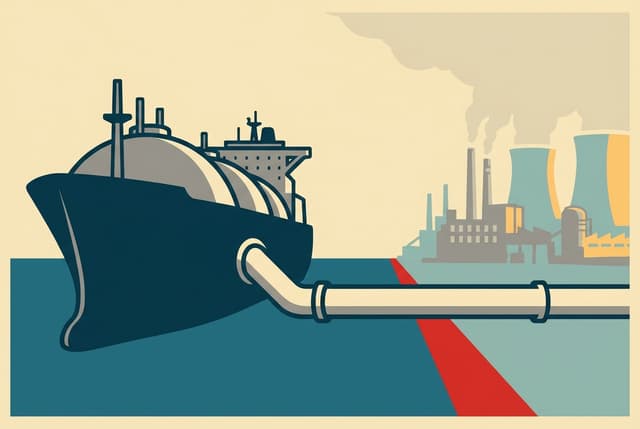
India's factories, power plants, fertiliser units, and the gas piped to millions of urban kitchen stoves consume far more than that. The gap between what India produces and what India needs is filled by imports: gas cooled to minus 162 degrees Celsius, compressed into liquid form, loaded onto specialised ships, and delivered to terminals on India's coastline where it is warmed back into gas and pumped into the national grid.
This process, liquefying gas, shipping it, and turning it back into gas at the other end, is called the LNG chain. LNG stands for liquefied natural gas. And the most important node in India's LNG chain is a terminal at Dahej, on the southern coast of Gujarat, operated by a company called Petronet LNG.
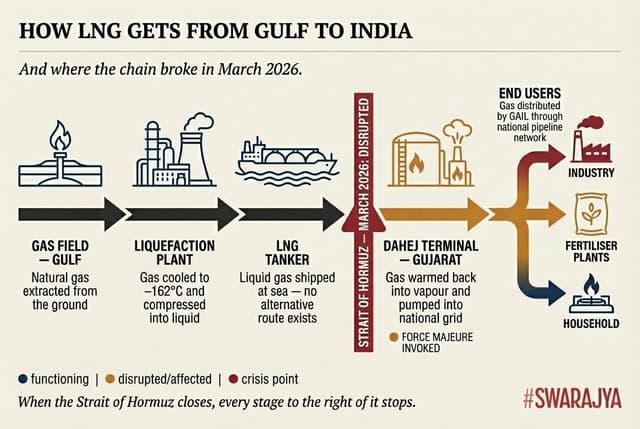
In the first week of March 2026, Petronet LNG invoked force majeure at Dahej. To understand why that matters, it helps to understand what force majeure means, and what Dahej does.
What Force Majeure Actually Means
A contract is a promise. A gas supply contract is a promise to deliver a specific quantity of gas, at a specific price, on a specific schedule. These contracts, between LNG suppliers in Qatar, the UAE, or Australia and buyers in India, run for years, sometimes decades, and are worth billions of dollars. They are the backbone of India's energy supply.
Force majeure is the clause in every contract that says: if something happens that is genuinely beyond anyone's control, a war, a natural disaster, an act of God, the party that cannot deliver is legally excused from the consequences of not delivering. It is not a default. It is not a failure of commercial will. It is an acknowledgement that some events cannot be planned for, and that no contract can bind a party to the impossible.
When Petronet LNG invoked force majeure at Dahej, it was saying, in formal legal terms: we are not able to supply LNG because the gas we contracted to receive is not arriving, and the reason it is not arriving is beyond our control.
The reason was the Strait of Hormuz.
The Strait That Everything Passes Through
The Strait of Hormuz is a narrow channel of water between Iran and the Oman Peninsula. At its narrowest, it is about 33 kilometres wide. Through it passes roughly 20 per cent of the world's oil and a significant share of the world's LNG, including the gas Qatar and the UAE ship to India under long-term contracts. There is no alternative route. The pipelines do not exist. The overland options do not exist. If the Strait closes, the gas stops moving.
Following the escalation of the US-Israel conflict with Iran in late February 2026, the Strait became operationally hazardous. Vessel movement slowed, insurers raised war-risk premiums sharply, and some ships stopped transiting altogether.
Qatar, for example, which supplies a substantial portion of Petronet LNG's contracted volumes at Dahej, faced disruptions to its loading operations. Ships that had been scheduled to arrive at Dahej did not arrive.
Petronet LNG had no gas to receive. It invoked force majeure.
What Dahej Does, and What Happens When It Does Not
The Dahej terminal is India's largest LNG import facility. It receives tanker ships from West Asia, offloads the liquid gas into insulated storage tanks, and then, through a process called regasification, warms the liquid back into gas and sends it down pipelines into the national grid.
On a normal day, Dahej processes enough gas to supply a significant share of India's industrial and domestic demand in the western and northern regions.
The industries connected to the pipeline network downstream of Dahej, including ceramics in Morbi, chemicals in Surat, fertilisers around Gujarat, and power plants across the region, plan their operations around the assumption that gas from Dahej will arrive as contracted.
When Dahej's supply drops, the rationing begins.
GAIL, the state-owned company that runs India's gas pipeline network, decides who gets how much. The hierarchy, both commercial and political, places household consumers, the gas that arrives at kitchen stoves, near the top. Industrial consumers come lower.
When supply is constrained, industries are told to reduce consumption or stop altogether. Adani Total Gas, which distributes piped gas to homes and businesses across several Indian cities, raised prices sharply in the same week as the force majeure declaration.
The Contracts India Relied On
India's LNG import strategy has, for years, rested on long-term contracts with suppliers in West Asia. The most prominent example is Petronet LNG's original 25-year supply agreement with Qatar's RasGas, signed in 1999 and since extended and expanded.
Long-term contracts offer price stability and supply certainty. They have one vulnerability, though. They assume the supply chain between the seller and the buyer remains intact. They assume the Strait stays open.
That assumption held for more than two decades. Until now.
What This Means Beyond the Terminals
The force majeure declaration at Dahej is, in isolation, a legal and logistical event. Its consequences are not isolated.
Every industry connected to India's gas grid, directly or through downstream distributors, felt the reduction in supply within days. The ceramic kilns of Morbi in northern Gujarat are one example. Fertiliser plants that use gas as a feedstock to produce urea, India's most widely used agricultural input, are another. Power plants that run on gas and supply electricity to the grid are a third.
India imports roughly 25 million tonnes of LNG annually, which is then regasified to yield 33 billion cubic metres of gas. This figure was expected to rise to 28–29 million tonnes through 2026, yielding around 38–40 billion cubic metres.
That expansion plan was built on the assumption that contracted supply would arrive.
The Lesson Written in a Legal Clause
India's energy planners have known for years that the concentration of LNG imports from a single region, flowing through a single chokepoint, was a risk. Diversification efforts, including deals signed with US suppliers in 2025 and 2026 and increased sourcing from Australia, are real and moving in the right direction. But they are not yet sufficient to absorb a sudden Gulf disruption of this scale.
The contracts that were meant to guarantee supply have been suspended by an event that the contracts themselves acknowledge no one can prevent.
That is what force majeure means.
 Join our