Tamil Nadu
Tamil Nadu's Skepticism Of Industries Has A Real Cost
K Balakumar
Mar 16, 2026, 06:59 AM | Updated Mar 14, 2026, 02:10 AM IST
We will start with the obvious.
Tamil Nadu today is one of India's most industrialised regions. Its factories produce automobiles for global markets, its garments are worn across continents, its engineering goods shipped to dozens of countries, and its electronics assembled for the world's largest technology companies.
According to the Economic Survey of Tamil Nadu 2025–26, the state clocked a robust economic growth of 11.2 per cent in 2024–25, the highest among major Indian states. The manufacturing sector expanded by 14.74 per cent, more than triple the national average. One in seven Indian factory workers is employed in Tamil Nadu. The state remains a national leader in electronics and electric-vehicle manufacturing and has around 40,000 registered factories, the highest number in India.
Data from the Annual Survey of Industries shows Tamil Nadu also leads the country in factory employment, accounting for roughly 15 per cent of India's industrial workforce. Manufacturing contributes around 24 per cent of the state's Gross State Value Added, significantly higher than the national average.
The automobile ecosystem centred around Chennai alone produces roughly a quarter of India's passenger vehicles. Coimbatore, Tiruppur, and Hosur anchor specialised manufacturing clusters that power exports and employment. Industry overall contributes roughly one-third of the state's economy, alongside agriculture and services.
Yet if one listens to political discourse in Tamil Nadu, a very different picture emerges.
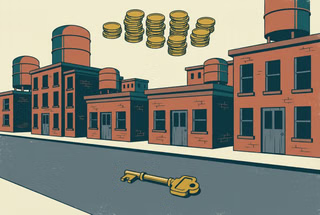
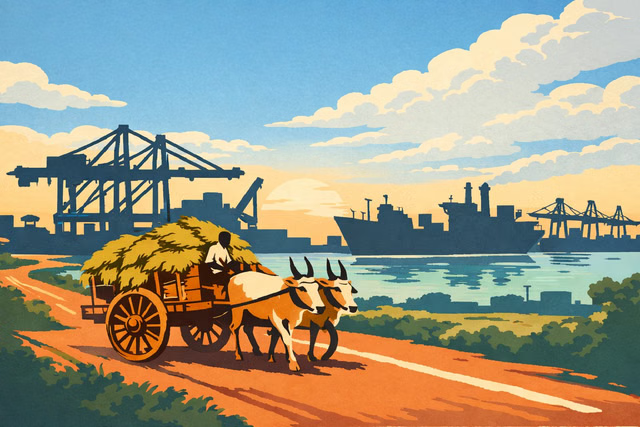
Factories are often viewed with suspicion. Infrastructure projects trigger protests. Industrial expansion is frequently framed as a threat to farmers, land, water, and identity. Election speeches and political debates increasingly reflect a vocabulary in which industry appears less as an engine of growth and more as a potential adversary.
What explains this contradiction? For this, one needs to look beyond economics to the deeper currents of Tamil Nadu's political and cultural imagination.
The politics of suspicion
Over the past decade, Tamil Nadu has seen repeated resistance to large industrial and infrastructure projects. Opposition has surfaced against hydrocarbon exploration in the Cauvery Delta, industrial corridors, mining and energy projects, and the expansion of industrial estates.
Few controversies illustrate this tension more dramatically than the closure of the Sterlite Copper smelter in Thoothukudi. For over two decades, the plant was among India's largest copper producers, supplying a significant share of the country's refined copper and supporting a network of ancillary industries. At its peak, it provided thousands of direct and indirect jobs.
But the facility was also the subject of persistent allegations of environmental violations. These concerns culminated in large protests in 2018. Police firing during demonstrations left 13 people dead, turning the issue into a political flashpoint. The state government subsequently ordered the plant's permanent closure.
The economic consequences were significant. India, which had earlier exported copper, suddenly had to import the metal after domestic smelting capacity shrank. A study supported by NITI Aayog estimated the consolidated economic loss from the closure at roughly ₹14,749 crore, around 0.72 per cent of Tamil Nadu's GDP.
Yet the Sterlite debate rarely unfolded as a technical discussion about environmental regulation or industrial compliance. Instead, it often became a moral narrative in which the framing was industry versus people.
Another example is the proposed eight-lane Chennai–Salem expressway. The project aimed to strengthen freight connectivity between northern Tamil Nadu and the western industrial belt, reducing travel time and improving logistics for manufacturing clusters. But it quickly ran into resistance from farmers and activists concerned about land acquisition and ecological impact. Once again, infrastructure necessary for industrial competitiveness became politically difficult to implement.
Industrial development, a bad word
The same pattern is visible in the prolonged protests against the proposed Parandur greenfield airport for Chennai. Despite compensation offers reportedly reaching 3.5 times market value, the project has been made out by opponents as an assault on local identity and agricultural land.
Similar local protests have also emerged against SIPCOT industrial expansions in districts like Tiruvannamalai.
Perhaps the most symbolic example is the controversy over hydrocarbon exploration in the Cauvery Delta. Energy exploration proposals in districts such as Nagapattinam and Thanjavur triggered intense resistance from farmers and environmental activists who feared damage to fertile agricultural land.
In response, the state government declared the Cauvery Delta a Protected Special Agricultural Zone, effectively restricting many forms of industrial activity.
To be sure, the environmental concerns are not trivial. Tamil Nadu is densely populated and ecologically fragile. But the tone of public debate often goes beyond caution into something broader. It becomes a political narrative in which industry itself is framed as suspect.
When that narrative dominates, every project risks becoming politically combustible.
The cultural roots of the narrative
This ambivalence toward industry is not entirely new. Tamil society has long celebrated the farmer as a moral ideal while rarely romanticising the industrialist.
The roots of this cultural memory run deep. Classical Tamil literature placed agriculture at the centre of ethical life. One of the most frequently cited couplets from the Thirukkural declares: "Only those who live by the plough truly live; the rest subsist by depending on them."
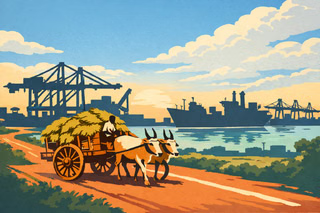
In this worldview, agriculture is not merely an occupation but the foundation of society itself. That cultural reverence has endured across centuries. Even today, political speeches frequently invoke the farmer as the civilisational backbone of Tamil society.
Industry, by contrast, is historically recent. Factories arrived only in the late nineteenth and early twentieth centuries and never acquired the same moral aura as agriculture.
Dravidian political rhetoric
The ideological framework of the Dravidian movement further reinforced this. In its rhetoric, the worker, the peasant, and the oppressed individual became powerful representations of their version of social justice. The industrialist, however, rarely fit comfortably into this narrative.
Entrepreneurs were often portrayed as beneficiaries of older caste hierarchies or as figures associated primarily with wealth accumulation. Whether or not this perception was always accurate, it shaped the political vocabulary of the state. The distinction persists in subtle ways even today.
Cinema and the moral imagination
Tamil cinema has also hammered down these archetypes. In countless films, the moral hero is a farmer, labourer, or oppressed villager. The antagonist is frequently the greedy landlord, corrupt businessman, or exploitative factory owner.
Over decades, this larger idea has seeped into popular imagination. Given cinema's enormous cultural influence in Tamil Nadu, these moral stereotypes have helped shape social attitudes toward wealth and enterprise.
The invisible industrialist
The result is a peculiar paradox. Tamil Nadu has produced some of India's most important manufacturing enterprises. Yet the founders of these businesses have rarely become cultural icons. Industrialists remain largely invisible in the state's public imagination compared to political leaders or film stars. Whenever this publication has profiled or run obituaries on its industrialists, the feedback received is often: "We didn't know these details about this man and his industry."
This stands in contrast to several other Indian states. In Gujarat, entrepreneurship is a matter of cultural pride. In Maharashtra, industry is seen as an institutional pillar of development. In Karnataka, especially around Bengaluru, entrepreneurship is closely associated with technological innovation.
To be fair, all states witness criticism of corporations from time to time. But the baseline political discourse in these regions generally treats industry as a legitimate partner in development rather than a morally suspect force.
The stakes for Tamil Nadu
Narratives matter. Where business is socially admired or politically normalised, industry finds a more comfortable ecosystem. Where rhetoric remains ambivalent, investors and entrepreneurs often sense hesitation, even when government policy is technically supportive.
Tamil Nadu's industrial success has survived this contradiction so far. But as competition among Indian states for manufacturing investment intensifies, the alignment between economic policy and political narrative will matter more.
If the political cost of supporting a factory becomes higher than the economic benefit of the jobs it creates, capital usually migrates.
The state's ambition of building a $1-trillion economy cannot rest on an agriculture-only foundation. A region with a Gross Enrolment Ratio of nearly 47 per cent in higher education, almost double the national average, cannot ask its engineers and technicians to return to the plough.
For Tamil Nadu's development story to remain coherent, its political discourse may eventually have to expand its moral vocabulary.
The farmer will always remain a civilisational hero in Tamil society. But the entrepreneur, the builder of factories, supply chains, and industrial towns, is also deserving of that recognition.
 Join our