Culture
The Coronation of the Mediocre
Aravindan Neelakandan
Mar 15, 2026, 08:55 PM | Updated 08:55 PM IST
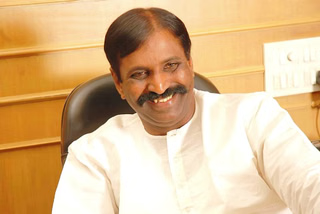
The Jnanpith Award has long been regarded as the highest altar of Indian literature. Since its inception in 1961, it has served not merely as a prize for popularity, but as a recognition of profound civilizational impact and linguistic mastery. From the first laureate, G. Sankara Kurup, to the towering figures of the Kannada Renaissance like Kuvempu and the gritty, socially transformative voices of Mahasweta Devi or Tamil Nadu’s own Jayakanthan, the award has historically demanded a level of intellectual and aesthetic rigor that transcends the ephemeral.
However, the recent announcement that the award is to be bestowed upon Vairamuthu marks a significant and troubling departure from this tradition. While the choice may be celebrated in the markets of consumerist pop-culture and even in the corridors of vested political interest, it forces a difficult conversation about whether we are witnessing a civilisational lapse in institutional judgment - one that substitutes cinematic utility for literary permanence.
The Dissonance of Popularity and Depth
To understand why this choice is so contentious, one must look at the nature of the output being honoured.
Vairamuthu is undeniably a master of his specific craft: the film lyric. Within the confines of a three-minute cinematic sequence, he is adept at capturing sentiment and crafting accessible, rhythmic lines that resonate with the masses. Yet, there is a fundamental difference between a songs-on-demand lyrics writer and a poet.
The work of a true literary laureate is characterized by an exploration of the human condition that remains relevant long after the music stops. In contrast, Vairamuthu’s output often feels vacuous when stripped of its orchestral accompaniment. It relies on a certain lyrical artifice-rhymes and sophisticated laundry lists, that are clever but shallow, and sentiments that are derivative rather than transformative.
The publication of his Kallikattu Ithihasam in 2001, and its subsequent receipt of the Sahitya Akademi Award in 2003, marked a pivotal moment in the intersection of populist Tamil culture and institutional literary recognition. With author's primary cultural currency being derived from the high-glamour, high-rhetoric world of Tamil cinema, the novel was immediately canonised as a 'modern epic'.
However, a rigorous critical inquiry from the vantage point of literary intelligence reveals a text that is fundamentally at odds with the structural and psychological demands of the epic form. While marketed as a poignant chronicle of displacement-specifically the flooding of fourteen villages in the 1950s for the Vaigai Dam reservoir—the work functions more as a showcase for the author’s idiosyncratic linguistic flourishes than as a profound exploration of the refugee experience.
To elevate a body of work primarily built on the exigencies of the film industry and shallow gimmickry of word salad to the same pedestal occupied by Jayakanthan’s fierce social realism is to fundamentally devalue what we mean by literature.
A Necessary Distinction
In discussing this crisis of merit, one must address the elephant in the room.
It is a necessary, if uncomfortable, confession: on a personal level, Jeyamohan occupies a spot in the top three of individuals I never want to meet again in my life. As a person, my disagreement with him is total; If we were walking on the same street, I would reflexively choose the opposite side.
But an objective assessment of literature demands that we separate the personal pathos from the pen.
If we look at the landscape of contemporary Tamil letters, Jeyamohan stands as a phenomenon of depth and intellectual stamina. He is a master of the craft who has forced at least two generations of thinkers to engage seriously with Indian civilization, philosophy, and literature. His work represents a rigorous attempt to bridge the ancient and the modern. While his followers exhibit a cultish devotion that is as insufferable as the man himself, the work remains-vast, complex, and undeniably significant.
The Civilizational Cost
The contrast is stark. On one hand, we have the phenomenon of depth represented by a writer who challenges the reader’s intellect; on the other, we have a merchant of the mediocre whose primary contribution is the commodification of emotion for mass consumption.
A Jnanpith for a writer of Jeyamohan’s stature would have been the natural continuation of the award's legacy, lending it the prestige that comes with recognizing genuine intellectual labour. Instead, the committee’s choice of Vairamuthu feels like a civilizational insult to the Tamil language-a language that deserves to be represented by its thinkers and writers of the finest quality not its cheap-entertainers, abusive and superficial power mongers.
It suggests that the benchmark for 'greatness' has shifted from the philosophical to the performative, from literary geniuses to lyrics littering mediocrity.
Looking Forward
There is a certain irony in this snub.
For a writer driven by the fuel of intellectual friction, an omission of this magnitude may only serve as a catalyst. It is likely to propel Jeyamohan toward even higher achievements, perhaps on an international stage where the politics of local cinematic popularity and imposed literary dictates of political calculations in upcoming elections, hold no sway.
When that happens, as a bitter Jeyamohan-critic I tell you, it will be a moment of pride for Tamil literature, and I hope it will be a moment of profound introspection for the Indian literary establishment.
History is rarely kind to the ephemeral.
When the cinematic glitter fades, when the election necessities and political calculations of under-table dealings end and the catchy rhymes of the moment get forgotten, the works that demand effort and offer depth are the ones that shall endure. The Jnanpith committee may have chosen to crown the popular for now, but the true master of the craft will always hold the mandate of history.
One final disclaimer: my personal list remains unchanged. It is personal and based on my personal value judgement. But even a personal adversary deserves the truth: Jeyamohan is a giant literary craftsman, and to ignore him in favour of a seller of lyrical trinkets is a farce that our literary history will struggle to forgive.
It is not too late to reverse course.
Though the cloud of #MeToo allegations offers a compelling moral and ethical reason to pivot, a reversal rooted in purely literary considerations would be the most valid path and appropriate reason. It is time for a collective awakening; concerned citizens must now lend their pens and voices to the protest against this selection.
सबको सन्मति दे भगवान।
 Join our