World
Modi In Israel, Xi Before Ukraine: Signalling Before Wars
Prof. Vidhu Shekhar
Mar 06, 2026, 07:30 AM | Updated Mar 05, 2026, 05:13 PM IST
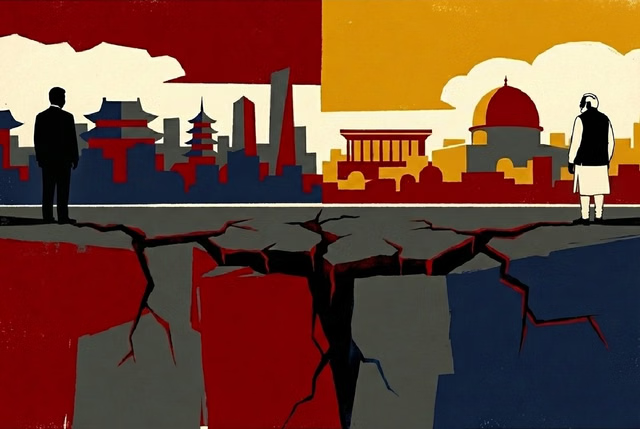
In February 2022, Vladimir Putin sat beside Xi Jinping in Beijing and declared a partnership without limits. Weeks later, Russian tanks crossed into Ukraine.
In February 2026, Narendra Modi addressed the Knesset in Jerusalem, received its medal, and departed with a suite of defence and technology agreements. Days later, Israel and the United States struck Iran. Ayatollah Ali Khamenei was killed.
Two visits. Two escalations. Neither caused what followed. But both shaped the diplomatic landscape in which it unfolded. The contrast between them reveals something important about how power is signalled in a fragmenting global order.
What Modi Did Not Say
In the days before Modi's departure, a widely watched policy discussion in India speculated about what he might say. With tensions rising across West Asia, Iran's nuclear programme advancing, Houthi disruptions in the Red Sea persisting, and Israeli operations in Gaza unresolved, some observers expected him to reprise a familiar line: this is not an era of war. India has often framed its diplomacy through restraint and civilisational balance. The phrase had become part of Modi's rhetorical signature.
He did not use it.
The visit, which concluded on 26 February, was measured but firmly oriented towards partnership. Joint statements focused on defence cooperation, counterterrorism coordination, technology transfer, and institutional linkages.
There was no pacifist framing directed at the regional tensions gathering force nearby. For a leader known for invoking moral positioning on conflict, that absence was noticeable.
When a leader who has previously emphasised restraint declines to do so at a moment of rising tension, and does so while standing in the parliament of a state widely expected to escalate, the omission registers.
It registers in Tehran. It registers in Washington. It registers in Gulf capitals weighing their own posture. What Modi did not say became part of the message.
An Unusually Broad Reception
The protocol surrounding the visit reinforced its significance. Modi addressed the Knesset, a rare honour, and was conferred its medal. More striking than the ceremonial gestures was their breadth.
Senior figures from across Israel's political spectrum, including prominent opposition leaders, publicly endorsed the visit. In a deeply fractured Israeli polity, where the Gaza campaign and judicial reforms have polarised the political class, bipartisan warmth towards a foreign leader was noticeable.
When both the governing coalition and its fiercest critics welcome a visit with equal visibility, the signal is institutional. The relationship is framed as structural rather than personal. It is designed to outlast individual governments. With elevated honours, cross-party affirmation, and choreographed visibility, Israel invested political capital in Modi's presence.
In a period when military planners in Tel Aviv and Washington were already modelling escalation scenarios, that investment was meaningful in itself.
Why India's Posture Matters
India today is not a peripheral actor in West Asia. It is one of the world's largest economies. It is a major defence partner of Israel. It is the third-largest energy consumer globally, with a substantial share of its crude imports originating from the Gulf. It maintains working diplomatic channels with Washington, Moscow, Tehran, Riyadh, and Abu Dhabi simultaneously.
It is not a Western treaty ally. Nor is it embedded in China's alignment against the West. Its defining posture remains strategic autonomy combined with cross-bloc engagement.
When such a state signals visible proximity to Israel at a moment of escalation, the diplomatic frame shifts. The confrontation becomes harder to cast as a narrow Western coalition confronting Iran. It introduces a variable that does not fit neatly into established blocs.
This does not mean India determines outcomes. No single visit alters the trajectory of a military campaign. But in high-risk environments, perception shapes escalation pathways. The composition of visible partnerships influences how third parties calculate their response.
For Gulf states balancing relations with both Tehran and Washington, India's positioning provides additional diplomatic cover. For countries in the Global South wary of bloc politics, it muddies the simplicity of a West-versus-Iran framing.
India's presence does not resolve the conflict, but it does reshape how it is interpreted.
The Beijing Parallel
The comparison with Xi Jinping's meeting with Putin in February 2022 clarifies the distinction.
That meeting, held during the Winter Olympics, produced a joint statement that went beyond routine diplomatic language. It declared a partnership without limits and questioned elements of the Western security order. The optics were deliberate. Two major powers presented a united front against what they characterised as American dominance.
Weeks later, Russia invaded Ukraine. The meeting did not cause the invasion. War planning predated the Olympics. But it altered the perceptual environment. Russia did not appear strategically isolated. A consolidated Eurasian bloc seemed to stand opposite a Western alliance structure. The geopolitical map appeared clearer, even if the reality was more complex.
The parallel with Modi's Jerusalem visit lies in timing and visibility. High-profile diplomatic engagements immediately before major escalations carry signalling weight. Yet the geometry differs sharply.
China's move before Ukraine narrowed geopolitical lines. It signalled structural alignment and reinforced bloc consolidation. India's visit before the Iran strikes signalled solidarity with Israel while preserving autonomy. It introduced ambiguity into a confrontation that might otherwise have been read as a straightforward Western-versus-Iran clash.
One clarified blocs. The other complicated them. Both mattered.
Escalation and the Diplomatic Matrix
Strikes of the magnitude that killed Khamenei are the product of prolonged intelligence preparation and operational planning. Before authorisation, planners model retaliation scenarios and the second- and third-order responses of major powers.
The reactions of Russia and China would have figured prominently. Moscow maintains defence cooperation with Tehran. Beijing depends on Iranian energy supplies and has expanded its diplomatic footprint in the region. Their posture in the aftermath of a decapitation strike would have mattered.
Russia and China condemned the strikes and called for restraint. They did not intervene militarily. Many factors shaped that restraint, including commitments elsewhere and the risks of direct confrontation with the United States.
Yet in a world where coalition optics influence strategic calculations, India's positioning has contributed to a more complex diplomatic landscape, making it harder to sustain a simple West-versus-the-rest narrative.
India's Signalling Leverage
The deeper story concerns the nature of India's rise.
India possesses what might be called signalling leverage. Because it is not bound by formal alliance obligations, its visible positioning is interpreted as deliberate rather than automatic.
When a treaty ally stands with Washington, the move is expected. When India signals comfort with Israel at a moment of tension, the interpretive weight is greater precisely because it was not structurally predetermined.
Autonomy enhances credibility. It allows India to engage across blocs while preserving the ability to signal preference. That flexibility makes its choices more consequential in the realm of perception.
The era when India was a distant observer of West Asian crises is over. Its diplomacy now interacts directly with major power calculations. Its presence is part of the equation, and its silence can be as consequential as its speech.
When Diplomacy Precedes War
Wars are fought with weapons. But the environment in which wars unfold is shaped earlier. Leaders travel. Statements are issued. Honours are conferred. Signals are sent. Sometimes words are withheld.
The Beijing meeting of February 2022 and the Jerusalem visit of February 2026 illustrate two modes of pre-escalation diplomacy in a fractured world. One demonstrated bloc consolidation. The other demonstrated calibrated solidarity from a rising power determined to preserve strategic autonomy while making its preferences legible.
In moments before war, presence itself becomes policy.
Dr. Vidhu Shekhar holds a Ph.D. in Economics from IIM Calcutta, an MBA from IIM Calcutta, and a B.Tech from IIT Kharagpur. He is currently an Associate Professor in Finance & Economics at Bhavan's SPJIMR, Mumbai. Previously, he has worked as an investment banker and hedge fund analyst. Views expressed are personal.
 Join our