Politics
Why Delhi Placed A Spymaster And A General On Either Side Of The Siliguri Corridor
Abhishek Kumar
Mar 12, 2026, 10:58 AM | Updated Mar 14, 2026, 03:45 PM IST
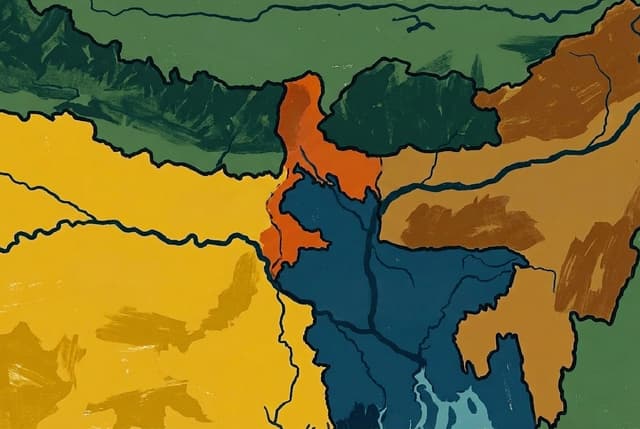
Between 25 February and 6 March, three events unfolded in quick succession that, read together, constitute the most significant administrative repositioning of India’s most strategically fragile geography since Article 370.
Union Home Minister Amit Shah arrived in Bihar’s Seemanchal for a three-day closed-door security tour. R.N. Ravi, a retired Intelligence Bureau officer whose official profile describes his specialisation as “the dynamics of human migration in South Asia and the political sociology of border populations,” was moved from Tamil Nadu to become West Bengal’s Governor. Lieutenant General Syed Ata Hasnain, architect of the “Hearts Doctrine” in Kashmir, was named Bihar’s Governor.
Both appointments were announced within twenty-four hours of each other. The RJD’s Ran Vijay Sahu immediately accused Shah of planning to “carve out a new Union Territory by slicing Seemanchal and West Bengal.” Pappu Yadav and other regional figures followed suit.
Looking at it from their perspective, the tension is not entirely without foundation.
The Map
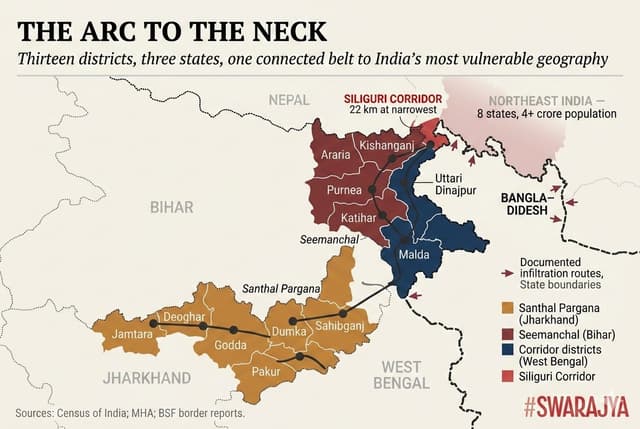
In Bihar, four districts — Kishanganj, Araria, Purnea, Katihar — crowd the Bangladesh and Nepal borders.
Move east into West Bengal, and Malda, Murshidabad, and Uttari Dinajpur fall in the vicinity. Swing south-west into Jharkhand and you enter Santhal Pargana: Sahibganj, Pakur, Godda, Dumka, Deoghar, Jamtara.
Thirteen contiguous districts, spanning three states and two international borders, describe an arc that terminates at the Siliguri Corridor. Known as Chicken’s Neck, twenty-two kilometres wide at its narrowest, it is the only land link between mainland India and eight northeastern states.
This geography has been contested before. It was contested at the moment India, in its modern geographical form, took shape in 1947. That year, a sabha of the Provincial Muslim League in Kishanganj demanded that the erstwhile Purnia district, along with parts of Bhagalpur, Munger, and the entire Santhal Parganas, be transferred to Bengal, which they wanted for Pakistan.
The areas were kept in India. In 1956, parts of Kishanganj subdivision were transferred to West Bengal’s West Dinajpur district to connect the two halves of the state that Partition had split. The corridor exists because that demand was denied. It remains vulnerable because the demographic tensions that produced the demand have intensified rather than receded in the succeeding decades.
During the anti-CAA/NRC protests, the corridor’s vulnerability was articulated as a target. In January 2020, Sharjeel Imam, an IIT graduate, JNU scholar, and son of a JDU politician from Bihar’s Jehanabad, stood at Aligarh Muslim University and told his audience that with five lakh organised people, “we can permanently cut off India and the North East.”
Emphasising demographic change, he added, “We can do it because the chicken neck belongs to Muslims.” In November 2025, Delhi Police played the clip before the Supreme Court, arguing that intellectuals who turn to terrorism are more dangerous than foot soldiers. The Court rejected his bail in January 2026.
Imam is from Bihar, was arrested in Bihar, and the geography he described as a strategic target runs through the districts now bracketed by the two new governors. A Delhi court described his role in the conspiracy as venomous and integral to planning and mobilisation.
The Numbers
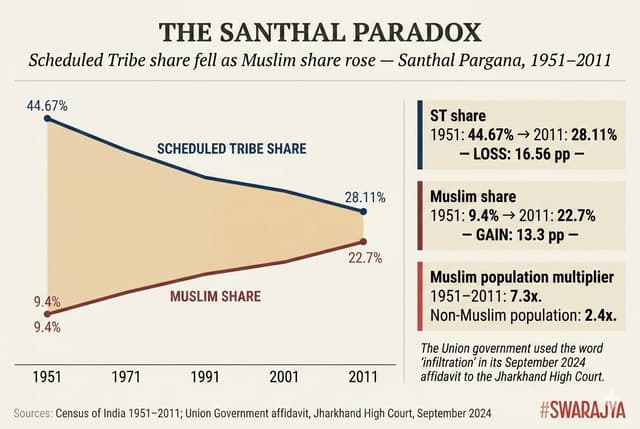
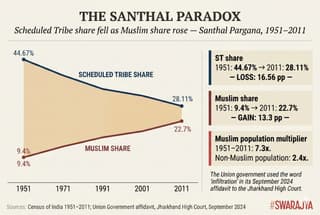
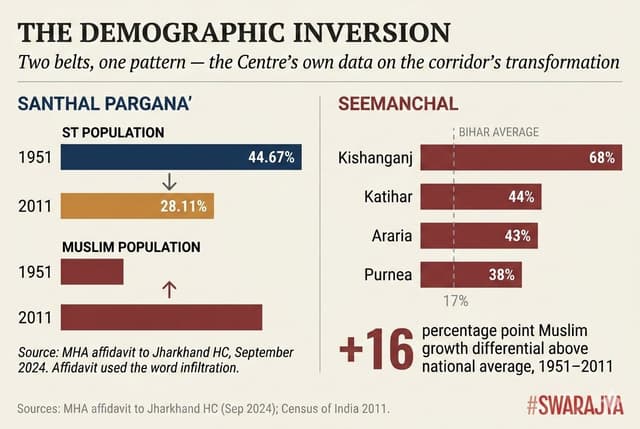
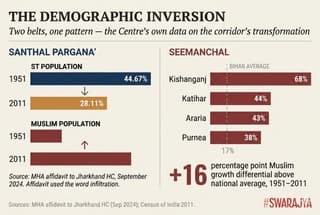
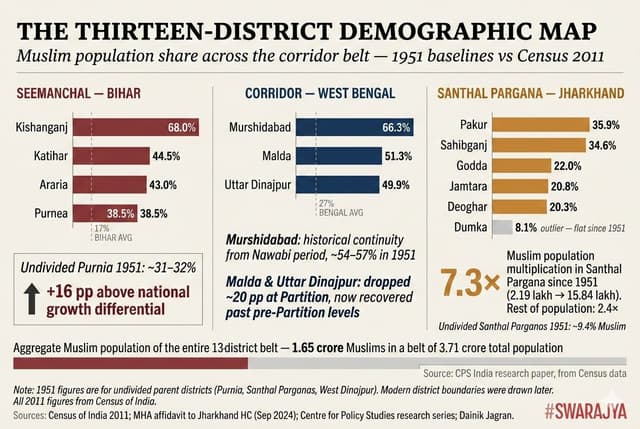
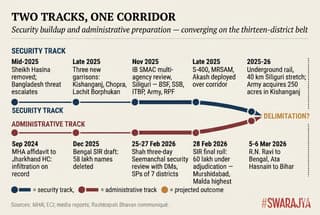
In September 2024, the Union government filed an affidavit before the Jharkhand High Court, placing on record that the Scheduled Tribe share of Santhal Pargana’s population had fallen from 44.67 per cent in 1951 to 28.11 per cent in 2011.
The Muslim share over the same period rose sharply, from single digits in 1951 to an estimated 22–24 per cent by 2011, with a 20–40 per cent increase concentrated in the border districts of Pakur and Sahibganj.
The affidavit used the word infiltration.
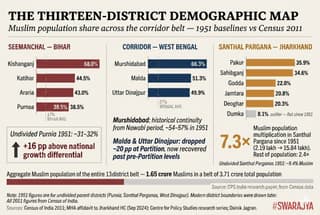
In Seemanchal, the numbers are starker. Kishanganj is Bihar’s only Muslim-majority district, with 68 per cent Muslims against the state average of 17 per cent. Katihar is at 44 per cent, Araria at 43 per cent, and Purnea at 38 per cent. Local Muslims credit Bangladeshi infiltration for this shift.
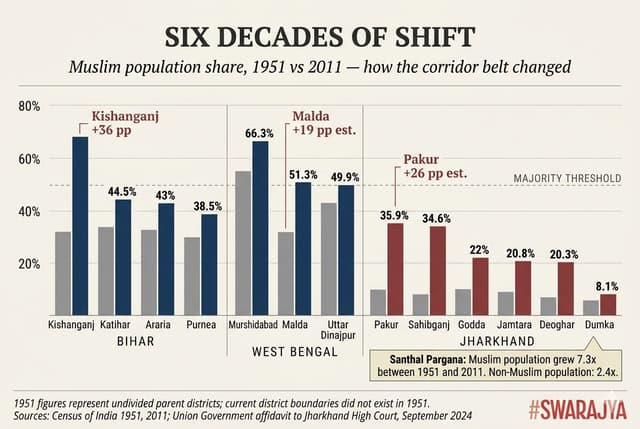
Known as Bhatias in Seemanchal, these Bangladeshis work as low-paid or even unpaid labourers for years, sometimes decades, until that loyalty pays off in land or monetary terms. The Muslim population growth differential in Seemanchal between 1951 and 2011 was sixteen percentage points above the national average.
In West Bengal, the Election Commission’s Special Intensive Revision (SIR) of voter rolls, published on 28 February — three days after Shah landed in Kishanganj — deleted 58 lakh names and placed 60 lakh more under adjudication. The highest concentrations of pending cases are in Murshidabad and Malda, the corridor districts.
Whether that reflects genuine non-citizenship or electoral engineering is fiercely contested. What is not contested is that this data now forms the administrative baseline on which the next delimitation exercise will draw.
For that exercise, gubernatorial appointments with serious backgrounds are needed.
The Two Men
Both appointments carry the weight of a sentence being completed rather than a new one being started.
Ravi is not a politician who drifted into Raj Bhavan. He is a career IB officer whose specialisation, on the record and in his official profile, is border population sociology and migration dynamics. He served in insurgency theatres across J&K and the Northeast, ran anti-corruption operations in the CBI, and was handpicked by Modi and Doval in 2014 to be the interlocutor for the Naga peace process.
The Framework Agreement he architected in 2015 remains the most significant breakthrough in India’s oldest insurgency. He chaired the Joint Intelligence Committee and served as Deputy NSA. In Tamil Nadu, he governed with a confrontational intensity that led the DMK to describe him as dictatorial: walking out of the Assembly, withholding assent to bills, publicly challenging the state’s name.
Delhi has placed that man in the Raj Bhavan of the state whose border districts are at the centre of the most contested voter roll revision in the country. Mamata Banerjee’s response to his appointment was immediate: “He (Amit Shah) never consulted with me as per the established convention.”
In Kolkata, Banerjee spent 7 and 8 March at a sit-in protest at Metro Channel. “Their intent is to divide Bengal. The BJP is planning to take away votes by dividing Bengal and turn parts of the state into a Union Territory,” she said, linking the SIR voter deletions to the UT plan. Daring the Centre, she added, “Let them touch Bengal if they have the guts. This is their conspiracy. They did it once in Bihar by creating Jharkhand, and now they are trying to do it again.”
Congress leader Jairam Ramesh, Mamata’s colleague in the opposition camp, described Ravi as “very much part of the Modi ecosystem” and predicted he was guaranteed to make a nuisance of himself in Bengal.
Ravi now sits across the table from a chief minister who has appeared before the Supreme Court personally to resist the SIR exercise, and who will treat every central intelligence initiative in the corridor as a provocation.
The Bihar governor’s appointment was less controversial, though the removal of Arif Mohammed Khan generated more headlines than the appointment itself. Syed Ata Hasnain, the new governor, commanded the Chinar Corps at its most difficult stretch, from 2010 to 2012, the years of mass stone-pelting in Kashmir.
His response was the Hearts Doctrine: civilian-centric community engagement built on the premise that kinetic operations alone cannot win populations whose alienation is historically layered. He has written and spoken about this for a decade, with consistent emphasis on the category error of treating an entire population as a security threat. His career is a study in governing contested terrain without pretending the contest does not exist.
He is now in Bihar, the state that contains Seemanchal, where Shah had just spent three days, and where a new army garrison was established at Kishanganj in late 2025.
The Security Architecture
The security infrastructure developments of the past year are a story of their own. Three new garrisons — at Kishanganj in Bihar, Chopra in West Bengal, and Lachit Borphukan in Assam — were established specifically for corridor defence.
Indian Railways began laying underground tracks in a 40-kilometre Siliguri stretch: infrastructure designed to survive surface disruption. Buried 20–24 metres underground between Tin Mile Haat and Rangapani, the hardened, multi-layered corridor is built to avoid the vulnerabilities of surface infrastructure.
S-400, MRSAM, and Akash missile systems have been deployed for layered air defence over the corridor. In November 2025, the IB’s Subsidiary Multi-Agency Centre convened a review in Siliguri that brought together BSF, SSB, ITBP, state police, the Army, and the Railway Protection Force — the kind of inter-agency assembly that does not convene for routine border management. The Indian Army is also acquiring 250 acres of land in Kishanganj.
Security efforts have intensified since Sheikh Hasina was undemocratically removed from power in Bangladesh. In the aftermath, multiple entities have signalled their intent to target the Chicken’s Neck. Several Bangladeshi nationals were detained near army installations in North Bengal, including one who attempted to enter the Bengdubi Army Base at Bagdogra posing as a local labourer.
Three garrisons, underground rail, missile deployment, a voter roll audit that deleted millions of names, heightened vigilance, and the appointment of governors with formidable records in both states: these developments, taken together, add up to something legible.
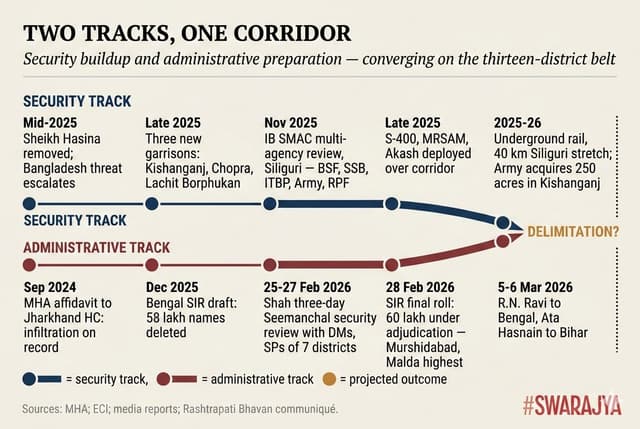
The question is what they add up to. Are the rumours about the creation of a new Union Territory comprising Seemanchal and parts of North Bengal true? And if so, whether Santhal Pargana districts are under consideration as well.
Notably, Santhal Pargana, though absent from the recent conversation, has been an integral part of the original UT demand raised by Bharatiya Janata Party (BJP) parliamentarian Nishikant Dubey from the Lok Sabha floor in July 2024. Dubey has said that local police have been hostile towards those who oppose infiltration, citing dozens of cases filed against him.
This is where the UT proposal acquires its practical logic.
Why a UT Is Too Costly
The corridor is too critical for fragmented state jurisdiction. The demographic transformation is on the Centre’s own court record. The secessionist threat is in judicial evidence. The J&K 2019 precedent exists.
The obstacles, however, are serious enough that informed opinion in Delhi appears to regard the proposal as intellectually coherent but practically unachievable.
Carving a new UT from three states requires a legally straightforward but politically complex process. Article 3 allows Parliament to alter state boundaries, but the process demands consultation with three legislatures, two of which are opposition-governed. Bihar’s NDA government may comply, but Bengal and Jharkhand would turn the referral into a national campaign.
Mamata Banerjee would weaponise it as victimhood. Hemant Soren, fresh from defeating the BJP’s Santhal Pargana infiltration argument decisively in November 2024 (including among the tribal communities the argument was designed to protect), would not cooperate with any measure requiring his legislative facilitation.
J&K’s reorganisation in 2019 worked because Article 370 provided the mechanism, the state was under President’s Rule, and no elected government existed to resist. None of those conditions apply here.
More fundamentally, the UT would contain the very population that can be instigated to commit violence by the perception of threat against itself. An administered territory whose residents include infiltrators and hostile non-citizens with the ability to influence locals does not become tractable; it risks becoming the next Kashmir.
A Seemanchal UT governed directly from Delhi, populated primarily by a mix of local elites and infiltrators used as instruments of leverage, would require either mass disenfranchisement or the normalisation of the precise demographic it was designed to address.
Responding to Pappu Yadav’s claims, Nityanand Rai, Minister of State in the Home Ministry, said, “It is totally contrary to the facts that there is any plan to carve out some districts from Bihar and West Bengal to form a UT. Nobody should take the tweet of Pappu Yadav seriously.”
No Indian government has carved a Union Territory from an unwilling state for security reasons alone. The precedent does not exist because political mathematics has never permitted it.
The Likelier Instrument
There is, however, a precedent for something else.
In August 2023, the Election Commission completed Assam’s delimitation, the first since 1976. It was carried out not by a bipartisan Delimitation Commission but by the ECI itself, under Section 8-A of the Representation of the People Act. It used 2001 Census data rather than the more demographically contested 2011 figures.
The exercise redrew all 126 assembly constituency boundaries, increased ST reserved seats from 16 to 19, and recalibrated political representation in ways that Bengali-origin Muslim communities — the fastest-growing demographic in lower Assam — argued had deliberately diluted their electoral weight.
Delimitation Commission orders have the force of law and are unlikely to be heard by courts unless they brazenly violate constitutional principles.
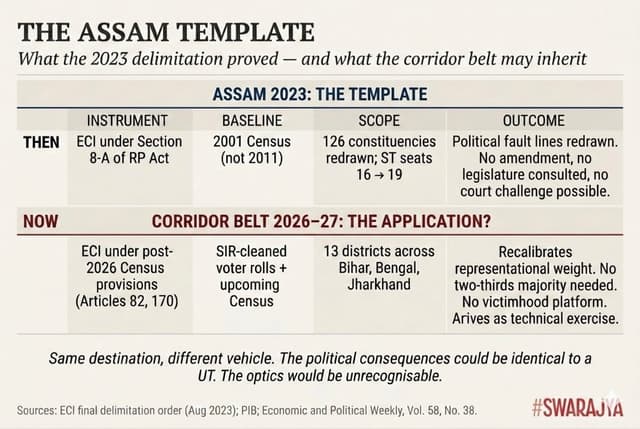
Now consider what already exists across the thirteen-district belt. Bengal’s SIR has produced a cleaned voter-roll baseline. The Jharkhand HC has the Centre’s demographic affidavit on record. Seemanchal’s District Magistrates have just briefed the Home Minister on settlement patterns and demographic monitoring.
The post-2026 Census provisions of Articles 82 and 170, which froze constituency numbers until the first census after 2026, are about to expire, reopening the door for nationwide delimitation.
A delimitation covering Seemanchal, Bengal’s corridor districts, and Santhal Pargana — triggered by the census now in preparation, conducted using the SIR-cleaned rolls as the baseline — achieves electorally what the UT achieves administratively. It recalibrates representational weight across the belt.
It does not require a majority. It does not hand Mamata a victimhood platform. It does not require Hemant’s cooperation. The Assam precedent shows that the choice of census baseline can itself be a political instrument. And it arrives not as a political event but as a technical exercise conducted by a constitutional body: routine democratic maintenance, not territorial surgery.
The political consequences could be identical to those of a UT. The optics would be unrecognisable.
The two governors — a spymaster who built his career studying how border populations move, settle, and alter the political map, and a general who built his career governing contested terrain through calibrated force and negotiated coexistence — are the human infrastructure for whatever comes next. Ravi is the Centre’s sensor inside a state whose government is hostile to every central intelligence initiative in the corridor.
Hasnain, with his counter-insurgency experience and commitment to community engagement, is positioned for the period when the administrative recalibration, if it comes, will need to be managed without producing the very alienation it is meant to prevent.
This is not the J&K of August 2019. There will be no midnight presidential order. It reads more like the J&K of 2016 to 2019: methodical preparation of conditions, conducted patiently, institutionally, below the threshold of crisis.
The formal instrument, when it comes, may not be reorganisation. It may be delimitation — the same destination, reached by means that do not require announcing the journey.
Abhishek is Staff Writer at Swarajya.
 Join our