World
India's Backyard, Not India's War: The Hard Truth About The Indian Ocean
Anmol N Jain
Mar 11, 2026, 06:59 AM | Updated 09:54 AM IST
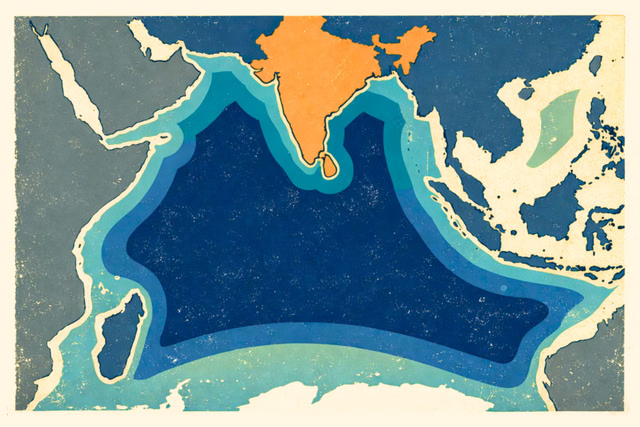
On the morning of 4 March 2026, the Sri Lankan Navy received a distress call from a vessel approximately 40 nautical miles south of Galle. By the time rescue boats arrived, the ship was gone. Sri Lankan sailors pulled 87 bodies from the water and rescued 32 survivors, some critically wounded.
The ship was the IRIS Dena, one of Iran's newest warships. The submarine that killed it was the USS Charlotte. US Defence Secretary Pete Hegseth later declared, "An American submarine sunk an Iranian warship that thought it was safe in international waters. Quiet death."
The IRIS Dena had docked at Visakhapatnam in February as a participant in the Indian Navy's International Fleet Review 2026 and Exercise MILAN, an event India's Defence Minister described as proof of the confidence the global maritime community places in India as a maritime partner. The Dena left Indian waters on 25 February. A few days later, it was at the bottom of the ocean.
The sinking happened in waters India considers its own backyard, and the question of what India owes to Iran, to the region, to the principle of maritime order, arrived immediately.
India has no treaty with Iran that obliges a response, no mutual defence pact with any party to this conflict. India was not attacked, Indian citizens were not killed, and Indian territory was not violated. And yet, India has since been urged to rage, condemn, and assert itself. It has done none of these, and it is right.
The Pressure To React Came Fast
India has faced a sustained campaign of pressure — from Tehran, from the domestic opposition, from the commentariat — to treat this as a national humiliation requiring a response.
Iran's Foreign Minister Araghchi called the sinking "an atrocity at sea, 2,000 miles away from Iran's shores" and pointedly described the Dena as "a guest of India's Navy." The framing was deliberate: it places India in the dock.
At home, Rahul Gandhi accused the Prime Minister of saying nothing. Jairam Ramesh called the government "timid and fearful," noting that the Defence Minister had personally inaugurated the exercise the Dena attended days before its sinking.
The implication behind much of this criticism is that the Dena's presence at MILAN entitled it to some form of Indian protection. It did not. The Dena was a combatant vessel belonging to a belligerent state; its recent attendance at a multilateral exercise, its armament status, and whether it was operating in a non-combat posture do not alter its status as a legitimate target at the moment of attack.
The legal position is clear. The harder question, and the one serious people are asking, is what the Dena sinking means for India's credibility as a maritime power. Retired service chiefs and former diplomats have raised this, and those questions deserve engagement.
But what has come from certain quarters of the political opposition is something else: reflexive outrage calibrated to the news cycle rather than to India's strategic interests. Much of the same political ecosystem that urged de-escalation during Operation Sindoor, when India's own territory was violated and its citizens killed, now demands a muscular response to a war being fought between other countries, in international waters, over a dispute India is not party to.
When the instinct is always to oppose the government's posture regardless of the posture, the criticism stops being strategic and becomes performative.
What India Actually Did
Against this noise, one must look at what India actually did.
India had offered the IRIS Dena safe harbour before the sinking; the offer was not taken up. A second Iranian warship, IRIS Lavan, which had also participated in the Fleet Review, developed technical problems and requested permission to dock. India approved on 1 March, and the Lavan sailed into Kochi, where its 183 crew members, many of them young cadets, are currently housed at Indian naval facilities.
A third Iranian vessel, IRIS Bushehr, was interned by the Sri Lankan Navy along with its 208 crew, the first warship interned in a neutral country since the Second World War. When the Dena's distress call was received in Colombo, the Indian Navy deployed a long-range maritime patrol aircraft to augment Sri Lanka's rescue effort, redirected INS Tarangini, and sailed INS Ikshak from Kochi to help locate missing personnel.
External Affairs Minister Jaishankar spoke to his Iranian counterpart Araghchi hours after the sinking, and at the Raisina Dialogue on Saturday he laid out India's position publicly. He called the sinking "unfortunate" and said the Dena had been "caught on the wrong side of events."
On India's decision to dock the Lavan, he said, "We approached the situation from the point of view of humanity, other than whatever the legal issues were, and I think we did the right thing."
On the criticism that India had failed as the Indian Ocean's "net security provider," Jaishankar was blunt, "Please understand the reality of the Indian Ocean. Diego Garcia has been in the Indian Ocean for the last five decades. The fact that there are foreign forces based in Djibouti happened in the early first decade of this century. Hambantota came up during this period." Other powers have operated in this ocean for decades, and acting surprised is not a strategy.
And then in his characteristic non chalance, he declared that "the rise of India will be determined by India. It will be determined by our strength, not by the mistakes of others."
The Doctrine and the Map
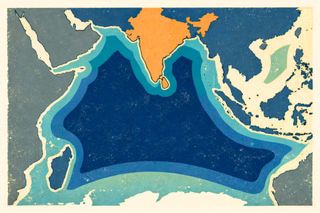
The Indian Navy's 2015 Maritime Security Strategy, Ensuring Secure Seas, includes a map of India's areas of maritime interest. The "Primary Area" covers the entire Indian Ocean, from the East African coast to the Malacca Strait, from the Persian Gulf to the waters north of Antarctica. The spot where the Dena was torpedoed sits at the heart of this map, not at its periphery.
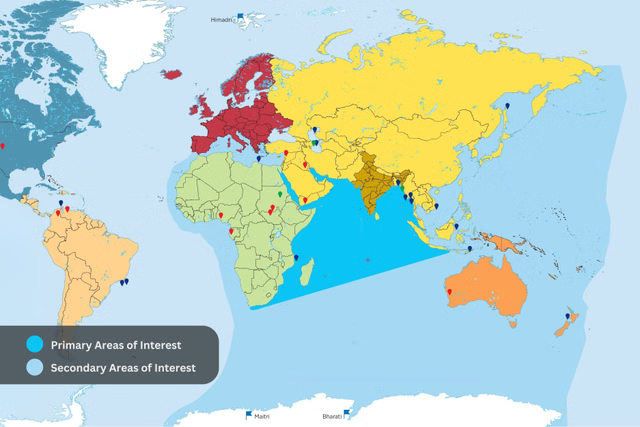
There is no honest way to deny that the Indian Ocean is India's backyard. India's doctrine says it is and India's geography confirms it. Denying this would be a convenient abdication. But acknowledging it does not mean every event in these waters demands an Indian military response. A primary area of interest is a statement of strategic priority, and strategic priorities require judgement about when to act and when to hold.
What India does and does not do in its own waters is itself a strategic choice, and the choice not to enter this war is the right one.
India's core interests — trade, energy, a navigable Indian Ocean — are best served by non-combatant status, regardless of how the war ends. Non-combatant status is itself India's most valuable strategic asset in this crisis, because every other major naval power in the Indian Ocean is compromised.
The US Navy is a belligerent, Iran's naval forces are being systematically destroyed, the Royal Navy has committed assets to supporting Washington, China is strategically aligned with Tehran, and Russia feeds Iran intelligence on American ship movements. India alone is uncompromised, and this is not an accident but the consequence of a deliberate posture.
The Gulf states that India has cultivated for over a decade are not looking for another combatant. A Saudi official said plainly on air that "America has abandoned us... leaving the Gulf states that host its military bases at the mercy of Iranian missiles and drones." What the Gulf needs is a partner whose presence provides stability rather than inviting retaliation, and India fits that description precisely because it is not a party to the war.
Iran, for its part, has been no friend of India. It has consistently interfered in India's domestic politics, particularly on Kashmir. Modi's silence on Khamenei's killing, his public solidarity with the UAE, and his recent address to the Israeli Knesset — "India stands with Israel, firmly" — are not neutral acts, even when they are autonomous.
India has chosen the Gulf and Israel over Iran, but choosing them does not require entering their war. The diplomatic choice is already legible to every capital in the region, and entering the war would only compromise it.
The Fleet Review
The Fleet Review itself is evidence that India already knows how to operate in this space.
India hosted 135 countries and showcased INS Vikrant on its first international outing since Operation Sindoor. The USS Pinckney, an American destroyer, withdrew at the last minute to redeploy towards the Iranian theatre, and the Royal Navy sent nothing. But the Dena came, and India simultaneously seized Iran-linked sanctioned tankers off Mumbai: a country hosting a belligerent's warship while enforcing sanctions against that same belligerent's shadow fleet.
When the war arrived, India extended the same logic: it offered the Dena safe harbour, docked the Lavan, deployed SAR assets, spoke to Tehran without condemning Tel Aviv or Washington, and operated by its own rules.
Nehruvian India would have issued a statement of high moral purpose. Post-Nehruvian India did what was operationally necessary and stayed silent where silence served it better, which is a more mature form of sovereignty.
The Hard Realities of Power
Beneath the restraint, there is a harder truth that Jaishankar himself gestured at. The "reality of the Indian Ocean" he described — Diego Garcia for five decades, Djibouti, Hambantota — is a reality of hard power, and India does not yet have the hard power that matches its doctrine.
The Chagos sovereignty transfer, championed by India is the most instructive example. Even the ICJ ruled in Mauritius's favour. Mauritius itself chose an Indian vessel to visit the islands. India's diplomatic investment was successful, right up to the moment it met American operational necessity. Trump killed the deal and Diego Garcia was used to bomb Iran. Every diplomatic victory India had secured was rendered inoperative by a single reality: the United States needed the base and had the power to keep it.
Consider, for perspective, a country with considerably more hard power. China asserts sovereignty over virtually the entire South China Sea, has the world's largest navy by hull count, and has built artificial islands with airstrips and missile batteries. And yet US Navy destroyers transit the Taiwan Strait routinely. When Nancy Pelosi flew to Taipei in 2022, Beijing responded with military exercises, not with a shot fired. China protests, shadows, but does not shoot.
This is not an argument that if China can't, India shouldn't. China's patience is rooted in a different calculation: it is building towards a confrontation it believes it will eventually win. India does not seek confrontation with the United States at all. But the comparison speaks to something Indians must be realistic about: the prevailing balance of power. If China, with its naval strength and territorial claims, calibrates when the US operates in its backyard, India's restraint off Sri Lankan waters is simply rational.
Caution is warranted for a further reason. No serious Indian strategist can look at this administration in Washington and conclude that this is a moment to test boundaries. Here is a president musing openly about seizing Canada, Greenland, Gaza, and the Strait of Hormuz; cataloguing American unpredictability under this regime is a tiresome exercise because the nature of what India is dealing with is self-evident. India has rightly recognised that engaging an erratic actor on his own terms is strategic recklessness. This particular moment in American power will pass, and India's task is to outlast it.
There is also a harder question circulating in strategic circles: did India know?
India and the United States share sensitive maritime data under the COMCASA and LEMOA pacts, raising the question of whether shared intelligence enabled the targeting. There is no public answer, and there may not be one. But India's calibrated response — the careful silence, the humanitarian action, the refusal to condemn — suggests a government navigating with more information than it can disclose, not less.
India's frameworks and diplomacy are not useless, but without the capability to enforce them they remain dependent on the goodwill of those with harder power, and goodwill, as Chagos demonstrated, evaporates the moment operational necessity demands it.
The hard currency in the Indian Ocean is sustained naval presence and the capability to act, and India is building both, slower than it would like, but building. The 'Net Security Provider' framework and the institutional architecture India has constructed over the past decade are not vanity projects to be mocked because they did not stop a submarine off Galle.
They are the scaffolding of the capability India is building, and they will matter more, not less, as this ocean becomes more contested. Hard power without regional trust is just another foreign fleet in someone else's waters, and India's institutional investments are what ensure that when the capability arrives, it will be welcomed rather than resisted.
So, the response to the Dena sinking, to Diego Garcia, to the war in India's waters, cannot be rhetoric alone. It must be to accelerate, quietly, the capability that will one day make the Indian Ocean, India's ocean, something others must reckon with rather than ignore.
"The rise of India will be determined by India. It will be determined by our strength, not by the mistakes of others."
What India does and does not do in its own backyard is a strategic choice, made on India's timeline, in India's interest, without the hysteria of a news cycle or the demands of those who confuse restraint with retreat.
The war in the Indian Ocean is not India's war to enter. But it is India's ocean to secure, patiently, strategically, and on terms that outlast the war itself.
Anmol N Jain is a writer and lawyer with a background in International Relations, Political Science, and Economics. He posts on X at @teanmol.
 Join our