Defence
Atmanirbharta vs. Imports In Defence Is A Non-Debate
Venu Gopal Narayanan
Mar 09, 2026, 10:34 AM | Updated 10:34 AM IST
The eruption of a fresh conflict in the Middle East on 28 February has brought into sharp focus an important debate which arose shortly before missiles began flying at Iran.
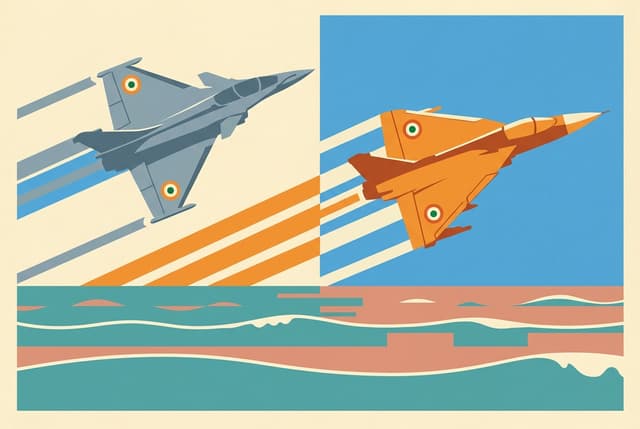
The defence corners of social media exploded indignantly last week when news emerged that India might be considering the purchase of a fifth-generation fighter aircraft, the Su-57, from Russia. This is a dark corner of the web, filled with some of the brightest, sharpest, most knowledgeable, and most patriotic individuals one could ever wish to meet. Their wit is as sharp as an urumi blade.
They received the news of the Su-57 with a mixture of disdain and trepidation: that this potential sale might affect the development of indigenous programmes, break the bank, and divert scarce funds, which ought to go for the procurement of desi kits, to costly imports from abroad. Doom-scrolling through the anguish and sarcasm, you would not be wrong in thinking that two squadrons of Su-57s had already landed at Gwalior and that the development of our own fifth-generation jet had come to a juddering halt.
Nonetheless, this unruly tribe cannot be ignored because it is they who meticulously use open-source intelligence to adeptly educate us on the realities of a formidably abstruse subject, and thumpingly counter nuanced, sinister narratives with facts and élan. They exist for a reason and do a heck of a lot of heavy lifting in the public domain for our government, exposing vested interests and calling out global "experts" whose intentions are maleficent to India. And their outburst had been brewing for some time.
It began in late 2025 with the news that India would purchase 100 Javelin anti-tank missiles and 216 Excalibur precision artillery rounds from America. This was followed over the next few months by reports of multiple intended Indian imports.
This long list included: 114 Rafale fighter jets from France, six P-8I Orion maritime surveillance aircraft from America, a memorandum with France to produce Hammer air-to-ground missiles in India, 288 missiles for our Russian S-400 air defence systems, five more S-400 systems, six Boeing 767-based mid-air refuellers from Israel, 12 airborne early warning and control (AEW&C) systems using Brazilian/French platforms, an $8 billion deal to buy a variety of missiles from Israel, and 36 French Meteor missiles for our Rafales in service.
Hot on the tail of this exhaustive list came more news: that Israel had offered a truly game-changing air-to-ground anti-radiation missile with a reportedly unmatchable standoff range of 800 km, the Golden Horizon, to India. And that does not even cover negotiations presently ongoing between India and Germany for six new submarines.
The 2026 Indian defence budget matched intent with rupee, with a record outlay of Rs 7.9 lakh crore, up 15 per cent from last year. And the capital expenditure proposed in it, the crux of our improvement in military gear, was Rs 2.2 lakh crore, a hefty 24 per cent increase year on year.
And yet, a worry persists that such costly foreign imports may affect the advancement of indigenous Indian weapons systems. The fears are not misplaced in some ways. For example, even though Indian radars and electronic warfare systems have evolved well beyond the French systems installed on the Rafales we purchased, it will not be possible to reverse-integrate our advanced systems onto these Rafales. This means that we are stuck with a platform whose key capabilities are decreasing in relative proportion to not just the systems being developed by India, but those of our enemy as well.
The Virupaaksha radar set to be installed on our Sukhoi-30 MKI jets is, to put it mildly, a beast in comparison. While the Rafale's radar is built with gallium arsenide transmitters and receivers, the Virupaaksha will have powerful next-generation cutting-edge gallium nitride modules. That is a generational leap by an order of magnitude in both sensor technology and electronic warfare capabilities.
Similarly, and equally pertinently, the manner in which numerous air defence systems in the Middle East were tested this week, and the efficacy of their responses under heavy fire from a plethora of missiles and drones, naturally brings into question the formidability of Indian air defence systems under similar conditions.
It is now becoming increasingly clear from OSINT satellite imagery that a number of American air defence systems were unable to weather the Iranian barrage. Radars, radomes, and associated buildings and structures were destroyed or damaged in at least a dozen locations across six Arab nations. Civilian areas in Israel have also been hit. We can discount the Iranian side since the majority of their air defences were hit and destroyed last year.
The bare fact is that current Indian air defence systems would be pushed to the limit to counter similar barrages. On the offensive front, questions are being asked about the status of India's LUCAS kamikaze drones like the Sheshnaag-150: Low-cost Uncrewed Combat Attack Systems which are deployed in large numbers to overwhelm defensive electronic systems through a saturation strike. Some analysts believe that we are not yet where we should have been on this front, and now worry that the Indian government's response will be to go for bulk imports off the shelf, even as indigenous programmes take their own sweet time to mature.
So, is the alarm justified?
We have to understand first that our military-industrial complex was wrecked soon after independence by socialism, naïve pacifism, and an absence of strategic thinking. And this dire predicament was kept that way for the next seven decades, for reasons that require no recounting here.
Yes, the Integrated Guided Missile Development Programme was launched in the 1980s, spawning multiple periodic successes. And yes, the Vajpayee government did try to fuse strategic thinking with long-term plans for research, development, and indigenisation, but there was only so much a fragile coalition government could do.
In any case, much of that received a setback during the lost decade of 2004–2014, as a result of which, instead of concretising the achievements of the previous decades, national security and defence procurement were left to hang solemnly in a dangerous limbo.
Thus, it was only from 2014 onwards that past learnings in manufacturing military equipment in India could be mated with what the nation required to defend its national interests. You needed a sizeable popular mandate if you were to enforce truly radical change in as delicate a sphere as defence, where, for almost all the time since 1947, sequential governments had failed to tame the influence of vested foreign interests on our core strategic decision-making. Like oil, the videshi arms bazaar set the rules for our desi needs. It is a point which Prime Minister Modi repeatedly touched upon during the early years of his tenure.
Even then, the paradigm shift could not be begun in earnest because of the shambolic state our economy was in in 2014. That had to be fixed before we could find the money for an aggressive, judicious weapons indigenisation programme.
To add to our woes, persistently hobbling the new government's efforts to fix something as central as the securing of our national security and interests, was the bane of reckless welfarism and lavish spending on subsidies and handouts which kept poor people poor and nothing else. And because this phenomenon has comprehensively permeated every inch of our electoral space and become a fundamental right in the most egregious of ways, it meant that sizeable funds could not be released for defence procurement without triggering political suicide.
That opportunity finally arose only by the time of the 2019 general elections, when the positive impact of the Jan Dhan accounts–Aadhaar–Mobile triangle and the institution of direct benefit transfers started becoming increasingly evident across the country. Welfare schemes like Ladli Behna, which are frequently underscored as wasteful expenditure that ought to have been diverted to defence spending, are the political reality of our times. They cannot be wished away any time soon. But then came the pandemic, setting back plans by two years. Which meant that a material, forceful push for atmanirbharta in defence could commence only by the time of the 2024 general elections.
As predicted by this writer in 2022–23, things have now started to come together. Our military-industrial ecosystem is firmly on the blossom at last. A few fruits, like the Tejas fighter jet, cutting-edge electronics, and a stable of new missiles, have ripened. Large orders have now started going to Indian companies for military equipment, including something as vital and relatively low-tech as bulletproof jackets for our troops. A home-grown jet engine, the holy grail of defence technology, still eludes us, but it is only a matter of time. The recent launch of a National Aero Engine Mission is indicative that our fighter jets will be flying on home-made engines within a decade.
But, for all that, we are not out of the woods yet. Thus far, this government has only drained a fetid swamp. The actual results of a push for atmanirbharta in defence will become evident only in the coming decade. Consequently, we have no option but to plug sizeable gaps through expensive imports for the time being. That is another reality we have to resign ourselves to.
Further, India is presently on a massive buying spree not because the progress of crucial projects has slowed down (they have not), but because our revised threat perceptions demand that a few crucial lacunae be addressed. We are stocking and rearming because, after the serial crises of Uri–surgical strikes, the Doklam plateau standoff, Pulwama–Balakot, the Galwan skirmish where Indian troops were killed, and Pahalgam–Operation Sindoor, the next episode is only a matter of time away.
This stockpiling is necessary for our military to withstand saturation barrages and to conduct surge operations during a major conflict. Indeed, we may very well see more of such large import orders in the coming financial year. After all, with the way things are in our region, no one can rule out a "hot" summer along the border; certainly not after a major terrorist plot by Lashkar-e-Taiba was ably foiled by Delhi Police last week, leading to the arrest of multiple terror accomplices in Tamil Nadu and West Bengal. The current status of Operation Sindoor is rightly a pause and not a conclusion, because the enemy is never going to change its belligerent stance towards us.
Add to that the severe trade disruptions we have been forced to face since the Russia–Ukraine conflict began in early 2022, the increasing burdens of securing our vital sea lines of communication, and our swiftly growing responsibility to secure the peace in our region, and the pattern of our recent intent to procure sizeable defence platforms and missiles from abroad becomes clear.
Thus, we see that atmanirbharta in defence versus purchases from abroad is not a binary because the two are not mutually exclusive. Foreign procurements are neither victories for "Import Bahadurs" nor portents of defeat for domestic programmes. And they are certainly not a sign of desperation or weakness on the part of the government.
Rather, both are complementary, necessary, pragmatic, a doleful reflection of legacy issues, and a recognition of the grave dangers we face. This government is not asleep and is seized of such threats better than any commentator. Indeed, it is quite possible that the AMCA programme, India's flagship project to build a latest-generation fighter jet, may be progressing faster than we think. Analysts are sensitive to silences, and like the secretive Shaurya missile programme, there is very little material information on the AMCA in the public domain. That means something.
A conclusion is best offered by Israeli President Benjamin Netanyahu, who recently proposed a "hexagon of alliances" across the Middle East and beyond, with, in his words, "global power" India as its cornerstone. This means that both atmanirbharta in defence and imports of military goods from abroad will progress in tandem, as India evolves into its destined role of a primary security provider for the Indian Ocean region. There is no contradiction.
Venu Gopal Narayanan is an independent upstream petroleum consultant who focuses on energy, geopolitics, current affairs and electoral arithmetic. He tweets at @ideorogue.
 Join our