World
Oil, Gas, and Leverage: The Quiet War America Is Already Winning Against China
Venu Gopal Narayanan
Mar 07, 2026, 07:00 AM | Updated 11:12 AM IST
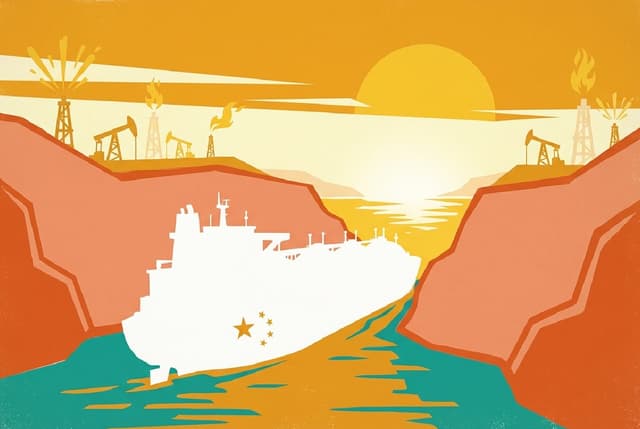
A fresh conflagration in the Persian Gulf last weekend has disrupted the global energy trade and severely affected many economies around the world. Iranian attacks on energy infrastructure in the Middle East, and their unilateral closure of the Strait of Hormuz, mean that a fifth of the world's oil and liquefied natural gas (LNG) supplies is now stuck in the Gulf. Both tactics are a ploy by Iran to force America and Israel into ending their attacks swiftly. As a result, stock markets have fallen sharply, currencies have weakened, and supply shortages loom globally.
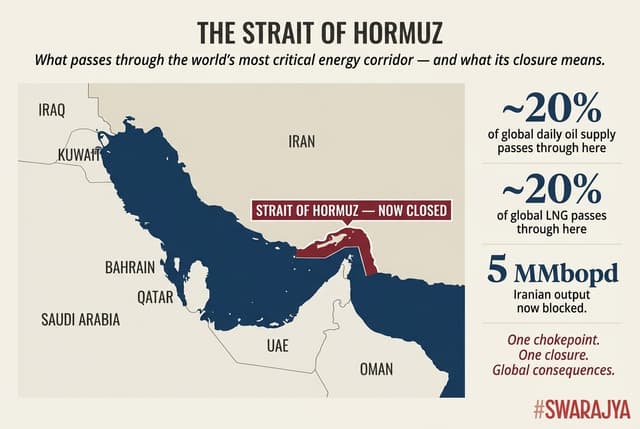
The world did not need this, burdened as it already was by a sluggish exit from the pandemic and the disruptions caused by an ongoing, four-year-old Russo-Ukrainian war.
The worst affected country is China, because it used to purchase the bulk of Iranian oil production — around 4 million barrels per day (MMbopd). Official and industry figures are much lower, but it is also a fact that Iran produces slightly under 5 MMbopd. This includes around 1 MMbopd of low-grade Iranian crude on the grey market for Chinese teapot refineries, a figure which neither government will ever confirm or deny. Half of China's oil imports flow from the Persian Gulf.
This blow comes on the back of America seizing control of all Venezuelan hydrocarbon resources. Venezuela has traditionally supplied sizeable volumes to China, and Beijing had entered into a long-term strategic partnership with Caracas hardly a month before American president Donald Trump ordered the abduction of the Venezuelan president and took control of its petro-economy. Note that until America began turning the screws on Venezuela almost a decade ago, it was producing 2.5 MMbopd and was a major oil exporter.
The Chinese cannot, therefore, be faulted for thinking that this attack on Iran was done, in part, to take 5 MMbopd off the Chinese import market, forcing them to consider American-controlled options of supply like Venezuelan crude or American shale oil. And maybe that is the game here, because Donald Trump knows that since he cannot tariff China into submission, the only way he can reduce America's trade deficit with China is by selling the Chinese bulk American products like crude oil.
However, in the present circumstances, China's graver problem is not actually crude oil but natural gas. Until 2010, China relied on its domestic gas fields for its gas needs. Production matched consumption. But when Chinese demand for gas grew sharply, it had no option but to start importing gas.
Initially, the majority of Chinese gas imports was piped gas from Russia, but today, 60 per cent of its gas imports are seaborne LNG, of which one quarter is sourced from Qatar, in a now-blocked Persian Gulf.
With half its oil imports and a quarter of its gas imports presently blocked, China must be livid because America has temporarily pinned it to the mat. No doubt, China may be able to manage some increase in piped gas imports, some LNG by hefty outbidding of other buyers, some increase in domestic production (which has been ramping up in the past five years), and a trimming of consumption, but this is unsustainable for any extended period of time.
The LNG sector, unlike oil, is built on long-term plans and purchase agreements, not spot purchases. For example, Saudi Arabia can swiftly increase oil output by 15–20 per cent, but a major LNG exporter like Qatar cannot, as the lead time for ramping up export volumes takes years.
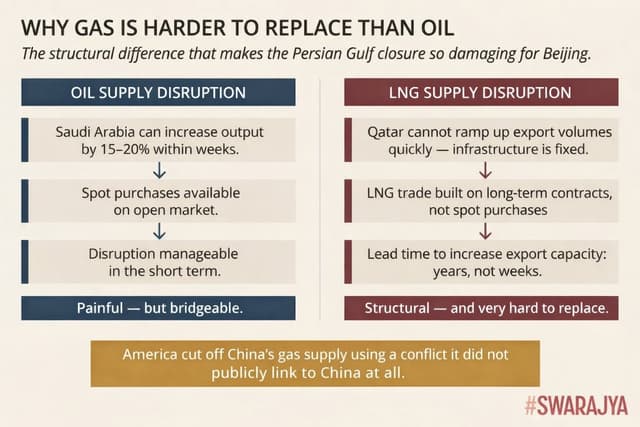
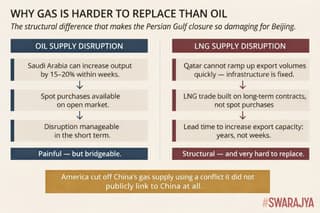
Even America, the world leader in LNG exports, cannot spare the volumes to match China's urgent requirements since it is so heavily committed elsewhere, especially to Europe, which is facing alarming gas shortages at present. America cannot redirect an LNG shipment to China without hurting its other buyers; at best, it can indulge in the odd token sale to make a puerile geopolitical point.
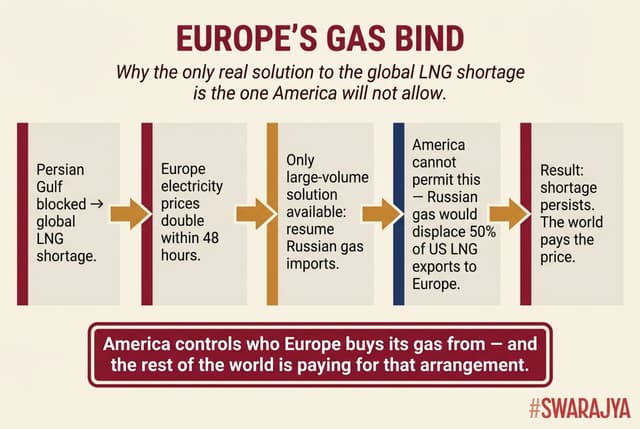
Today, the only way meaningful volumes of LNG can be freed up to meet the current global gas shortage caused by this conflict is if Europe revolts against its trans-Atlantic master and resumes gas (and oil) purchases from Russia at pre-2022 levels. And it is coming perilously close to that, because Europe is still in the midst of winter, a time when gas is required the most. Within two days of the Persian Gulf conflict erupting last weekend, electricity prices in Europe spiked painfully to around double, and the continent is now staring at galloping inflation.
But would America permit a resumption of gas flow to Europe from Russia? That is hardly likely, because it would gravely impact its own gas sales to Europe (50 per cent of American LNG exports), and, more pertinently, undo America's basic strategy of containing Russia. They cannot have their way, and the world is paying the price for this absurdity.
So, where does that leave China?
Strangely, this crisis has created a rare moment when China's core strategic interests are temporarily aligned with India's. Together, the two giants import more oil and gas than any other jurisdiction on earth, including Europe. Together, they can mitigate the prevailing critical shortages and ensure that such episodes do not recur in the future. But would China be willing to work with India? It is a question for the ages, and an eventuality the Russians have been yearning for years.
We ask this because, if such an acute crisis could be so easily perpetrated, and short of using its navy to break the present impasse, there is very little China has been able to do about it thus far, save garner a few gas shipments at expensive premiums — then what? The bottom line here is that America has successfully turned the screws on China without touching the South China Sea, and without ever stating that the China angle was indeed one of America's reasons for attacking Iran.
The Persian Gulf conflict is a painful lesson for Beijing, as indeed for other economies. But the one thing China needs to understand is that logic dictates such an episode could come to pass again, and again. And each time, China would find itself at the mercy of the very nation it perceives as its principal adversary — America. What value, then, for China's eternal efforts to hobble India in active alliance with its iron brother, Pakistan? That relationship, and that belligerent strategy, would have zero meaning when America once again demonstrates its ability to indirectly inflict severe pain upon China and hobble it.
Or would China read the tea leaves right and say that they are capable of weathering what is, in their inference, only a passing storm? Why make up with India then? More JF-17s to Rawalpindi, instead. After all, no one can reject the real possibility that the Gulf crisis might decrease in intensity soon. Reinforcing this view is recent official news from America that sanctions on Russia have been eased, thereby permitting India to purchase Russian crude oil without bringing the Indo-American trade deal into conflict. The guffaws in foreign offices around the world over this volte-face would likely leave American diplomats with red faces for some time to come.
This is an inflection point in China's strategic calculation. And yes, like most others, this writer too is of the impression that the likelihood of any Sino-Indian thaw seems low at present. Why would they budge even a bit from their rigid stance when they are so heavily invested in an anti-India strategy? Perhaps they do not even see a connection between their present energy crisis and their outlook towards India. Also, a mandate of heaven still drives the Middle Kingdom, even if it is ruled by Communists.
Perhaps so, but the logic of the moment suggests that if China were to forgo this rare opportunity, it would be a fatal strategic error which will cost China dearly in times to come.
Why do we say that? Look at the logic: if India and China were to consider détente, it would be contingent upon a reduction of Chinese support to Pakistan. If that happens, then Pakistan is, for all practical purposes, finished. Or, to put it in more elegant terms, it would mean an easing of the two-front threat to India.
However, if India and China do not enter into a détente, India will still do what is needed to counter the two-front threat, leaving Pakistan up a creek without a paddle. Thus, if the outcome is the same in either scenario — if Pakistan is going to receive the harsh end of the stick in any case, whether there is a thaw in Sino-Indian relations or not — then does logic not dictate that it is more profitable for China to work with India rather than against it?
The inference, thus, is that the onus of any thaw rests solely upon China, because India has zero expectations from China and no geopolitical need to mend ties with Beijing. India has learnt to live with a two-front threat, and soon will be in a position to negate it. We are building our own string of alliances and an indigenous ecosystem with which we will secure our interests on our terms.
In conclusion, the ongoing conflict in the Persian Gulf demonstrates equally to America and China that you cannot have your cake and eat it too. Both nations need to consider a strategic reset in their geopolitical outlook — China more than America — if they are to avoid getting embroiled in strategic quagmires of their own making.
Venu Gopal Narayanan is an independent upstream petroleum consultant who focuses on energy, geopolitics, current affairs and electoral arithmetic. He tweets at @ideorogue.
 Join our