Bihar
Bihar 2025: Deciphering NDA's Majestic Sweep And INDI Bloc's Collapse
Venu Gopal Narayanan
Nov 25, 2025, 03:49 PM | Updated 03:49 PM IST
Election results in Bihar are probably the most difficult to analyse because coalitions rarely stay the same for two elections in a row. The 2025 assembly elections in Bihar were won by the National Democratic Alliance (NDA) led by the Bharatiya Janata Party (BJP), the Janata Dal (United) (JD(U)) of Chief Minister Nitish Kumar, the Lok Janshakti Party (Ram Vilas) (LJP) of Chirag Paswan, the Hindustani Awam Morcha (Secular) of Jitan Ram Manjhi, the Rashtriya Lok Morcha (RLM) of Upendra Kushwaha and one independent.
Arrayed against them was the INDI Alliance consisting of the Rashtriya Janata Dal (RJD) of Tejashwi Yadav, the Congress, the Left parties and a clutch of small parties. A third force, restricted to Muslim-majority areas, was the All India Majlis-e-Ittehadul Muslimeen (AIMIM) of Asaduddin Owaisi.
We cannot compare these results to the assembly elections of 2020 because the LJP contested against the JD(U) even though both were members of the NDA. As a result, we are forced to compare these elections to the 2024 Lok Sabha elections (at the level of assembly segment leads) when the coalitions were broadly the same.
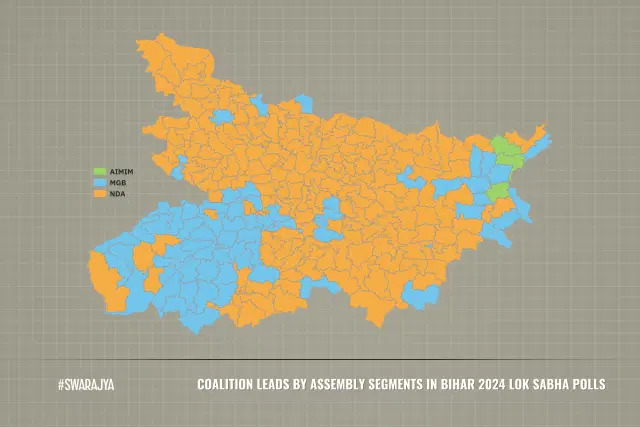

In 2024, the NDA led in 175 of 243 segments, well above the halfway mark of 122. But it won only 29 of 40 Lok Sabha seats, dropping down nine from the sweep of 2019. All these nine losses went to the INDI alliance, with the RJD winning four, the Congress three and the Maoists two.
The bulk of the damage to the NDA was done in southwest Bihar where, among other factors, a sizeable portion of the Dalit vote shifted to the INDI alliance. The NDA’s response was to initiate a massive grassroots outreach programme, quietly led from the front by the Rashtriya Swayamsevak Sangh (RSS), and strongly supported by dozens of Sangh-affiliates. The bad blood between the JD(U) and the LJP was also resolved, thereby permitting a smooth seat-sharing process this year. This was bolstered by two factors.
First, Prime Minister Narendra Modi ran a blistering campaign across the state. Second, the INDI alliance ran a listless, vacuous campaign in which they had nothing concrete to offer in terms of either policies or programmes, except their staid old bromide of identity politics.
The results were unexpectedly spectacular with the NDA winning 202 of 243 seats. The INDI alliance slumped to a paltry 35 seats, down 31 from the 66 segments they led in during 2024. Interestingly, 14 of the INDI alliance’s 35 wins were gains from 2024. Compared to the last assembly elections of 2020, the RJD lost 50 seats, falling to 25, and managed to retain the official title of principal opposition party by a solitary seat.
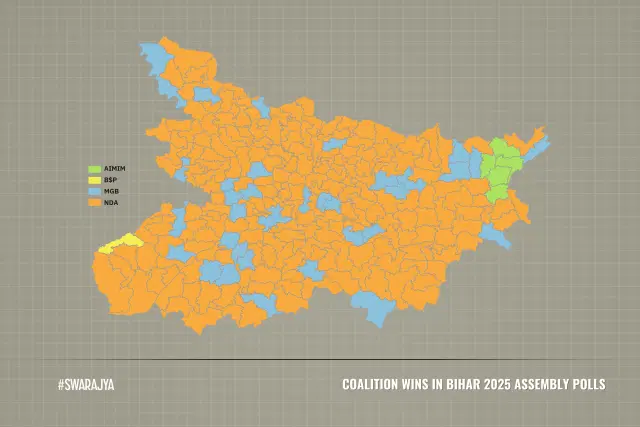

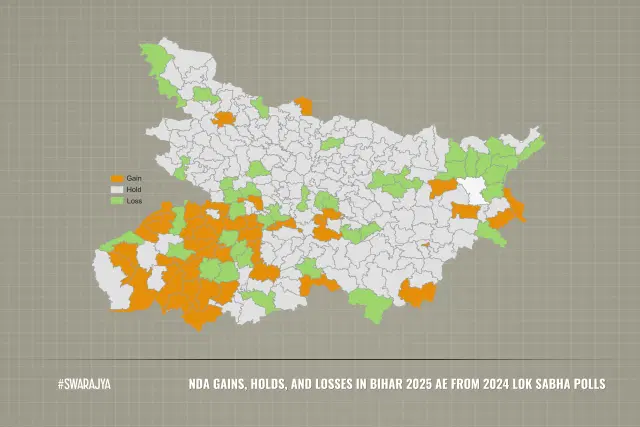
The harshest blow to the INDI alliance was delivered by the voters of southwest Bihar who voted overwhelmingly for the NDA. The true magnitude of this electoral carnage becomes apparent when we realise that of the 35 seats they won, 14 were gains, mainly from other parts of the state. But for that saving grace, the RJD might even have been humiliatingly reduced to the low teens. A gains map of the NDA in 2025 shows this clearly.

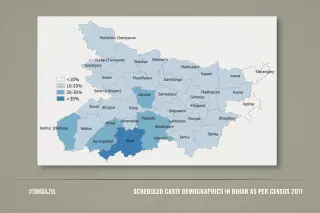
And as a Scheduled Castes demographics map of Bihar below shows, a shift of votes to the NDA was led from the vanguard by Dalits, most forcefully in southwest Bihar where they are more heavily concentrated, with a ripple effect spreading across the rest of the state.

It actually gets worse for the RJD. Five of their ten firewall seats, which they had won back-to-back in the assembly elections of 2010, 2015 and 2020, went to the NDA. The implications for the RJD are severe. Such losses show that a part of the Muslim-Yadav axis has been broken, with Yadavs, traditionally staunch loyalists of the RJD, now shifting their votes to the NDA in meaningful numbers.
Worst of all, the RJD’s weakening in 2025 even cut across secular lines, with the AIMIM winning all five seats where their legislators had been poached by the RJD. The irony is unmistakable. Perhaps Tejashwi Yadav can take heart from the fact that the RJD performed better than Prashant Kishore’s Jan Suraaj Party, heralded by the media as the next best thing since sliced bread, which promptly sank without a trace.
Very pertinently, Akhilesh Yadav and his Samajwadi Party should take heed of this development because, if the Muslim-Yadav axis can be broken in Bihar, and that old Laloo magic finally begins to wane, then Uttar Pradesh is next on the BJP’s anvil.
There is little to be said about the Congress because it ceased to be a political force in Bihar 40 years ago. Their leader Rahul Gandhi’s monsoon Yatra across Bihar seems to have had negligible impact on voters. It is doubtful if the party will ever revive in this state as long as a Gandhi family member is at the helm of affairs.
All in all, the results are great news for the people of Bihar, who may now begin to hope in earnest that the advent of investment, industrialisation and infrastructure is finally on the cusp.
Venu Gopal Narayanan is an independent upstream petroleum consultant who focuses on energy, geopolitics, current affairs and electoral arithmetic. He tweets at @ideorogue.
 Join our