Bihar
How INDI Alliance Lost Bihar: The Five Fault Lines That Broke the Alliance
Abhishek Kumar
Nov 19, 2025, 10:24 AM | Updated 01:32 PM IST
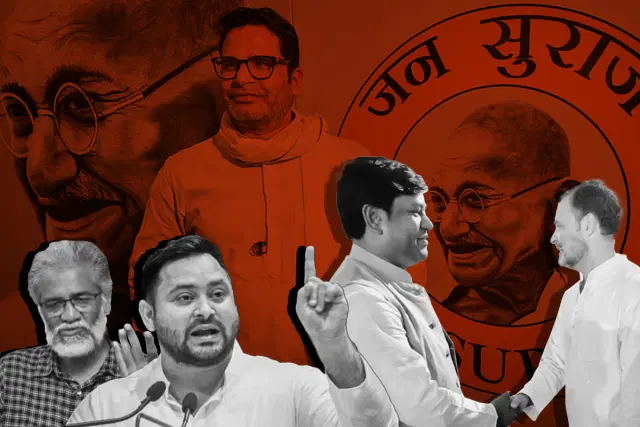
The results of the 2025 Bihar assembly elections vindicate the prevailing narrative that one credible statesman can trump the united opposition.
Mahagathbandhan, the coalition comprising Rashtriya Janata Dal (RJD), Indian National Congress (INC), Mukesh Sahani led Vikassheel Insaan Party (VIP), a group of left parties and Indian Inclusive Party (IIP), secured only 35 seats out of 243, while the National Democratic Alliance (NDA) emerged victorious with 202 seats.
Even in demographically advantageous regions like Magadh and Seemanchal, the Mahagathbandhan was harmed by the Asaduddin Owaisi led All India Majlis e Ittehadul Muslimeen (AIMIM). The alliance secured only one seat, Kishanganj, where Muslims are in an electorally decisive majority.
In the Magadh Shahbad region, the Mahagathbandhan lost 39 seats, which was 31 more than its 2020 tally, out of 48. Trends across other regions remained broadly similar.
For short term observers, the result was not a surprise, except for the scale of the NDA victory. However, it is important to note that the Mahagathbandhan did not begin its strategy with a deficit, nor did the NDA have a significant narrative lead for more than 90 per cent of Nitish Kumar’s 2020 to 2025 tenure.
In fact, if anything, the last five years of Nitish Kumar’s administration were widely seen as the most inefficient in his 20 year tenure. Corruption, highlighted by collapsing bridges, brought a poor reputation to the state, while the speed with which criminals committed offences hinted that the Chief Minister had lost his sheen.
It is beyond doubt that anti incumbency towards Nitish Kumar existed among the masses. These problems were amplified by the persistent inaction of elected representatives belonging to NDA constituents.
However, this social and economic opposition was not capitalised upon by the main political opposition, which ultimately led to a division of opposition votes. One umbrella reason explains why the opposition failed: complacency. For instance, they treated social media traction and rally crowds as votes, which was evidently a false assumption.
The confidence gained from such brittle indicators drove them to commit several errors that led to a devastating loss. Here are some of them.
Deviation from local issues
Just after the Election Commission of India (ECI) announced a Special Intensive Revision (SIR) exercise to smoothen the voting process, the Mahagathbandhan sought to consolidate the votes of Muslims and backward castes in its favour. The rationale behind this was that due to limited documentation, poorer communities may face hardship and could therefore be galvanised.
The thought process was sound, but the implementation was haphazard, random, decentralised, and ultimately faulty. Rahul Gandhi and the INC machinery began projecting it as his own pet project rather than a shared effort with Tejashwi Yadav, the Chief Ministerial face of the Mahagathbandhan.
In the name of alliance unity, Gandhi also ensured that Pappu Yadav received respect and shared the stage with Tejashwi Yadav. Both Yadavs had an acrimonious past, and Gandhi was credited with uniting them. He also called high profile faces such as Telangana's A Revanth Reddy, Tamil Nadu's M K Stalin, Karnataka's Siddaramaiah, Himachal Pradesh's Sukhvinder Singh Sukhu, Jharkhand's Hemant Soren and the Samajwadi Party’s Akhilesh Yadav.
Tejashwi Yadav had sensed even before the campaign escalated that the Congress was positioning itself for its own branding. The scale of its later interventions confirmed this suspicion and deepened his irritation. This explains why RJD leaders, including Tejashwi Yadav himself, recommended two corrective measures: declaring Tejashwi Yadav as the Chief Ministerial face and raising local issues such as migration, unemployment, and rising crime.
Gandhi, other INC leaders and non local political leaders rejected these suggestions. In a widely circulated video, Yadav was heard asking Gandhi to raise these issues, but Gandhi did not oblige.
As a result, by the time the SIR exercise reached maturity, the Mahagathbandhan failed to establish its fear psychosis narrative, even though RJD and left parties’ cadres fully mobilised. The problem was worsened by the remarkable efficiency of the ECI, which left little scope for exploiting administrative gaps.
At the end of the SIR exercise, only the RJD and the left parties were aligned, while the INC had grown emboldened against the RJD. The VIP, led by Mukesh Sahani, which had allegedly been promised significant influence in seat sharing by Tejashwi Yadav, chose not to take sides in the intra alliance conflict, which escalated during ticket distribution.
The alliance fight
The tussle over seat distribution began immediately after the SIR exercise. Based on its past performance and the presence of a probable Chief Ministerial face, the RJD demanded over 150 seats, at least six more than its 2020 tally of 144. Left parties, buoyed by their strike rate and cadre strength, pushed for forty seats, while VIP leader Mukesh Sahani initially demanded 60 seats and a Deputy Chief Minister position.
In Patna’s political circles, it is widely believed that the unrealistic VIP demand of more than 50 seats was a tactic by Tejashwi Yadav to weaken the INC after Krishna Allavaru, the Congress state in charge, took steps to revive the party. Gandhi is believed to have retaliated by making the anti SIR campaign revolve around himself and his slogan of vote chori.
Meanwhile, the INC refused to concede ground and continued demanding more than its 2020 tally of 70 seats. Sahani also saw a chance to expand his influence despite the political realities. These complications intensified Tejashwi Yadav’s frustration, particularly with alliance members, especially the INC, refusing to declare him the Chief Ministerial face.
Yadav stopped campaigning and remained in his residence for two weeks during a crucial phase of the campaign and ticket distribution. The ticket distribution drama continued until the final hour of nominations. Many likely candidates were called for symbol allocation but never received them, while others withdrew after filing nominations.
INC candidate Satish Kumar withdrew from Warisaliganj in Nawada, clearing the way for the RJD nominee, while Tauqeer Alam withdrew in Pranpur. VIP’s Bindu Gulab Yadav stepped aside in Babubarhi (Madhubani), enabling the RJD to contest alone. INC’s Aditya Raja withdrew from Lalganj in Vaishali to avoid clashing with RJD’s Shivani Shukla.
However, eleven seats namely Vaishali, Rajapakar (SC), Bihar Sharif, Bachhwara, Beldour, Kahalgaon, Sultanganj, Chainpur, Sikandara (SC), Karahgar and Narkatiyaganj, witnessed unavoidable friendly fights between alliance partners.
Due to Tejashwi Yadav’s pressure in ticket distribution, the INC ended up with 61 seats, 30 of which were not alliance strongholds, while nine had friendly fights. Moreover, the RJD demanded Kutumba, the INC state president’s seat, weakening his prospects.
VIP’s Mukesh Sahani suffered reputational damage, receiving only 15 seats, four of which were considered unwinnable. In Gaura Boram, Mukesh fielded his brother Santosh Sahani, against whom the RJD fielded Afzal Ali Khan. Hours before polling, Santosh withdrew and supported Khan, which VIP supporters viewed as humiliation.
The Left, however, remained accommodating and committed to its ideological goal of defeating the BJP and its allies. Its prospects were nonetheless damaged by corruption allegations against its 2020 winners.
Mukesh Sahani factor
The second most damaging part of the alliance conflict was Tejashwi Yadav’s tussle with Mukesh Sahani, who began his political career as the leader of the Nishads, who comprise around 9 per cent of the state’s population, as per Sahani’s calculations of various sub castes. Nishads and other riverine castes fall under the category of extremely backward classes (EBCs) in Bihar. Sahani’s long standing demand has been their inclusion under Scheduled Caste status.
However, for a considerable period, Sahani has described himself as the “son of EBC” rather than simply the “son of Mallahs”. Hindu EBCs comprise over 25 per cent of the state’s population, expanding his appeal. He currently seeks to capture the EBC space that may open after Nitish Kumar’s likely political exit.
But due to fragmentation within VIP, which left Sahani with a strong ground presence but limited representation, he sought a Deputy Chief Minister post and at least 30 winnable seats. Tejashwi Yadav kept reducing this number, ultimately agreeing to 15, a quarter of which were compromised seats.
During the campaign, Tejashwi Yadav and the RJD largely sidelined Sahani and his cadre. A section of EBCs and the entire Nishad community withdrew support from the Mahagathbandhan, with their decision formally announced in Kaimur district.
EBCs not joining hands with Yadavs
Although VIP’s humiliation played a role, the larger reason why EBCs did not support the RJD and its allies lies in the historical leakage in the RJD vote bank, which Tejashwi Yadav could not address.
EBCs voted for Lalu Yadav’s leadership in 1995 AE. Experts described this as the “Jinn out of the bottle”. In the same year, Nitish Kumar reportedly said he would harness this Jinn to oust Yadav in the future, which he eventually achieved.
In Bihar, it is now widely accepted that EBCs and Dalits were the worst affected in the violent conflict between backward and forward castes. Often used as foot soldiers in social justice battles, they were never given leadership roles in the new political order dominated by non forward communities.
As the social hierarchy shifted, their interests were compromised in favour of more vocal and already dominant communities. When the dust settled, EBCs were worse off than they were before the 1990s.
They first rallied around Nitish Kumar’s welfare initiatives that provided education and basic necessities. Later, Prime Minister Narendra Modi consolidated them through direct benefit transfers, housing programmes and other welfare schemes. Among EBCs, Kumar and Modi are seen as a genuine double engine government.
For the RJD, securing this voting bloc is essential. They begin with nearly one third of the electorate through Yadav and Muslim votes. Adding even 30 per cent of EBCs would provide both a numerical and narrative breakthrough, almost guaranteeing victory.
However, social friction with the RJD cadre has prevented this combination. When confronted with a choice between emerging neo feudal actors and those labelled as historically feudal, an image increasingly unsupported by evidence, EBCs have chosen the option that offers stability, predictability and tangible welfare.
Nitish Kumar strengthened this further by giving 22 tickets to EBC candidates, the highest among all parties. This prevented fragmentation among the 112 EBC sub castes.
While the Mahagathbandhan continued making mistakes, another wave was rising in Bihar that the alliance failed to anticipate.
PK factor
When Prashant Kishor began appearing in television and YouTube interviews on local media platforms, he quickly became a major ratings attraction, earning the label of narrative setter.
After targeting Tejashwi Yadav, Kishor launched a strong attack on Nitish Kumar’s governance. In Kishor’s view, Bihar was experiencing another phase of Jungleraaj, driven by lawlessness and bureaucratic corruption. With incidents such as the killing of businessman Ashok Khemka, gang wars inside Patna’s Paras Hospital and viral videos of shootings, Kishor intensified his critique.
However, two technical issues weakened his claims. Firstly, except for the Paras Hospital incident, most crimes stemmed from personal rivalries. Secondly, no one reported fear of travelling after dusk. These factors led voters to dismiss the Jungleraaj label as exaggerated.
Tejashwi Yadav saw an opportunity to counter the RJD’s association with Jungleraaj. He released crime bulletins and expressed genuine concern.
This changed the course of the campaign. Under these posts, people began recalling horrific incidents from his parents’ rule. The BJP IT Cell noticed this and accelerated the campaign. By the campaign’s end, PM Modi and senior leaders repeatedly referenced those dark years during public rallies.
The script flipped quickly. The NDA’s communication strategy turned anti Nitish sentiment into anti RJD sentiment.
However, anti incumbency cannot be fully erased, which is where the PK factor mattered. Voters unwilling to support the NDA had two alternatives: the Jan Suraaj Party (JSP) and the RJD.
Data shows that in 35 constituencies, JSP’s vote share exceeded the victory margins, meaning JSP indirectly split anti incumbency votes. This writer estimates that 80 out of 100 migrant anti incumbent votes went to JSP, while 20 went to the Mahagathbandhan. Among those living in Bihar, the ratio reversed.
Ultimately, Bihar’s voters were not driven by nostalgia, fear, caste arithmetic or emotional mobilisation. They were driven by a cold assessment of stability, delivery and coherence. Prashant Kishor offered part of that equation but could not inspire confidence.
He sowed the seed, the Mahagathbandhan tried to harvest the fruit, but it was the NDA that ate it. The NDA, despite its weaknesses, appeared more predictable than an opposition bloc consumed by internal conflicts, confused messaging and tactical complacency.
Abhishek is Staff Writer at Swarajya.
 Join our