Bihar
How Nitin Nabin's BJP Is Sealing Nitish Kumar's Exit Options
Abhishek Kumar
Feb 25, 2026, 01:48 PM | Updated 01:48 PM IST
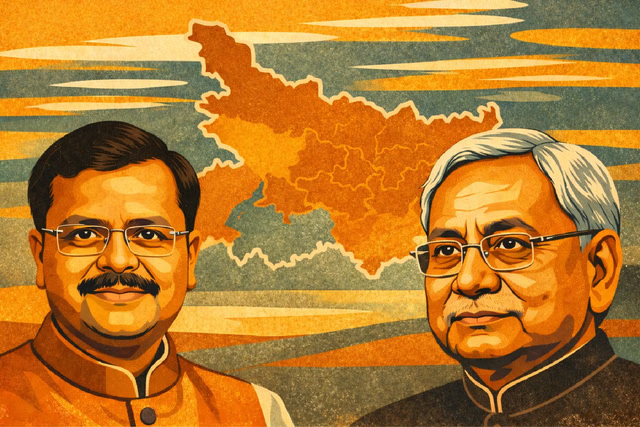
On 10 February 2026, Nitin Nabin walked into the Bihar Legislative Assembly for the first time since becoming the National Working President of the Bharatiya Janata Party (BJP).
He was escorted by BJP MLAs chanting Bharat Mata Ki Jai. Both Deputy Chief Ministers, Samrat Choudhary and Vijay Kumar Sinha, were present. Coalition partner Janata Dal (United) (JDU) was left to watch the scene unfold.
Prem Kumar, the Assembly Speaker, called Nabin's ascent a matter of pride for Bihar. Vijay Kumar Chaudhary, a senior JDU minister, called his elevation a natural choice. Nabin spoke for fifteen minutes, praising both Prime Minister Modi and Chief Minister Nitish Kumar for Bihar's transformation over two decades.
The overall display lasted 45 minutes, for the entirety of which, Chief Minister Nitish Kumar, the man often hailed as close to Nabin's family, was not inside the House.
Rather than reading it as a scheduling issue, his absence is seen as more of a growing concern regarding the BJP trying to overshadow JDU.
The Bridge Builders
Nabin's active presence in Bihar signals something different from the old model: a Modi-Shah appointee now in de-facto command of local units, rather than a homegrown BJPian confined to Patna's power circles and content to negotiate on the party's behalf. This is where the architecture of the BJP-JDU combination departs from a three-decade-old tradition.
For three decades, the BJP-JDU (earlier Samata Party) alliance in Bihar functioned through a specific category of bridge leaders. These were figures who could operate in the BJP's RSS-rooted organisational culture and simultaneously navigate Nitish Kumar's deeply personalised style of governance. They existed because the gap between the two cultures was real, and someone needed to manage the voltage.
The most prominent archetype was the late Sushil Kumar Modi. Born in 1952, a product of the JP Movement, the same forge that produced both Nitish Kumar and Lalu Prasad Yadav, Sushil Modi was General Secretary of the Patna University Students' Union in 1973 when Lalu was its president and Ravi Shankar Prasad was its joint secretary.
He held press conferences, marshalled evidence, and filed the Public Interest Litigation in the Patna High Court that triggered the fodder scam prosecution.
Inside the alliance, Sushil Modi was more diplomatic than adversarial. As Deputy Chief Minister and Finance Minister for over a decade across the 2005 and 2010 governments, he managed Bihar's fiscal recovery while absorbing the political friction that coalition governance inevitably produces. The Nitish-Sushil pairing was called the Ram-Laxman ki jodi in Bihar's political folklore.
His political mentor, the RSS ideologue K.N. Govindacharya, once said that Sushil Modi's defining qualities were simplicity, frugality, and discipline. Hardliners in the BJP blamed his accommodative stance for the party's inability to outgrow its junior-partner status.
Scholars of Bihar's political economy have long argued that the JDU–BJP alliance rested on a broad, cross-caste coalition of the poor, unlike the RJD–Congress's more socially limited support base. But this wider social bloc was not self-sustaining; it depended on leaders who could translate caste arithmetic into credible governance and delivery. Sushil Modi came to personify that crucial link.
He died of cancer on 13 May 2024. Amit Shah mourned the loss. Nitish Kumar himself unveiled a memorial plaque in Rajendra Nagar, Patna. The wider signal, read in BJP circles at the time, was that the party's organisational machinery had concluded that this kind of bridge would not be rebuilt.
Others had played adjacent roles. Kailashpati Mishra, the party's first state president when the BJP was founded in 1980, a lifelong bachelor from Buxar called the Bhishma Pitamaha of Bihar BJP, had set the template for institutional patience long before electoral success was even conceivable.
Sanjay Jaiswal, the Paschim Champaran MP, navigated the alliance as Bihar BJP president from 2019 to 2023. But all of them operated within a framework that accepted the BJP's subordinate position in the coalition. The party needed Nitish because Nitish delivered the non-dominant OBC and Extremely Backward Class vote, the Kurmis, Koeris, and Mahadalits, that the BJP's traditional upper-caste constituency could not reach on its own.
Nitin Nabin's active presence in Bihar, after becoming National Working President, signals that the BJP believes this dependency is close to its end.
Numbers That Changed Equations
The 2025 Bihar Assembly election produced a verdict that, on the surface, looks like continuity. The NDA won 202 out of 243 seats, its second 200-plus tally after the 206-seat sweep of 2010. But the internal composition has fundamentally shifted. The BJP won 89 seats. The JDU won 85. For the first time in Bihar's history, the BJP was the single largest party in the state assembly.
Both parties had contested an identical 101 seats each. The BJP's conversion rate marginally outperformed its ally.
What encourages the BJP more is the shift of non-aligned vote. The non-aligned vote in Bihar, meaning the share not committed to either the NDA or the RJD bloc, has collapsed from approximately 50 per cent in 2005 to around 15 per cent in 2025.
This represents a near-total bipolar consolidation of the electorate, with the NDA commanding the dominant share through a caste-plus-class strategy that absorbs demographics once independently contested. Bihar's NDA now exhibits a consolidation pattern that fundamentally alters the bargaining power within the ruling coalition.
The RJD's collapse compounded this. From 75 seats in 2020, when it was the single largest party, Tejashwi Yadav's party plummeted to 25. The Indian National Congress won six seats, its worst performance in the state. Prashant Kishor's Jan Suraaj Party failed to scale despite its ambitious Bihar Badlav Yatra.
This is where the NDA's colossal victory has become a bittersweet headache for JDU. Nitish Kumar's greatest weapon within the NDA alliance was his exit option. He exercised it in 2013, breaking with the BJP after Narendra Modi was declared PM candidate, memorably declaring "mitti mein mil jayenge, BJP ke saath wapas nahi jayenge" (I would rather be reduced to dust than return to the BJP).
He exercised it again in 2022, forming a Mahagathbandhan government with Tejashwi as deputy. Each time, the BJP absorbed the shock and negotiated his return on his terms. Each time, the RJD was the waiting alternative.
That alternative no longer exists.
With the RJD at 25 seats, the INC functionally irrelevant, and no credible third front, Paltu Chacha, as social media christened him after his January 2024 return, cannot execute another palti (somersault). The room has been sealed, not by a lock, but by the demolition of every exit.
The Man Who Knows the Map
When the BJP parliamentary board named Nabin as National Working President in December 2025, barely a month after the Bihar results, the appointment was calibrated to send multiple signals simultaneously.
Nabin is 45. He is a five-time MLA from Bankipur, a Patna constituency his late father, Nabin Kishore Prasad Sinha, a veteran BJP leader, represented before him. He is a Kayastha, Chitraguptavanshi, a historically significant but numerically modest community in Bihar.
He rose through the Bharatiya Janata Yuva Morcha, served as the party's in-charge for Sikkim, and as co-in-charge for Chhattisgarh, where the BJP won 54 out of 90 seats in the 2023 elections. He held cabinet portfolios in Nitish Kumar's own government: Road Construction, Urban Development, Law and Justice. He won Bankipur in 2025 by over 51,000 votes.
This is not a Delhi transplant parachuted into a state he does not understand. This is a man who sat in Nitish Kumar's cabinet meetings, who knows precisely where the JDU's organisational hollows lie, which booth committees are paper constructions and which district units function on one leader's personal network.
As PM Modi observed at the Sangathan Parv, Nabin grew up listening to the radio and is now an active user of AI, a deliberate framing of generational transition inside the world's largest political party.
Alongside Nabin's national elevation, Sanjay Saraogi has been given the state party's reins. The entire command structure in Bihar, from the national presidency to the state unit to the Deputy CMs, now consists of leaders who owe their positions to the BJP's central leadership, not to Nitish Kumar's patronage system.
The Home Portfolio: The Real Signal
But perhaps the clearest indicator that the BJP-JDU equation has structurally shifted lies not in party positions but in a single portfolio allocation.
For nearly two decades, through every government formation since 2005, Nitish Kumar personally retained strict control over the Home Department. It was his most jealously guarded instrument of administrative control, overseeing the police, the CID, the Special Task Force, and the entire law-and-order machinery that underpinned his Sushasan Babu image.
He held it even in 2020, when the JDU was reduced to 43 seats and the BJP had every arithmetical justification to demand it. He refused, and the BJP swallowed it.
In November 2025, for the first time, Nitish Kumar handed the Home Department to someone else.
Deputy CM Samrat Choudhary, a BJP leader from the Kushwaha community, the third leg of the historically dominant Yadav-Kurmi-Koeri agrarian triad, took charge. The signal from the BJP is clear: in a state where backward politics will remain dominant, Kushwahas are now positioned as third in the OBC pecking order, after Yadavs and Kurmis, for the top position.
Almost immediately, police action against criminal gangs in Begusarai followed, in what BJP functionaries described as a conscious replication of the Yogi Adityanath model of aggressive law enforcement. The phrase is gaining currency in party circles, where Choudhary is increasingly referred to as the mini-CM of Bihar.
During the election campaign, Amit Shah had visited Choudhary's constituency and told voters to ensure his victory because "we are going to give him a big responsibility." That promise now has a portfolio attached to it.
The surrender of the Home Department was a concession extracted from a position of diminished leverage. Nitish retained General Administration, Cabinet Secretariat, and Vigilance, important but procedural portfolios. The coercive machinery of the state, the power to deploy police, to order investigations, to control the security apparatus, now answers to a BJP man.
The most closely watched minister in this cabinet is also a BJP leader: Vijay Kumar Sinha, who has been in mission mode on land-related cases in Bihar, drawing appreciation from across the political spectrum.
What the Architecture Tells Us
The BJP's Bihar strategy has matured through three discernible phases, each defined by a different relationship between party strength and coalition dependency.
The first was the Kailashpati Mishra era: patient organisational building from 1980 onwards, when the party was marginal and the idea of governing Bihar was aspirational at best.
The second was the Sushil Kumar Modi era, the age of bridge leadership, where the BJP served as a competent but subordinate coalition partner, trading fiscal management for Nitish Kumar's social coalition and governance brand. The JDU provided the electoral front; the BJP provided the organisational backend and national connection. The bridge leaders ensured the current flowed both ways without a short circuit.
The third is the Nitin Nabin era. The BJP has emerged as the single largest party. It controls the Home Department for the first time. Its national working president is a Bihar-born, Bihar-raised leader who knows the state's political geography at the mandal level. The organisational backend has become the political front.
This does not mean an immediate rupture. The NDA's 202-seat mandate is too comprehensive, the opposition too enfeebled, and the next electoral cycle too distant for dramatic moves. But the terms of the alliance have inverted. For the first time since 2005, it is the BJP that sets the pace and the JDU that must keep up.
As veteran journalist Arun Sinha observed in his political biography of Nitish Kumar, the conventional wisdom in Bihar's political circles was that "development did not win votes." Nitish challenged that assumption and transformed the state.
The irony of February 2026 is that the man who proved development could be electorally decisive now finds that the very success of that project has made him dispensable to the partner who benefited most from it.
The era of the Lutyens-Patna bridge is over. The Chanakya of Bihar, the grandmaster of survival who navigated five alliance switches in a decade, now sits in a room where the windows are being sealed, not by an adversary, but by an organisation that has graduated from seeking mediators to preparing successors.
Abhishek is Staff Writer at Swarajya.
 Join our