Bihar
Inside The Mechanics of NDA’s Landslide Victory In Bihar
Abhishek Kumar
Nov 14, 2025, 12:57 PM | Updated 03:08 PM IST
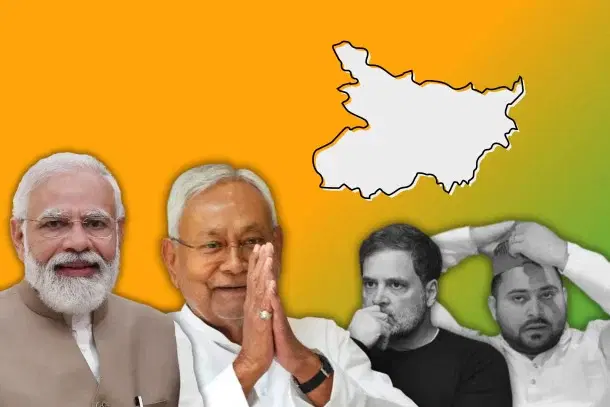
In the post-morning trends, the Bharatiya Janata Party (BJP)-led National Democratic Alliance (NDA) appears set to secure a comfortable majority with more than 180 seats. Some experts estimate that by the end of the day, the NDA may even surpass its 2010 tally of 206 seats.
The scale of the results is notably unexpected. In the run-up to the election, it was widely believed that Nitish Kumar was facing the most severe anti-incumbency of his two decades in power. For many observers, the election seemed the opposition’s to lose.
However, the NDA altered the dynamics with a multi-pronged strategy that involved increasing cash incentives and widening the beneficiary base, notably by including a relatively small group of 16 lakh registered construction workers.
Nitish, the Phoenix
As in previous elections, the most decisive factor appears to be cash incentives to women under the Mukhyamantri Mahila Rojgar Yojana. Women associated with the expansive Jeevika Didi network received 10,000 rupees to start small businesses. The government has also promised a review in the coming months, indicating that if the scheme is found to be scalable, the next instalment could be as high as two lakh rupees.
Bihar has 1.4 crore Jeevika Didis. For women from socially and economically backward communities, the initiative functions as a significant source of financial empowerment. NDA cadres also maintain regular contact with these women, assisting them throughout the process and ultimately aiding their mobilisation on polling day.
Even women who have not yet received their instalments express confidence that as long as Nitish Kumar is in office, the money will eventually reach their accounts. The consistency of this sentiment is striking, and it is reasonable to infer that nearly 90 per cent of Jeevika Didis vote for the NDA.
A further factor bolstering Nitish Kumar’s appeal was the way he revived his public image mid-campaign. His energetic rallies countered the narrative about his declining health and suitability for another term. His enthusiasm often outmatched that of Tejashwi Yadav, despite the age difference. A widely circulated video in which Kumar stated he had never sought personal gain in his life resonated strongly with voters.
By the time campaigning resumed in full swing after the Chhath festival, the Janata Dal (United) cadre were on firm footing. Their primary task was to counter local misinformation and ensure voter turnout at the booths.
BJP's Election Management
The BJP, however, grappled with a series of internal challenges. The party faced pressure due to Prashant Kishor’s continuous attacks on senior leaders, including state president Dilip Jaiswal and Deputy Chief Minister Samrat Chaudhary. Given Chaudhary’s role as the face of the Kushwaha community, distancing from him was not an option, and he was eventually directed to contest from Tarapur, a seat not originally preferred by him.
Ticket distribution created additional complications. Upper-caste voters displayed noticeable shifts towards both Tejashwi Yadav and Prashant Kishor. Amit Shah intervened to ensure that roughly half of the BJP’s tickets were allotted to upper-caste candidates.
Another issue involved smaller potential vote-cutters who were dissatisfied with the distribution process and threatened rebellion. Shah personally engaged with block-level figures to pacify them and preserve the BJP’s vote base. In Tarapur, for example, he managed to convince four potential candidates not to contest against Samrat Chaudhary.
Chaudhary subsequently played a crucial role in consolidating Kushwaha support for the NDA in the Magadh–Shahabad region, where the alliance is poised to regain significant ground after nearly a decade.
The BJP also faced complications over Chirag Paswan’s seat demands, which Jitan Ram Manjhi opposed. Multiple rounds of negotiations followed, with Nityanand Rai attempting to mediate, though unsuccessfully. A compromise was eventually reached, with Paswan securing 29 seats, 10 of which were reportedly provided by the BJP.
Another challenge was informing Gen Z voters about the realities of the Jungle Raj era and its impact on Bihar. Early attempts fell flat until the local pop industry unexpectedly stepped in, producing songs and videos depicting the resurgence of criminal elements if Tejashwi Yadav were to come to power.
The BJP amplified these songs across platforms, creating momentum. Later in the campaign, Prime Minister Modi reinforced the message by recounting specific incidents from that period.
NDA’s Own M-Y
Despite countering all these problems, the NDA still had a demographic hurdle in front of it. Muslims and Yadavs, the traditional M-Y, together constitute nearly one third of voters. Additionally, their voting percentage is quite high. Both communities were expected to show full support to Tejashwi Yadav, which later turned out to be true.
In the exit poll conducted by Axis My India, more than 90 per cent of Yadavs voted for Tejashwi Yadav while 79 per cent of Muslims did so. Both these figures are higher than the loyalty quotients usually acquired by the NDA’s traditional vote banks.
What worked for the NDA is its own version of M-Y. The NDA’s M-Y comprises Mahila (women) and Youth. This formula was first explained by Chirag Paswan when he spoke about the rationale behind ticket distribution of his party during the Lok Sabha elections.
Women are the biggest beneficiaries of Nitish Kumar. Since coming to power, his schemes have mainly focused on empowering women. For women over 18, he gave representation and dignity through safety and livelihood opportunities. For young girls, he provided education by mandating free dress, school books, bicycles and by ensuring there were safe roads.
When these educated girls grew up, Kumar provided them with 35 per cent reservation. Those who did not get government jobs are now ready to start their own businesses with the help of the government. It is no surprise that despite being 46 lakh fewer in absolute numbers than men, four lakh more women came to the booth. At many booths, the women to men ratio was seen to be 3:1.
On the other hand, fewer young people supported the NDA compared to women of all ages. Even then, it cannot be said that the youth entirely wanted to do away with Nitish Kumar, despite facing lathi-charges and paper leaks. The anti-incumbency among young people, especially men, was reduced significantly by making sure they saw the full picture before choosing the alternative.
Ultimately, a large chunk of those youth who simply wanted Nitish Kumar out of power ended up pressing Jan Suraaj’s symbol rather than that of the Mahagathbandhan. In that sense, the splitting of anti-NDA young male voters helped the NDA, while it pushed harder to ensure female voters from the same age group.
Abhishek is Staff Writer at Swarajya.
 Join our