Bihar
Nitish Kumar Leaves Bihar For The Rajya Sabha. What Does He Leave Behind?
Abhishek Kumar
Mar 06, 2026, 09:07 AM | Updated 10:51 AM IST

Every week, in the early years of his chief ministership, Nitish Kumar held a Janata Darbar at his Patna office. Hundreds would queue in the heat outside, many having travelled overnight from remote districts with loosely drafted petitions.
Kumar would sit at a bare desk with a microphone, a pen, and a clock in his line of sight. No ornament, no excess layered bureaucracy. Easy accessibility for the public. For the traveller, what mattered more than the solution was the respect he commanded in front of the officer who got a rebuke call from the chief minister's office.
Citizens, who had for decades assumed that the state was not for them, suddenly saw that the government was paying attention.
One Branch, Two Divergent Leaves
Bihar in November 2005 was a state that had ceased, in any functional sense, to govern. The fifteen-year dispensation of Lalu Prasad Yadav and Rabri Devi had produced a particular kind of institutional collapse in which the apparatus of the state was not merely indifferent to citizens but had been actively repurposed as a mechanism of extraction.
Dozens of caste massacres claiming hundreds of lives, with effective impunity for their perpetrators, were routine affairs. Kidnapping for ransom, extortion, and murder were commonplace. Registering a complaint would invite more trouble from the law enforcement machinery itself.
Government offices in the capital were still running on Remington typewriters. Teacher and doctor posts had been left vacant for a decade—not out of neglect alone but because filling them removed a patronage lever.
People did not step out after dark. To be called Bihari, anywhere else in India, was to be diminished.
What is often forgotten is that Lalu Prasad and Nitish Kumar, both protégés of the socialist leader Karpoori Thakur, share the same political parentage. Lalu's singular achievement was to make backward-caste identity a source of dignity rather than shame.
But the dignity he offered was symbolic, and the governance it came attached to was ruinous.
What Kumar understood, arriving from the same social and political milieu, was that the same communities Lalu claimed to represent would respond to something more concrete: roads they could drive on, schools their daughters could reach, police stations that would actually file their complaints.
On law and order, Kumar was a single-issue candidate when he ran in 2005.
His instinct on taking office was not to launch schemes but to restore the credibility of the state's basic functions. He assured bureaucrats of personally honouring their three-year postings — a guarantee so unusual in Bihar's patronage culture that it functioned as a signal of seriousness.
He depoliticised government appointments, filling teaching and medical positions that had been cynically vacant for years.
He brought in Abhayanand, then Additional Director General of Police, to anchor the Speedy Trial programme. Legislators were jailed, including from his own alliance. The prison transfers of strongmen like Mohammed Shahabuddin to high-security cells in Bhagalpur and Beur, physically severing their networks from the jail staff they had cultivated, were a new administrative design in the state.
Kumar later told Princeton's Innovations for Successful Societies that the single most important shift he observed over his tenure was a change in Bihar's mood from fear and mistrust to confidence in government and law and order.
That was his first-term achievement in a sentence.
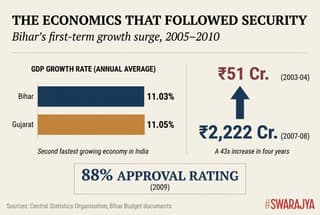
The economics followed once security was credible, in a sequence that makes sense if one thinks about why capital had fled Bihar in the first place. Between 2004–05 and 2008–09, Bihar's GDP grew by 11 per cent annually — the second fastest in India, fractionally behind Gujarat. Road expenditure went from Rs 51 crore in 2003–04 to Rs 2,222 crore in 2007–08.
Why Nitish Became an Emotion
Villages that had never known a functioning grid received electricity. The Bihar Investment Promotion Board attracted capital that no rational investor would have directed at the state five years earlier. Kumar's government enjoyed an 88 per cent approval rating in 2009.
Lalu Yadav had famously said that "development does not win votes". The 2010 Bihar Assembly election, which Kumar won with a larger mandate than in 2005, was the reply.
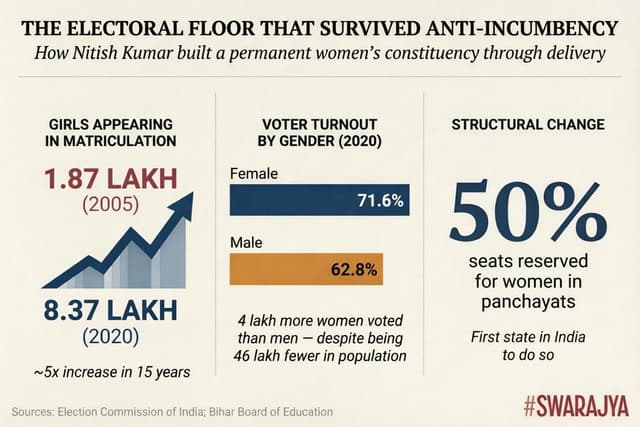
But the truest measure of the Nitish era — the one that outlasts every alliance switch, every political contradiction — is what happened to Bihar's women. The bicycle scheme for schoolgirls, executed at scale with fanfare, addressed a binding constraint with disarming simplicity. Girls used to drop out because schools were far and travel was unsafe.
For the half-dozen kilometre distance between a poor girl's home and school, the state apparatus had to simultaneously improve law and order, build roads, and provide bicycles for travel. In popular opinion, Kumar succeeded on all these fronts.
The 50 per cent panchayat reservation for women converted rural women from passive welfare recipients into an organised political constituency. Even in 2025, when half the commentariat had written his obituary, it was this constituency that carried him back.

The Jeevika programme, launched in 2006–07 with World Bank support, belongs to the same lineage. It opened bank accounts for rural women, distributed credit, and trained them in skills matched to local demand. The women who ran these cooperatives became known across the state as Jeevika Didis.
Later, their remit expanded. They ran pantries feeding state-run schools and hospitals under Didi Ki Rasoi, and acted as banking correspondents in villages where no scheduled bank had a branch. The programme was never the subject of a prime-time television debate. It was, quietly, one of the most consequential institutional interventions in rural India since NREGA.
The electricity story is similarly among the most under-appreciated chapters of his administration. Kumar had a personal connection to this problem, both through his engineering degree from NIT Patna and through the fact that Bihar's power sector when he took over was less a grid than a collection of failing components.
He made a public commitment from Gandhi Maidan on Independence Day 2012 that he would not seek votes if he failed to bring electricity to every Bihar household by the 2015 elections. The declaration was grandiloquent, and he missed the deadline. But the machinery he set in motion — eventually anchored by his energy secretary Pratyay Amrit, who cut contractor payment cycles from 120 days to 15 and replaced 40,000 transformers in 180 days — was real.
A light bulb in a village that had known only kerosene for thirty years — and which the government had officially classified as "electrified" for those same thirty years — is not an abstraction. A daughter cycling to school on a government-issued bicycle without being stopped by a village strongman is not a statistic. A woman in a self-help group taking a small loan, buying a sewing machine, and repaying it without a police officer's brother taking a cut is not a policy brief.
For the families who lived this, Nitish Kumar is not an alliance calculation. He is the man who came. This is the register in which his first decade should be read, alongside the GSDP growth charts.
Not Beyond a Point
Yet two decades is a long time, and the second decade does not read like the first. Bihar's share of national GDP actually fell from 3.6 per cent in 1990–91 to 2.8 per cent in 2021–22 — a decline sustained across Kumar's entire tenure, including its most celebrated phase. Per capita income, at Rs 69,321 in 2023–24, remains almost one-third of the national average.
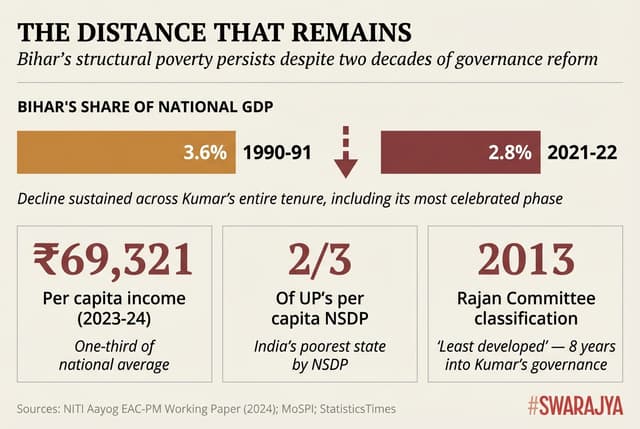
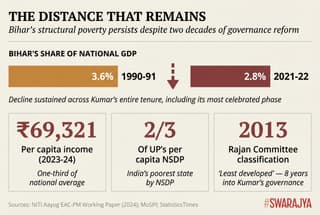
The Raghuram Rajan Committee classified Bihar as "least developed" in 2013 — eight years into Kumar's governance. The private sector never arrived at scale. The sarkari naukri remains the dominant economic aspiration of young Biharis, which is itself a diagnosis.
His political tally of ten swearing-in ceremonies and five alliance changes has earned him the Paltu Ram nickname that will likely follow him into the history books. Each switch followed its own logic, and each hollowed out the moral capital he had spent years building.
Every time he sat beside Lalu on a shared stage and pretended the jungle raj years had not happened, the credibility of his governance narrative took a wound.
By 2024, his loyalists defended each turn with diminishing conviction; his critics had stopped defending them at all.
Something similar is happening with the prohibition policy as Kumar draws the curtains on his chief ministership. His policy, though genuinely popular among women, created a parallel bootlegging economy and selective enforcement apparatus that his own administration could not control.
The question of dynasty, now impossible to avoid, sits in direct tension with the entire arc of his public life. Nishant Kumar's likely elevation to Deputy Chief Minister is being managed with the language of organic political entry.
A career that began in the JP Movement — a movement that was, at its core, a revolt against inherited power — may end with the chief minister's son being given the deputy's chair, not for the first time though.
Nitish Kumar once told reporters that he falls asleep at night thinking about bureaucratic red tape and the obstacles it poses to development. It is an unusual thought to have before sleep, since most of his contemporaries in Indian politics fall asleep thinking about something else entirely.
The Bihar he found in 2005 and the Bihar of 2025 are not the same state. In the villages where a bicycle changed a girl's trajectory, where a bulb finally lit a room that had known only kerosene, where a woman stands behind a bank counter as a Jeevika Didi having never imagined such a thing possible — in those places, Nitish Kumar is not a statistic or an alliance calculation. He is, simply, the man who came.
The Bihar of 2025 and the Bihar that its economic potential suggests are also not the same state. The distance between the two is the unanswered question of his legacy — and, given that he is now heading to the Upper House, no longer an open one.
His move to the Rajya Sabha closes the longest chapter in Bihar's post-Independence political history. The particular Nitish Kumar model — the administrator who governed on delivery rather than identity, who built a women's constituency through welfare rather than rhetoric, who once resigned a Union Cabinet berth because 300 people died on his watch — does not transfer.
It was not a system. It was a temperament. And temperaments leave with the men who carry them.
Abhishek is Staff Writer at Swarajya.
 Join our