Bihar
No, SIR Didn't Defeat The MGB. NDA Won On Its Own Strength
Tryambakam Shrivastava
Jan 12, 2026, 04:48 PM | Updated 05:11 PM IST
In the recently concluded Bihar assembly elections, the National Democratic Alliance (NDA) secured a commanding victory, winning 202 out of 243 seats. It marked the alliance's second-best performance in the state after 2010, when it had secured 206 seats. The alliance is a coalition of Nitish's JD(U), BJP, Chirag Paswan's LJP and some smaller parties.
The victory has been attributed to several factors: Nitish Kumar's long-cultivated reputation for good governance, targeted cash transfers to women before and during the elections, the NDA's and in particular the BJP's formidable election machinery and political strategy, and of course the charisma and mass appeal of Prime Minister Narendra Modi.
There has, however, also been some noise around SIR and alleged voter-roll deletions. The opposition, especially the Congress, has argued that these deletions and irregularities transformed the final outcome, claiming that the Mahagathbandhan would have won otherwise. The MGB is a coalition of mainly Lalu's RJD and Congress.
Yet a careful reading and analysis of the available constituency-level data shows that the scale and distribution of deletions were insufficient to overturn the statewide verdict. NDA would have won in any case.
Before diving into what the data actually says, it is important to understand the categories of voters who were deleted or excluded from the rolls during the revision.
The first category comprises duplicate voters: people whose names appeared on multiple rolls. Removing these entries is least likely to affect outcomes because such voters had only one legitimate vote to begin with and could not potentially vote in the same election, given indelible ink that is applied. Deleting extra entries does not stop anyone from voting.
The second group is the deceased, identified through BLO verification. Since these voters cannot vote, their removal has virtually no electoral impact. Occasional errors are possible, but the scope for affecting results is minimal.
The third category is permanently shifted voters: those who have moved out of the constituency. This group is slightly more error-prone because migration can be hard to verify, but even here, most would not have voted locally anyway, limiting the impact on results.
The final category is untraceable voters. This set carries a somewhat higher chance of including genuine voters who were missed, but the category actually serves as a safeguard. By giving BLOs a neutral option when a person cannot be found at their address, it prevents wrongful classification into harder categories like 'deceased' or 'shifted', ensuring those other categories remain more accurate.
So what does the data say?
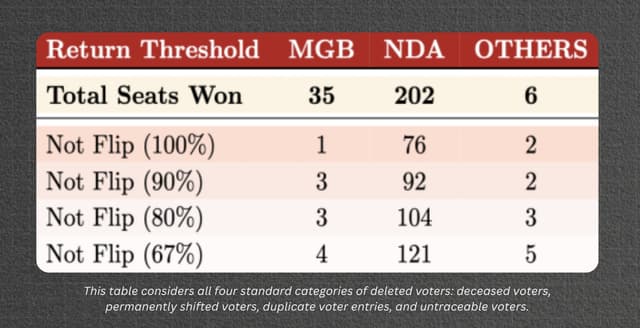
First, most constituencies lay well outside any realistic danger zone. Even under the harshest assumptions, where a very high share of deleted voters is imagined to 'return' to the rolls and vote unanimously for the runner-up, the majority of seats simply do not flip. In most constituencies, the margin of victory was larger than the total pool of deleted voters.
Table 1 illustrates this clearly: even if 67% of all deleted voters across all four categories were to turn out and vote entirely for the MGB, the NDA would still retain 121 seats, just one short of a majority, and these seats would not flip under any circumstances. This is an impossible scenario, given that duplicate and deceased voters obviously cannot vote. The 67% figure is selected since this was the overall turnout rate.
In contrast, only four MGB-held seats fall into a similarly 'safe' category for the opposition. Even when we push the simulation further, assuming that 80% or more of deleted voters turn up and vote en masse for the challenger, well over a hundred NDA seats remain unaffected.
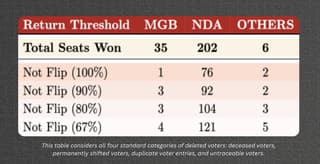
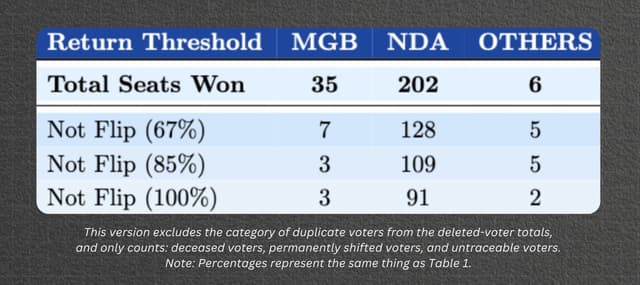
As the deletion categories are refined by removing implausible voters such as deceased, permanently shifted, or duplicate entries, the number of theoretically vulnerable seats drops even more sharply.
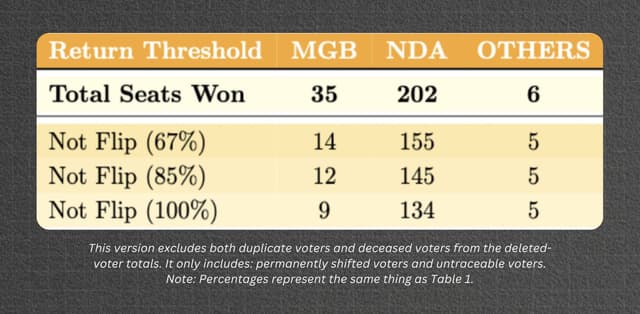
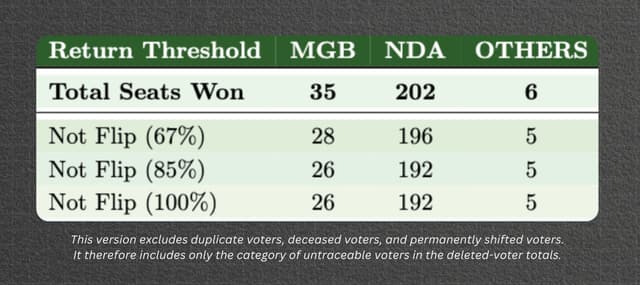
Tables 2 and 3 present a more realistic picture. Table 2 excludes duplicates, whilst Table 3 excludes both duplicates and the deceased. If we again assume a 67% turnout amongst deleted voters and, more importantly, accept the opposition's extreme claim that every deleted voter would have voted for the MGB, a highly unrealistic assumption, the NDA would still comfortably win 128 seats under the Table 2 scenario and 155 seats under the Table 3 scenario.
The mathematics simply does not support the opposition's claim. Even with assumptions deliberately tilted in favour of the MGB, the results do not change meaningfully.
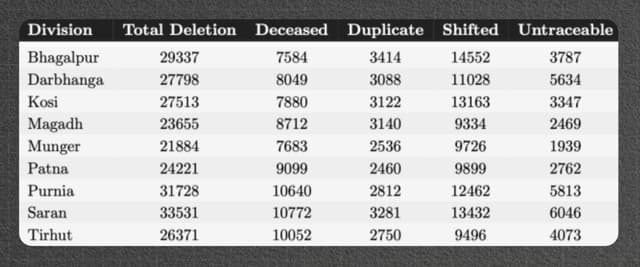
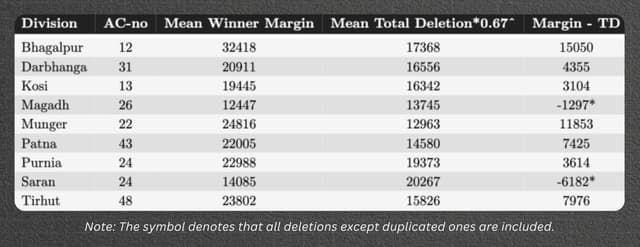
Second, the arithmetic of margins versus deletions overwhelmingly favours the NDA. A division-wise comparison, presented in Table 6, shows that in most divisions, the average margin of victory was substantially higher than the average number of deleted voters. This is calculated after excluding duplicates and applying the 67% turnout assumption.
This means that even in the most unrealistic scenario, where every deleted voter magically reappears and votes in perfect coordination for the MGB, the gap is simply too large to bridge.
Only a couple of divisions, notably Magadh and Saran, show a pattern where deletion estimates slightly exceed average margins, suggesting isolated pockets of vulnerability. But these pockets together account for only about 40 NDA seats, and since these are averages, individual constituencies may differ widely. Critically, even in these two divisions, the deletion numbers do not consistently overwhelm margins across all seats.
When we keep both points in mind, the strength of the NDA's position becomes even clearer. The analysis relies on deliberately extreme assumptions. It treats every deleted entry as a potential voter who could return, even though many of these deletions arise from categories that cannot vote again: the deceased, those who permanently migrated, and duplicates removed during roll clean-up.
It further assumes that every such voter would not only turn up but would vote unanimously for the runner-up, an implausible behavioural pattern in any real-world election. In reality, voter preferences are scattered, turnout amongst marginal or previously inactive voters is unpredictable, and even the strongest campaigns cannot engineer such perfect one-sided mobilisation.
By using these maximalist assumptions, the analysis effectively stress-tests the election for even the faintest possibility of seat flips. The fact that very few seats flip even under these exaggerated conditions only strengthens the conclusion that the overall outcome is robust.
Moreover, the spatial distribution of deletions matters. Deletions were not concentrated in any one region or division; they occurred in broadly similar ranges across Bihar. As a result, there was no geographic cluster where deletions aligned neatly with razor-thin margins in a way that could overturn dozens of results.
Taken together, the evidence points to a clear conclusion: SIR did not alter the outcome of the Bihar assembly election. The NDA's commanding 202-seat performance holds up even under the most pessimistic simulations. The margins were too large, the deletions too scattered, and the assumptions required to reverse the result too unrealistic. In the end, the electoral arithmetic, much like the political momentum, remained firmly on the NDA's side.
The conclusion is straightforward: SIR had no effect on the Bihar election outcome. The NDA would have won anyway.
Tryambakam Shrivastava is currently an Economic Research Consultant at Imperial College London. With a postgraduate training in Economics from IIT Delhi, he combines rigorous training with a passion for exploring the intersections of economic, political, social, and civilizational topics. As an Indic thinker, he enjoys contributing thoughtful commentary to issues concerning India.
 Join our