Bihar
The State As Catalyst Or Custodian: What Will Be Bihar's Choice Of Governance Model?
Abhishek Kumar
Nov 10, 2025, 01:53 PM | Updated 03:49 PM IST
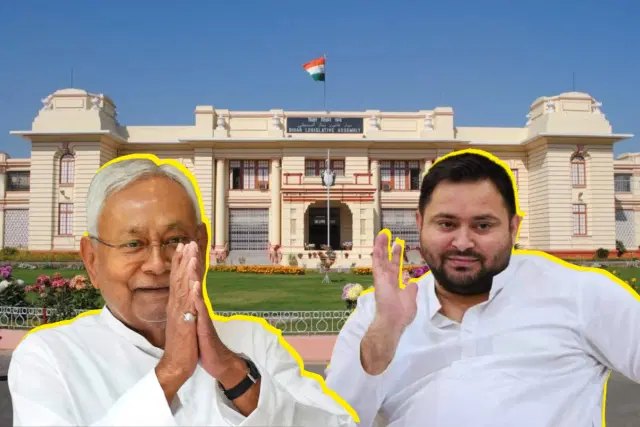
Assembly election in Bihar is not just about the cliché battle of political ideologies. Ideology, if anything, is making space for politics of representation, leading to hyper-localisation of the contest and hyper-fragmentation of identities.
The local representative has ceased to matter positively as big faces contest for their own waves. In this election, statewide popular faces represent two separate models of governance with very few conversion points, that too owing to the government’s constitutionally defined role as a welfare state.
Building on its promise of Raftar Pakad Chuka Hai Bihar, the Nitish Kumar-led Bihar chapter of the National Democratic Alliance (NDA) is promising to let the animal spirit of entrepreneurship take charge, while the Tejashwi Yadav-led Mahagathbandhan—the Bihar chapter of the Indian National Developmental Inclusive (INDI) Alliance—has promised more space for government in everyday life.
One wants the government to step back and allow private money to flow in, while the other wants it to come forward and distribute guarantees like ration cards.
NDA Manifesto
The NDA released its manifesto in a 26-second-long press conference. More than the manifesto, its late release and the duration of the conference made the buzz. Named Sankalp Patra, it launches a categorical attack on Lalu Yadav and his Rashtriya Janata Dal (RJD) by comparing key metrics between 1990–2005 and 2005–2025.
The operative part of the document begins with a headline promise of one crore jobs, which are both government and private in nature. In the same vein, it talks about conducting a skill census and establishing a mega skill centre in every district, transforming Bihar into a global skilling hub, subtly hinting that the job promise will be fulfilled through industrialisation, skilling, and entrepreneurship.
Ten new industrial parks, a factory in each district, one hundred MSME parks, and Centres of Excellence for sports and training in every division are also part of these initiatives. These relatively smaller units are tied to larger projects like semiconductor and manufacturing hubs, a new defence corridor, and ₹9 lakh crore in prospective investments.
Together, they form the architecture of a state that builds platforms, invites private investors, and expects the market to complete the story.
This philosophy is well reflected in the promises of seven expressways slicing through the state's congested veins, modernisation of 3,600 kilometres of rail tracks, introduction of metro railways in four cities, Namo Rapid Rails, Amrit Bharat Express, and international airports, aiming to hoist Bihar into the global supply chain.
Other big infrastructure pushes include a Viksit Bihar Medicity envisioned as a healthcare cluster of national scale, supported by medical colleges in every district, and an Education City bringing together universities, start-ups, and research hubs.
What the manifesto does not specify is how these promises will be met. Nowhere does it specify who will execute these projects—state, private, or through Public-Private Partnership—perhaps intentionally so. In the manifesto’s vocabulary, the mechanism of delivery has mattered less than delivery itself. The speculation about the execution arm is left to probabilistic prediction based on the NDA’s track record.
By keeping the grammar of governance managerial, project-driven, and growth-oriented, the NDA has signalled intent and seeks to orchestrate convergence of stakeholders by reimagining Bihar as a node in India’s infrastructure and manufacturing chains rather than a self-contained welfare state.
The orchestration theme is present in other announcements as well. Women, the unsung anchors of Bihar’s agricultural households, work as the sheet anchor of the state’s MSME journey. The document speaks of creating one crore women Lakhpati Didis by offering ₹20 lakh collateral-free loans for women-led ventures, providing ₹2 lakh under Mukhyamantri Mahila Rojgar Yojana and Jeevika Devi Credit Cards.
For context, there are over 1.4 crore Jeevika Didis in the state. According to Deputy Chief Minister Samrat Chaudhary, their contribution to the state GDP is over 23 per cent. Nitish Kumar is credited with empowering them through credit, productivity, and scale. The NDA’s manifesto also speaks of the same.
Despite its emphasis on nudging creation, the authors of the manifesto feel the need to cater to the rural political reality, read by others as welfarism. Under the Karpoori Kisan Samman Nidhi, the document promises ₹3,000 over and above the higher PM-Kisan aid of ₹6,000, taking the final tally to ₹9,000. Other key welfare measures include doubling support for fishermen and buying paddy, maize, and wheat at MSP prices at the Panchayat level.
Balancing fiscal prudence with social welfare, the NDA has pledged to continue its flagship initiatives, including free electricity, free food, medical coverage of up to ₹5 lakh, and the construction of 50 lakh new houses.
For all its talk of private dynamism, the NDA model of development risks assuming capacities Bihar has not fully developed. Despite recent land bank initiatives, land acquisition remains heavily dependent on political connections, while much-talked-about power initiatives have hit a hurdle in the name of freebies.
The existing bottlenecks are responsible for steady growth, but its distribution has been uneven. Its real GSDP may have crossed 8 per cent, yet low per-capita income negatively skews the national average. The manifesto seems to be positioning another wave of infrastructure as destiny, but Bihar’s migration experience suggests that roads and railways alone do not automatically translate into sustainable long-term livelihoods.
The distance between economic momentum and social welfare remains wide.
By insisting that the state play its role as a contractor and allow citizens’ entrepreneurship to take over is a bold departure in a culture where the dominant social discussion still prioritises public employment, subsidies, and transfers for social stability.
The transitory period in which the state transforms itself from guarantor to enabler risks widening inequality, especially in a state still marked by rural poverty and weak institutions.
This is the exact redistribution fear on which socialist politicians prey in Bihar. The state’s collective psyche has a habit of getting into a comfort zone after achieving small industrial momentums, hence igniting the chorus of redistribution without the adjacent growth in production.
Tejashwi Pran, the manifesto of the Mahagathbandhan, invokes a similar design.
Mahagathbandhan
In Tejashwi Pran, the state takes on the role of guarantor and hence custodian of livelihoods. The INDI Alliance promises a government that treats sweeping legislation as a solution to uncertainties.
The document opens with a mountainous promise to pass a law guaranteeing one government job in every family within 20 days of assuming power. It is as if public sector employment is a right, not an outcome of administrative need. The pledge to make all contractual workers permanent and end outsourcing by law imagines Bihar’s government as an employer with infinite capacity.
Similarly, the reintroduction of the fiscally unsustainable Old Pension Scheme, abandoned by most states, doubles down on this vision of government as the ultimate provider. The authors of the document cannot fathom treating precarity as a manageable economic reality; instead, they see it as a consequence of administrative error.
The manifesto is silent on sources of revenue generation to fund these without hiking taxes or reckless borrowing, indicating a departure from the traditional formula of the state first hoarding and then dispensing money.
The command polity envisioned by Tejashwi Yadav is not new to India. In fact, Bihar’s consistent downward standings on multiple indices, foremost of which is per capita income, stand as a strong testament against flirting with the idea. In post-60s Bihar, the state was seen as the largest employer, the arbiter of opportunity, the allocator of resources, and the primary engine of growth.
Its public sector enterprises were the foremost employers of thousands. Its bureaucracy was vast and reached deep into rural life and psyche. However, this model soon collapsed under its own weight.
The results were catastrophic. The bloated bureaucracy and political patronage led to the outward flow of existing private capital. Bihar's growth rate consistently lagged the national average, and its per capita income reached the nadir among Indian states.
By the 1990s, Bihar had become a cautionary tale of what happens when the state tries to do everything and ends up doing nothing well. When the rest of India was liberalising, Bihar was mired in Jungle Raj, a breakdown of governance so complete that the state became synonymous with failure.
Yet the Mahagathbandhan manifesto regards this history as irrelevant or misunderstood. Reading between the lines hints that Tejashwi Yadav treats the Bihar of the 1990s not as a failure but as an incomplete project of his father. For the Mahagathbandhan machinery, the 1990s were a success in which the Mandal Commission and related momentum democratised access.
This machinery views Bihar’s entry into the liberalised economy after the 2005 reforms not as a positive development but as a widening of existing divides. That is the only plausible intellectual jugglery that can explain the sweeping redistribution announced by the Mahagathbandhan.
Other populist big-bang reforms include free exam forms and travel for competitive tests. For students from Class 8 to Class 12, tablets are on offer. If, after school, they wish to attend a new university, the Mahagathbandhan promises to keep it within a 70 km radius, evoking the falsely marketed egalitarian fervour of Charwaha Vidyalaya.
Expanding the welfare net further, women of the state will receive ₹2,500 monthly under the Maa-Bahini Maan Yojana, while also enjoying the 200 units of free electricity provided for their households and health insurance with a cap of ₹25 lakh. Additionally, the promise to provide gas cylinders for ₹500 to the poor is also a scheme targeting mainly rural women of the state.
For 1.40 crore Jeevika Didis, Tejashwi offers a permanent job offering ₹30,000 per month and other tangible benefits associated with the job.
Very few of these largesse are fiscally tenable for a state whose budget has just crossed the ₹3 lakh crore mark. Free tablets, free exam forms, free travel, and cylinders worth ₹500 seem to be the only plausible ones given the current debt burden of using nearly 25 per cent of its revenue receipts on interest payments and loan repayments.
If implemented in toto, the proposed welfare schemes would first consume the whole budget and then extract a demand for debt which would be at least 300 per cent more than the budget itself. In the process, there would be absolutely no room for capital expenditure on the very infrastructure capable of generating future revenues and hence expanding the budget, as deputy chief minister candidate Mukesh Sahani talked about.
Effectively, by guaranteeing consumption today, it mortgages the investment of tomorrow, something which Bihar witnessed in the 1990s.
Despite that, dismissing such absurdities as fiscal fantasy of the dreamland would be a gross misreading of Bihar’s political economy.
The appeal of health insurance, cheap cylinders, virtually free education, guaranteed employment, permanent jobs, and direct cash transfers may be irrational populism, but it is also a clever response to the lived reality of crores in the state, which has one of the highest rates of outmigration in India, with millions of its youth working as daily wage labourers, carrying stones, building bridges and houses, roasting themselves in the chilling heat of mines, or driving e-rickshaws in other states.
For families dependent on remittances from this back-breaking work, a promise of government employment within twenty days is not a policy proposal but the difference between dignity and desperation. Here, the distinction between contractual and permanent work is not a bureaucratic manoeuvre but a difference between security and disposability.
In this context, the Mahagathbandhan's manifesto speaks to an electorate that lies at the bottom of the hierarchy. At this position, the brain is heavily tilted towards positive information, no matter how improbable it is. Tejashwi Yadav and his team know that fully well.
The MY-BAAP political acronym for the inclusion of every community under the RJD’s fold not only appeals to caste groups but also to deprived sections who treat the government as MY-BAAP.
Which is better?
The pertinent question is what suits Bihar's populace. The implicit codes in the language of both these manifestos have been implemented in Bihar. In its early post-independence avatar, Bihar chose to side with entrepreneurship and economic aspirations, with corresponding efforts towards social justice.
The state assumed the role of an economic facilitator and saviour on the social front. Social justice proponents consider the second version a necessary evil of the time while disregarding the impact it had on economic facilitation.
The facilitator role returned with Nitish Kumar in 2005, by which time caste identities had become more entrenched than those of the 1960s, albeit with the justification of reversing the old order. He faced the dual challenge of reducing the role of caste in society without excessive centralisation of economic and distributive power in government’s hands.
Simultaneously, states like Gujarat, Madhya Pradesh, and later Uttar Pradesh built growth platforms first and used rising revenues to expand welfare without destabilising the budget. In this context, the NDA’s slogan Raftaar Pakad Chuka Hai Bihar places Bihar at a similar inflection point.
Bihar has seen the government more in its custodial role than as catalyst. Human development indices and reports of respective eras do indicate that people here need a guarantor in the state.
The question is not what people need. It is what people of the state want. What they get is the consequence of what they vote for.
Abhishek is Staff Writer at Swarajya.
 Join our