Books
Beyond God And No God: The Radical Argument Of The Logic Of Ish
Aravindan Neelakandan
Dec 05, 2025, 06:00 AM | Updated Dec 05, 2025, 12:59 AM IST
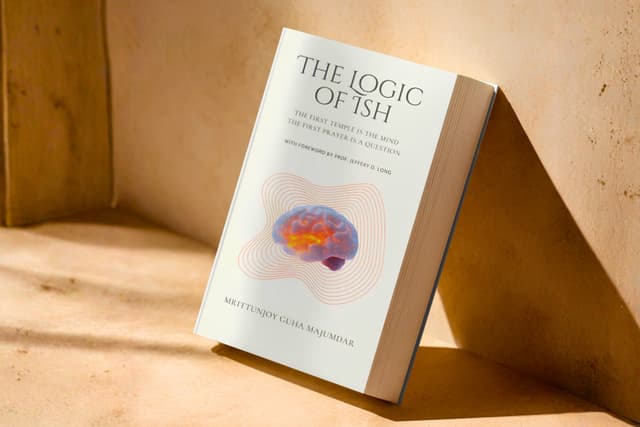
The Logic Of Ish. Dr Mrittunjoy Guha Majumdar. MLBD Publications. Price: Rs 829.
In the intellectual landscape of modernity, we are offered a stark binary: either you are a "believer" who accepts God on faith, or you are a "rationalist" who embraces the scientific worldview. Richard Dawkins's The God Delusion and the legions of apologetic responses form the opposing trenches of this war.
Dr Mrittunjoy Guha Majumdar's The Logic of Ish, however, refuses to occupy either position. Guha Majumdar, a Cambridge-trained physicist deeply rooted in Indian Knowledge Systems particularly Trika Saivism, performs a vital act of intellectual archaeology and reconstruction.
He resurrects the 11th-century Naiyāyika logician Udayanācārya, not to preserve him in a museum of Indology, but to let him wander and observe in the laboratories of quantum mechanics, schools of evolution and information theory. The result is a work that argues for Īśvara not as a matter of cultural identity or blind faith, but as a rigorous logical necessity.
Iśvara (the Lord) is neither the bearded Creator of Christian monotheism nor a delusion conjured by evolutionary psychology, but an immanent principle—a derived creative state from Brahman—and the intrinsic source of cosmic intelligibility.
This is not a book written to convert the sceptic or to console the faithful. It is a book written to restore the much-needed presence of the Indic philosopher of science—the figure who transcends easily constructed binaries and dares to ask whether the opposition between 'God' and 'No God' is itself a category error born of conceptual poverty.
From an evolutionary perspective, this makes The Logic of Ish the most challenging 'theistic' (if at all one can call it that) text I have encountered. It does not reject Darwinian natural selection; it subsumes it into a deeper ontological structure. The slippery slope is that it bears superficial resemblances to Intelligent Design. But if one deep-dives into the pages, the ontological differences are so profound that conflating the two would be a philosophical crime.
Iśvara Is Not the Creator-Designer
The first misunderstanding that must be cleared is the nature of Iśvara itself. In the Western imagination, "God" is the Watchmaker—an external agent who stands outside the universe, designs it, winds it up, and occasionally intervenes. This is the God that Dawkins rightly demolishes. But this is not Udayana's Iśvara, nor is it Guha Majumdar's.
In the metaphysical architecture of Nyāya-Vedānta, Iśvara is not the "first cause" in the chain of existence. Iśvara is the first manifestation of Brahman—the point where the infinite potentiality of Brahman becomes actualised as the vast self-awareness comprehending and apprehending every possibility. Thus, Iśvara is more immanent than transcendent in the dualistic sense. He is not a 'cosmic mechanic' who tinkers with the universe from the outside. As Guha Majumdar writes:
This intelligence need not operate externally like a cosmic mechanic, but may reside at the ontological root of the cosmos—as an intrinsic source of intelligibility and relationality.p.161
This is a radical departure from the God of William Paley's Natural Theology or the 'Intelligent Designer' of the creationist Discovery Institute. The latter posits an agent who intervenes in the biological process to 'design' the molecular motor of the flagellum of the single-celled organism or the intricate mechanism of the vertebrate eye.
Iśvara, by contrast, is the condition for the possibility of any process at all. Iśvara does not 'design' natural selection; He is the ontological ground that makes the laws of natural selection intelligible and operative.
Here is where the evolutionary critique must proceed carefully.
At first glance, the arguments—especially the revival of the Āyojanāt, which he explains as derived 'from the observation of systematic arrangement and functional coordination that pervade the natural world' (p.157)—dangerously seem to replicate the Intelligent Design playbook. DNA is a code; codes imply coders. Atoms are inert; their combination implies a combiner. Is not this just Paley's Watchmaker in Sanskrit?
No. And the difference is ontologically profound. As Guha Majumdar explains early on this difference:
Unlike arguments that rely merely on mechanical intricacy or superficial analogies with human artefacts, the āyojanāt inference penetrates deeper—it invites us to reflect on how independent elements, disparate processes, and apparently autonomous systems cohere into ordered, self-regulating wholes. It is one thing for a machine to be complex; it is quite another for complexity to give rise to systematicity, to sustain harmonized interdependence across scales, and to preserve a unity of function amidst multiplicity of structure.p.158
This makes the book quite challenging and important. Guha Majumdar's Iśvara, in a way though defined by the by contrast, operates within the textual framework of Nyāya system, seems to have an inherent expectation of non-dualism (or qualified non-dualism, depending on how one reads Nyāya in relation to Vedānta).
Iśvara is not external to the universe; He is its ontological substrate. He does not 'intervene' in natural law; He is the reason there are natural laws in the first place. As Guha Majumdar writes:
If consciousness is indeed irreducible to physical computation and yet essential to the universe's most sophisticated forms of information processing, then the explanatory demand cannot be satisfied by materialistic frameworks alone. In classical Nyāya, this insight is prefigured in the invocation of chaitanya—consciousness not merely as a byproduct, but as a fundamental ontological principle, a causal reality in its own rightp.156
Here is where the book becomes philosophically scintillating. The book does not argue for the Iśvara who designed the genetic code in opposition to random mutation. Instead it argues that the capacity for information to exist at all—for a universe to be 'readable', for patterns to persist, for negentropy to fight entropy—requires a pre-physical principle of Chaitanya.
In this model, Darwinian natural selection is not displaced; it is contextualised. It operates as a 'Crane' (a bottom-up mechanism, as philosopher Daniel Dennett famously characterised evolution) within a universe that is itself grounded in a Chaitanya Substrate.
The laws of physics, the arrow of time, the Second Law of Thermodynamics, the informational stability of DNA—all these are local emergences within a cosmos whose ultimate nature is Chaitanya (Consciousness-as-Being).
Material Universe Emerges from the Navel of Pure Chaitanya
Expanding further on physicist John Wheeler's vision of 'It from Bit' hypothesis, Guha Majumdar suggests that the physical universe ('It') arises from information ('Bit'), and information itself presupposes an ontological intelligence which can be both impersonal and non-anthropomorphic, that makes it 'mean' something rather than being mere noise.
Natural selection, then, is the method by which this intelligence unfolds complexity in the biological realm. But the intelligence is intrinsic, not extrinsic.
Guha Majumdar enlarges Wheeler's view that the universe might be a 'self-excited circuit' that requires observation to actualise its potential. So he is not arguing for a God of the Gaps. Rather he is arguing for a God (or most befittingly perhaps a Goddess) of the Ground—who can be the 'Meta-System' that makes the distinction between 'meaning' and 'mechanics' possible in the first place.
By placing 'Chaitanya' at the ontological root, 'The Logic of Ish' creates a model where the conventional biological arrow of time (Matter to Mind/Srishti->Drushti) and the metaphysical arrow of time (Mind -> Matter/ Drishti->Srishti) form a closed, self-sustaining loop: Vishnu as pure Chaitanya and the infinite petalled material universe and Brahma emanating from His navel.
Non-Existence is Real
The book's yet another deeply beautiful insight is its harmonisation of silence and non-existence (Abhāva) as ontologically significant categories. Udayanācārya's arguments operate within the Vaiśeṣika metaphysical framework, established by Ācārya Kaṇāda. This framework originally provided six categories. It was later that Vaiśeṣika philosophers added a seventh category, non-existence (abhāva).
This provides quite a formidable conceptual and epistemological tool that elevates Indian Darshanas and Guha Majumdar puts it in wonderful words:
These silences are not failings but indicators of discipline-specific scope... But the very act of abstraction entails exclusion. Thus, when science is treated as a totalizing epistemology, these exclusions are misrepresented as non-existence. The metaphysical, the aesthetic, the ethical, and the contemplative are not eliminated but muted. A silence becomes mistaken for a negation.
Here, the author connects modern philosophy of science with the ancient Indian appreciation for Abhāva. In the West, absence is mere negation. In India—from the Nāsadīya Sūkta ("Then there was neither existence nor non-existence") to the Vaishnava mystic Nammazhwar—non-existence is a category of importance.
Nammazhwar (circa 6th century) sang:
"To those who assert His existence all forms that exist are Him. / To those who assert His non-existence, all that without form are Him. / With both Existence and non-Existence being His attributes / He permeates with both these attributes in all."
Autopoietic Universe with a Meta-Computational Ground
Had this book been just a philosophical discussion of concepts in tune with the philosophical implications of modern science, still it would have been a great book but it would have lacked a scaling up of the vision into value system. The author has also made that expansion of the vision into a deep-ecological value system.
It is quite interesting that two physicists separated by five decades, Fritjof Capra and Guha Majumdar have arrived at the same progression: from parallels of modern physics to Vedanta, they have moved into the larger understanding of self-organisation and naturally into a deep-ecological vision. Guha Majumdar writes:
The biologists Humberto Maturana and Francisco Varela introduced the concept of autopoiesis to describe living systems as selfproducing and self-maintaining entities. Autopoietic systems are operationally closed in the sense that the processes within them recursively generate the very components and boundaries that constitute the system itself. A living cell, for instance, continually produces the components that define and sustain its structure, distinguishing it from mere aggregates of matter. While originally proposed in the context of biology, autopoiesis has since been extended into other domains. Economic systems, ecosystems, and even certain classes of physical systems display autopoietic traits—systems in which internal rules and dynamics maintain the system’s integrity over time.p.191
The book is a golden treasure for anyone who wants to engage with the best of the modern thought through Indic lens. Here Gödel's Incompleteness theorem resonates with the Nyāya rejection of cakraka (circular reasoning) and anavasthā (infinite regress). The chain of explanation must terminate in a self-grounding reality—Iśvara—who is the 'meta-computational' ground of the cosmos.
The way the author starts with Gödel and expands it with Turing's halting problem and then onto Chaitin's incompressibility theorems, converging them all to show the necessity of Iśvara consistent with Udayanācārya's worldview is amazingly marvellous:
This leads to the concept of a foundational computational substrate: an information-processing system that is self-referential (capable of modelling and computing its own structure), self-defining (deriving its operative rules internally), universal (able to simulate any possible state or configuration of information), infinite in scope (unbounded in computational capacity), and ontologically foundational (from which all other processes derive). The need for such a system is not simply metaphysical; it is a requirement if we are to reconcile the formal and physical limits of computation with the observed informational richness of the cosmos.p.202
This passage is science. This is also a deep meditation. This is when the 'Philosopher' eventually gives way to the 'Seer' (Rishi). The rigorous definitions of causality and the debates on atomic combination serve to plough the mind-intellect complex, preparing it for the Anubhava—the direct experience of the Real.
The Logic of Ish is a demanding text. It requires the reader to abandon the comfortable prejudices of the "God vs. Science" culture war. It asks us to stop thinking of God as a "super-person" and start thinking of Īśvara as the ontological necessity that keeps the universe from collapsing into absurdity.
By reclaiming the dignity of the Philosopher over the partisanship of the Believer, Guha Majumdar has written a book that does not ask for faith, but demands attention. It is a formidable demonstration that the ancient fires of Indian logic, when fed with the fuel of modern science, burn with a clarity that illuminates the deepest questions of our age.
 Join our