Books
From Outsider To Local: How Sangh Wove Itself Into The Northeast's Social Fabric
Kishan Kumar
Nov 22, 2025, 07:00 AM | Updated Nov 21, 2025, 08:21 PM IST
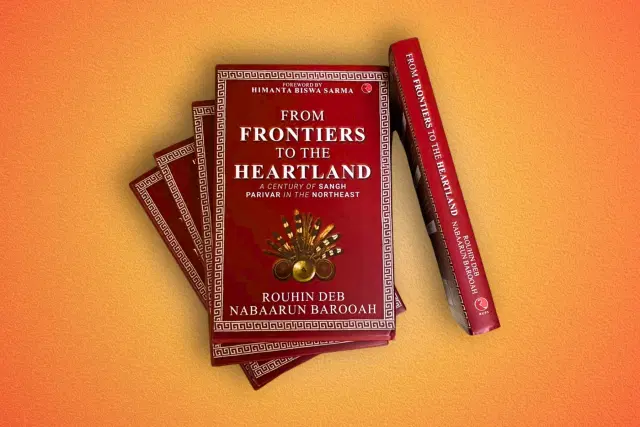
From Frontier to the Heartland: A Century of Sangh Parivar in the Northeast. Rouhin Deb and Nabaarun Barooah. Rupa Publications India. Pages: 312. Price: Rs 619.
Rouhin Deb and Nabaarun Barooah’s From Frontiers to the Heartland is a meticulous historical and sociopolitical chronicle tracing the evolution of the Sangh Parivar in India’s Northeast, a region often treated as a periphery in the national imagination.
The authors bring rare insight into how the Rashtriya Swayamsevak Sangh (RSS) and its affiliates navigated the complex ethnic, linguistic, and religious terrains of Assam and its neighbouring states over a hundred years.
The book opens with a tense, cinematic prologue, set during the anti-CAA protests in December 2019, where an RSS karyalaya in Dibrugarh is set on fire. This immediacy pulls the reader into the lived conflict that underlies the Sangh’s presence in the region. From there, the narrative unfolds historically, transitioning from “The Dark Days of the Raj” to “A Rendezvous with Destiny,” documenting the gradual and strategic integration of the Sangh into Northeast India’s sociocultural networks.
The strength of the work lies in its archival precision and the quality of its fieldwork. Oral histories, local interviews, and organisational documents are interwoven with national political developments, revealing how the Sangh adapted its nationalist vocabulary to resonate with local idioms of identity, culture, and religion.
Chapters like “Echoes of the Old Gods” and “The New Millennium” show how the organisation reinterpreted indigenous faith systems and engaged with tribal communities without erasing their distinctiveness, an aspect rarely explored with such nuance.
Politically, the book neither indulges in uncritical celebration nor distant condemnation. Instead, it treats the Sangh’s rise as a process of cultural negotiation and political expansion, situating it within the broader question of how “frontier” spaces become “heartland.” It is as much a study of ideological movement as it is of geography and belonging.
The prose is lucid, the structure chronological yet reflective, and the research substantial. The exquisite foreword situates the text within the contemporary Assamese political milieu, adding a layer of lived legitimacy to the analysis.
Negotiating the Early Republic and the Demand for Autonomy
Deb and Barooah anchor their historical analysis in the immediate post-Independence era, detailing the severe political and administrative challenges faced by a nascent Indian state in integrating the rugged, ethno-culturally distinct Northeast. The book meticulously recounts how the region, often feeling betrayed by Delhi's policies, became a hotbed of secessionist movements (p. 42).
The most prominent example covered is the crisis of the Nagas. The authors discuss the Naga National Council (NNC) and its pivotal role, noting how the NNC organised a plebiscite in 1951 to affirm Naga sovereignty and boycotted the general elections in 1952 (p. 42). The deep-seated divergence between the Centre's attempts at negotiation (like the Nine-Point Agreement) and the leaders’ insistence on Naga independence established a precedent for conflict and mistrust that characterised the entire region.
Similarly, the seeds of the Mizo conflict are detailed, particularly the formation of the Mizo National Front (MNF), which transitioned from a voluntary organisation providing relief to a sovereign-seeking militant group (p. 43). This period is crucial for understanding the environment the Sangh entered: one marked by deep distrust of central authority and a pervasive sense of exclusion.
The book transitions smoothly from these tribal autonomy movements to the broader political upheavals of the 1970s.
The authors position the 1971 war and the ensuing Emergency (1975–77) as a dark watershed moment for Indian democracy, noting how civil liberties were suppressed and opposition leaders, including those from the Sangh Parivar, were jailed (p. 56). This shared experience of political repression, the book argues, helped forge alliances and gave Sangh affiliates like the Jan Sangh and later the Janata Party a platform to champion the restoration of democratic rights (p. 92).
The Violent Crucible of the Assam Agitation
Perhaps the most illuminating sections of the book deal with the Assam Agitation (1979–1985), which erupted over the issue of illegal immigration and the perceived threat to Assamese identity.
The authors highlight how the youth-led movement, galvanised by the All Assam Students’ Union (AASU), sought to "detect, delete, and deport" immigrants, primarily of Bangladeshi origin (p. 104). The agitation's deep roots in the post-1971 influx of refugees and migrants meant that the issue was not purely political but was tied directly to demographic and cultural survival (p. 103).
Deb and Barooah carefully map the Sangh’s involvement in this turbulent period. They argue that the Sangh's ideological and organisational strength was thrown behind the agitation, viewing it as a righteous struggle to preserve the region's cultural fabric (p. 104). The cost of this engagement is starkly illustrated through accounts of targeted violence. The chapter “Tales of Bullets and Blood” recounts the brutal assassination of Shaileshwar Medhi, an RSS karyakarta, by ULFA on 30 August 2005, following years of threats and warnings (p. 111).
Similarly, the account of Madhumangal Sharma in Manipur facing death orders and threats due to his work for the Hindutva cause underscores the extreme physical danger faced by those embedding the Sangh's ideology on the ground (p. 177). These episodes serve to emphasise the courage and conviction required of Sangh volunteers in a highly militarised and volatile region.
The Architecture of Service and Cultural Adaptation
The organisational genius of the Sangh, according to the authors, lay in its long-term strategy of seva and cultural negotiation, which forms the core of Chapters 5 and 6. This approach focused on providing essential services that the state had failed to deliver, thus building trust and loyalty at the grassroots level.
The Vivekananda Kendra Vidyalayas (VKVs), for instance, are detailed as central to this strategy. By the 2000s, the number of VKVs had expanded significantly, with 350 such schools operating in the region, bridging a critical gap in educational access and simultaneously imparting the Sangh’s values (p. 200).
Furthermore, the book explores how the Sangh addressed the issue of conversion to Christianity, which it viewed as a threat to cultural identity. Organisations like the Vishwa Hindu Parishad (VHP) launched initiatives to "counter these conversions," often through cultural revival and preservation of indigenous faith systems (p. 184).
In the “New Millennium,” the RSS consciously sought to understand and preserve the unique culture of tribal communities. This involved utilising platforms like the Wangala festival of the Garos and the Lungkung festival of the Khasis to celebrate local heritage (p. 160).
This process, which the authors call a “cultural renaissance,” served to reduce the perceived gap between tribal identities and the national identity championed by the Sangh (p. 214).
The Sangh’s commitment to providing necessities, from healthcare to education, meant that its ideology was often carried into the community on the back of tangible, material benefits, making it an internal part of the social fabric rather than a purely political entity (p. 138).
The Rendezvous with Destiny and the 'Heartland'
The final chapters of the book, culminating in the Epilogue, analyse the moment when organisational groundwork transitioned into political hegemony. The authors pinpoint the 2013–2014 period as the definitive “Rendezvous with Destiny,” arguing that it marked a fundamental fracture in the region's political history (p. 222).
The rise of Narendra Modi’s leadership provided the perfect mechanism for the Bharatiya Janata Party (BJP) to capitalise on the vast network and ideological foundation that the Sangh Parivar had systematically constructed over the preceding decades.
This victory was not merely a triumph of electoral mathematics; it was, as the authors suggest, a culmination of decades of parishram (hard work) and tapasya (dedication) (p. 222). The Sangh, long committed to bridging the gap between the Northeast and the rest of India, was finally seeing its vision enacted through the ascendancy of leaders like Himanta Biswa Sarma.
The Epilogue summarises the profound shift in the Sangh's status: it transformed from an organisation that was “viewed as the RSS with scepticism, perceiving it as an outsider attempting to impose unfamiliar ideologies” to a force that successfully embedded itself in local traditions, languages, and ethnic diversity (p. 226).
From Frontiers to the Heartland is, therefore, a chronicle of ideological endurance and transformation, where nationalism meets the margins, and the margins, in turn, redefine the nation.
Verdict: A rigorous, field-grounded, and necessary work for anyone studying political mobilisation, identity formation, or the expansion of the Hindu nationalist movement in the Indian Northeast.
Kishan Kumar is a graduate in Economics from the University of Delhi, currently working in the political communication space. He focuses on narrative-building, strategic messaging, and public discourse, with a strong interest in politics, policy, and media. He posts on X from @FreezingHindoo.
 Join our