Books
How A Sanskrit Play Brings Ancient Theatre Into Today’s Bengaluru
R S Hariharan
Nov 30, 2025, 07:00 AM | Updated Nov 29, 2025, 06:30 PM IST
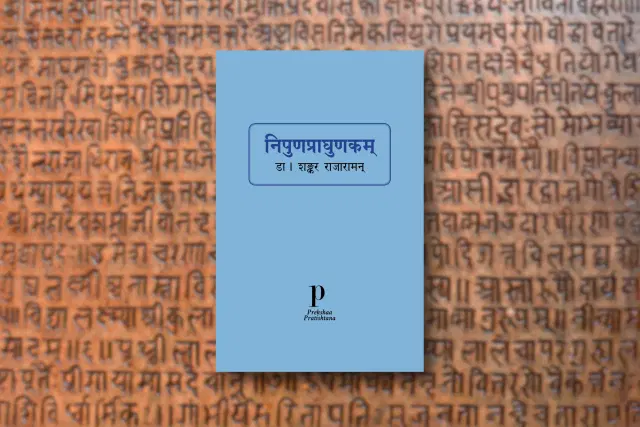
निपुणप्राघुणकम् (Nipuṇaprāghuṇakam). Dr Shankar Rajaraman. Prekshaa Pratishthana, Bengaluru.
In an era when Sanskrit theatre is often either viewed through the museum-glass of reverence or dismissed as a relic unsuited for modern expression, Dr Shankar Rajaraman's one-act Sanskrit play Nipuṇaprāghuṇakam offers a refreshing and compelling counter-argument. One of India's most original Sanskrit poets, Shankar brings to this Bhāṇa an unusual combination of classical grounding and contemporary insight.
The result is a work that simultaneously honours the architectural rigour of ancient dramaturgy and fearlessly ventures into modern urban life, without ever compromising linguistic or aesthetic authenticity.
A Classical Form, Reborn
Nipuṇaprāghuṇakam belongs to the genre of Bhāṇa, one of the ten classical types of Sanskrit drama described in the Nāṭyaśāstra. The Bhāṇa is arguably the most demanding dramatic form ever conceived in Sanskrit literature: a single actor, performing multiple unseen characters, maintaining narrative coherence solely through dialogue, gesture, and the device of ākāśabhāṣita—conversing with characters who are never actually present on stage.
Shankar embraces these conventions with full fidelity:
It is an Ekāṅka-rūpaka—a complete drama in one act.
The lone actor, Śekharaka, must voice every character encountered across the narrative.
The play opens with a Nāndī dedicated to Kāma, signalling the Bhāṇa's classical expectation of śṛṅgāra as the dominant mood.
It demands formidable virtuosity from its performer yet requires almost nothing in terms of stage design or props, a form both economical and artistically formidable.
In a time when most contemporary theatre avoids such austerity, Shankar's decision to compose a new Bhāṇa is itself a bold artistic statement. That he succeeds is an even greater achievement.
A Modern Plot in a Classical Frame
Traditional Bhāṇas revolve around viṭas (a paramour), courtesans, and their social milieu. Shankar departs from this world; not by discarding it, but by translating its narrative DNA into a modern setting.
The play is set in Kalyāṇapura (Bengaluru), whose traffic, pollution, and chaos subtly echo the bustling marketplaces and taverns of ancient urban plays. The viṭa figure becomes Śekharaka, a film scriptwriter, whose cleverness (nipuṇatā) drives the plot.
His mission is not to woo a courtesan but to reconcile two film celebrities—Milindaka, the errant hero, and Citralekhā, the offended actress, after an alcohol-fuelled misadventure at a party.
In classical Bhāṇas, the thinness of plot is well-known. The critic Dhanika even chides earlier playwrights for insufficient narrative development. Shankar turns this critique into a creative opportunity.
As Śekharaka moves through the city, he encounters a succession of characters—auto driver, barber, dance choreographer, journalist, and others—each offering a partial, biased, or self-serving version of the central event. Through their conflicting testimonies (rāga-dveṣa-coloured), the audience slowly reconstructs the truth.
This is both a commentary on modern media ecology and a sophisticated structural update to the Bhāṇa tradition.
Śekharaka ultimately resolves the situation through tact and ingenuity, saving Milindaka from professional disgrace and reuniting him with Citralekhā at her birthday celebration. The clever visitor lives up to his name.
A Feast of Classical Expression
What truly distinguishes Nipuṇaprāghuṇakam is its unapologetically classical Sanskrit. Shankar refuses the easy route of colloquialism. Instead, he proves decisively that Sanskrit can narrate modern experiences with the same grace and power it once used to evoke palaces, hermitages, and divine encounters.
The diction is pure, lucid, and recognisably classical; something a Śūdraka or Bhāsa might well have approved of.
The chandas repertoire is rich: Anuṣṭubh, Āryā, Mālinī, Vasantatilakā, Harinī, Śārdūlavikrīḍita and more.
Śabda and Artha alaṅkāras abound, but never feel ornamental; they emerge organically from the situation.
The script is peppered with learned references to Āyurveda, Mantraśāstra, Malla-vidyā, and the Nāṭyaśāstra, befitting a protagonist who is himself a literate and reflective creator.
Classical poetic conventions (kavisamayas) appear with elegance; such as the graceful swan among cranes image for a dignified woman amid lesser companions.
Discreet Purāṇic allusions (Pṛthu, Kālīya) blend seamlessly with references to traffic jams, film sets, and modern rituals of celebrity culture.
Perhaps the most delightful aspect is Shankar's ability to coin new Sanskrit words for modern objects; terms that feel surprisingly at home in the classical matrix. This is Sanskrit not as a static ornamental language, but as a living, elastic medium of imagination.
Society Through the Bhāṇa's Mirror
While the play is entertaining and linguistically dazzling, its social commentary is equally sharp.
The predatory godman (Premānanda Mahārāja) is a satire drawn from contemporary scandals.
The dance choreographer who dismisses Nāṭyaśāstra rules mirrors the modern disdain for traditional frameworks.
The pushy mother-manager of a young actress exposes the darker side of glamour industries.
The journalist eager to sensationalise events reflects media tendencies to distort and provoke.
The landscape of Bengaluru—traffic, pollution, urban disarray—serves as a realistic, almost symbolic backdrop.
In this sense, the play does what Sanskrit literature has always done: hold a mirror to society, without losing aesthetic poise.
A Triumph of Modern Sanskrit Creativity
Nipuṇaprāghuṇakam is far more than a clever experiment. It is evidence that Sanskrit theatre is still capable of renewal, not through self-conscious modernisation, but through honest engagement with contemporary life while remaining anchored in classical aesthetics.
Through Śekharaka's vivid voice, the audience experiences an entire social spectrum—from drivers and barbers to film stars and manipulative swamis. The play's structure is classical; the world it depicts is unmistakably ours.
Shankar's drama is thus like a beautifully carved antique jewel-box, but the jewels it stores are bright, modern, and unexpectedly relevant. It demonstrates, not theoretically but performatively, that Sanskrit can still speak the language of today.
For readers, actors, and scholars seeking proof that Sanskrit theatre remains alive, supple, and imaginatively capacious, Nipuṇaprāghuṇakam is a landmark work—bold, faithful, humorous, and profoundly original.
Note: You can purchase the book here.
R S Hariharan, PhD, is Assistant Professor at CAHC, JAIN University. With a background in science and technology and experience across research, linguistics, and industry, his work explores Sanskrit literature and India’s civilisational and scientific thought.
 Join our