Books
India Should Read This Book On The Chinese 'Engineering State'
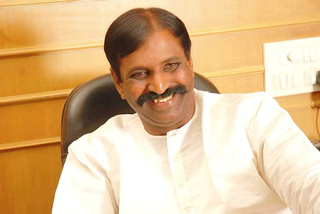
Satendra Thakur
Mar 06, 2026, 12:05 PM | Updated 12:19 PM IST
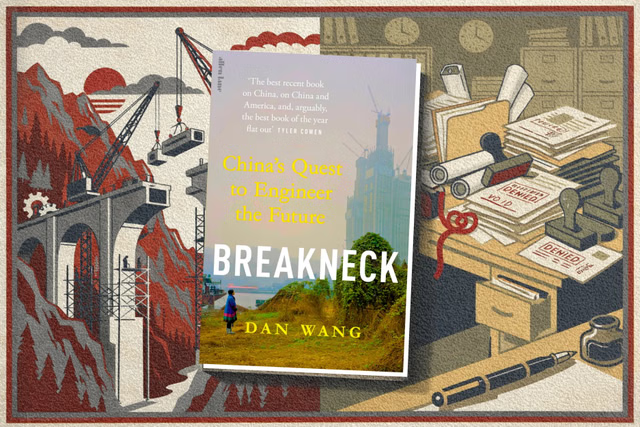
Breakneck: China's Quest to Engineer the Future. Dan Wang. Penguin. Pages: 264. Price: Rs 968.
Breakneck is the story of China as an engineering state: a civilisation that has ruled itself for millennia through the construction of things — canals, walls, railways, cities, demographic policies, pandemics — and what happens when that impulse is unleashed at the scale and speed of the modern world. For those living outside China, it makes you feel curious, then genuinely alarmed.
Dan Wang is a Canadian of Chinese origin who spent his early childhood and then a few years inside China during the Covid pandemic. He is critical of the lack of human rights in China, but his central argument survives his personal disillusionment: the engineering state, for all its brutality and irrationality, builds. It builds roads, factories, weapons, and dominance over global supply chains.
And nations that cannot build, or will not, are left behind.
This review reads Wang's book through an Indian lens: not just as admiring spectators of China's rise, but as a country that faces the important question — can we build too?
The Core Argument
Wang's thesis is simple.
China is an engineering state, which can’t stop itself from building, facing off against America’s lawyerly society, which blocks everything it can.
China is an engineering state led by builders, and America has become a lawyerly society run by blockers. By 2002, all nine members of China's Politburo Standing Committee had training as engineers. In the United States, five of the last ten presidents went to law school.
Engineers ask: what can we build? Lawyers ask: what can we block? The result is for everyone to see.
China opened the Beijing–Shanghai high-speed rail line in 2011 at a cost of $36 billion, completing 1.35 billion passenger trips in its first decade. California, seventeen years after voters approved its own high-speed rail ballot measure, has built a small stretch connecting two cities in the Central Valley — neither of which is close to San Francisco or Los Angeles. The latest estimate for California's line: $128 billion.
These kinds of direct and embarrassing comparisons make you think. Wang traces the origins of the lawyerly society to the 1960s, when elite law schools, especially Yale and Harvard, responded to the disasters of American technocracy — toxic rivers, demolished neighbourhoods, the Vietnam War — with a strategic turn towards litigation. "Sue the bastards!" became the rallying cry of a generation.
Both the left and the right worked to constrain the American state. The result of the rise of the lawyerly society was a government addicted to process, incapable of outcomes.
Building Big: The Wonders and the Wreckage
China's national achievements are staggering. Since 1980, it has built an expanse of highways twice the length of the entire US Interstate Highway System. Its high-speed rail network is 20 times more extensive than Japan's and longer than the rest of the world's put together. It builds as much solar and wind power capacity as the rest of the world combined. The country produces one-third to one-half of nearly every manufactured product globally.
But China keeps building to the point of overbuilding. It has built ghost cities, hollow skyscrapers, and a library in Tianjin filled not with books but with digital prints of book spines — a metaphor Wang uses for China itself: great hardware, no content.
But the bridges are real. The railways are real. And the pride felt by a villager in Guizhou, who can now commute to a market town in forty minutes instead of half a day, is real. Wang insists that Americans, unable to appreciate material progress because they have not felt any in decades, are blind to what this means for the Communist Party's legitimacy.
As Wang puts it:
Call it propaganda of the deed, but one way to impress a billion-plus people is to pour a lot of concrete.
The Debt Problem
Wang is equally clear-eyed about the engineering state's fiscal recklessness. Local officials like Li Zaiyong — who spent $21 billion trying to turn a coal-mining city into a ski resort, constructing faux European town squares, and was eventually jailed — are the logical result of a system that incentivises construction. The political system promotes officials who build, not officials who govern wisely.
The deeper problem is structural. Local governments lack a comprehensive property tax system, so they primarily fund themselves through land sales to real estate developers. This creates an iron link between political ambition and real estate speculation, and it has loaded provinces like Guizhou and Tianjin with debt-to-GDP ratios approaching Italy's. The engineering state builds because engineers run it. It overbuilds because its incentive structure demands it.
Tech Power: Process Knowledge over Patents
Wang's chapter on technology offers a valuable perspective on the global conversation about China's rise. He discards the American establishment's lazy explanation of "they just steal our IP". He does not deny that theft happens, but argues that this framing fundamentally misunderstands how technological power is actually built.
His concept of "process knowledge" or tacit know-how is crucial. Technology is not just patents and blueprints. It is the accumulated, embodied know-how of a workforce that has assembled millions of iPhones. It lives not in documents but in people — in the network, the fingers, and the muscle memory of those who work in the factories. The armchair experts ranting against "Assemble in India" miss this point entirely.
Shenzhen did not become the hardware capital of the world simply through state planning. It became so because Apple and Foxconn built a community of engineering practice there, which then grew its own momentum. BYD, DJI, and Huawei are all Shenzhen companies. The city built the ecosystems that produce them at scale, and then scaled faster than anyone expected.
Wang's warning to America is stark: every factory closure represents a likely permanent loss of process knowledge. A country that forgets how to make things cannot simply decide to remember. If the United States fails to scale up its inventions, it will keep inventing ladders for Chinese companies to climb.
The Engineering State's Worst Crimes
Ren tai duo. Too many people?
Being an engineering state, China does not only build infrastructure. It also tries to engineer everything else — including its people.
The one-child policy originated in 1978 when Song Jian, a missile scientist, returned from a Helsinki conference intoxicated by cybernetic population modelling. He convinced the leadership, using models that turned out to be deeply flawed, that China faced demographic catastrophe. What followed was the implementation of the one-child policy. It was one of the biggest catastrophes of the engineering state.
Forced abortions were conducted in numbers approaching the population of a large country. Doctors sometimes injected formaldehyde into newborns' heads or smothered them at birth.
The engineering state is literally-minded. It saw a population number it disliked and turned a valve. It is now trying to turn the valve the other way.
Xi Jinping, addressing an all-female audience of party cadres, instructed them to "cultivate a new culture of marriage and childbirth". Chinese families currently average 1.0 children. The valve is stuck. Apparently, engineering society is tougher than manufacturing products, and its damage is irreversible.
Many people in India also think we have too many people and demand a "population control bill". Thankfully, sanity has prevailed in India regarding this matter.
Zero-Covid
Zero-Covid followed an identical logic. Xi Jinping gave the Communist Party a number — zero infections — and organised the entire apparatus of the state around achieving it. For three years, the government made it impossible to buy ibuprofen or fever reducers, because that might help avoid detection. Shanghai's 25 million residents were confined to their homes for eight weeks. A diabetic was denied dialysis. An asthmatic nurse died at the gate of her own hospital. Drones with loudspeakers flew through residential neighbourhoods instructing residents to repress the soul's yearning for freedom.
Fortress China: The Endgame
The closing chapters examine what Xi Jinping is actually preparing for: a great-power confrontation, possibly military, with the United States and its allies. Xi's rhetoric about "extreme scenarios" and "dangerous storms" should be taken seriously. He has surrounded himself with aerospace and defence executives. China has nearly 1,800 ships under construction; the United States has five. When Russia invaded Ukraine, Ukraine burned through several years of American munitions stockpiles in months; American factories could not keep up.
Wang's warning here is stark: "manufacturing capacity is military capacity".
China's political system is consciously being organised around the logic of wartime production. Its extreme focus on technology and production comes from a specific understanding of history. As Wang writes:
China’s political leadership has long cherished its hatred of Western domination and nurtured its fantasy that the country could have succeeded if only it had science, technology, and industrial production. Every Chinese leader since the Qing emperors who lost the Opium Wars has felt aggrieved about falling behind in technology. Maintaining an industrial base is the best guarantee that China won’t lose again.
This understanding of history, and this vision of China as an industrial powerhouse, gives rise to a few special characteristics of the Chinese economy.
Focus on the Real Economy
Peter Thiel has mourned Western civilisation's focus on "bits over atoms". As he has said: "We live in a financial and capitalist age, not a scientific or technological age." Or his more famous observation: "We wanted flying cars, instead we got 140 characters."
Xi Jinping has understood this at a civilisational level. On a 2023 inspection tour of Jiangsu province, he declared that the real economy is the foundation of a country's economy, the fundamental source of wealth creation, and an important pillar of national strength. He has repeatedly described financialisation as the "fictitious economy" and contrasted it with the "real economy" of manufactured products.
State-affiliated researchers routinely denounce the hollowing out of manufacturing and financialisation in the same breath.
Xi has put a leash on digital platforms, cracked down on financialisation, and refused to let industry hollow out in pursuit of paper returns. America has gone the other way. A civilisation that once put men on the moon is now running prediction markets on absurd questions like "whether Jesus will return before 2027". This is a symbol of what happens when a society loses the habit of making things and starts making money off everything instead.
Completionism
Xi has declared a doctrine of completionism: China must never deindustrialise, not even in low-end industries. He does not want production to follow economic logic and migrate to lower-cost countries. He refuses to let industry shift out. It is strategically deliberate.
A country that retains all 419 categories of industrial production tracked by the United Nations retains the process knowledge, the workforce, and the supply chains to manufacture anything it needs — including weapons — in a crisis. China added more coal-burning capacity in 2023 than the rest of the world combined. It prefers energy self-sufficiency over a focus on climate change. It would rather burn domestic coal than import Middle Eastern oil. Xi prefers his industry heavy and his output hard.
What Stops India from Being a Great Power?
While reading the book, I was continuously thinking about what I could label the Indian state as. It lacks China's ruthless capacity to build without consent. It has the lawyerly society's capacity for obstruction without America's underlying wealth to absorb the cost. We have built a system very good at stopping things and not particularly interested in building them.
Why has India struggled to become a great power despite having the talent and the demography? Why has it failed at building infrastructure, a manufacturing base, or state capacity? These questions require being honest about several issues.
The Absence of Historical Memory and Strategic Vision
Wang identifies a crucial thread running through every Chinese leader since the Qing emperors who lost the Opium Wars: a burning civilisational awareness of why China fell behind, and a determination that it will never happen again.
Xi clearly states his technology agenda as a response to the historical humiliation China faced from Western ships and cannons. The declaration that China must become a science and technology superpower by 2035 is the expression of a lesson drawn from history. The Chinese leadership knows what it lacks, knows why it lacked it, and has organised its state around never lacking it again.
India has no equivalent historical memory embedded in its governing class. The intellectual frameworks that dominated our elite after 1947 — Gandhian self-sufficiency, Nehruvian socialism, the romantic valorisation of the village economy — never asked honestly why India was conquered and held for hundreds of years. The answer, which Chinese leaders grasped intuitively, is technology, industrial capacity, and organised state power. A nation that does not understand why it was weak cannot build lasting strength.
India has no coherent vision for the future either. It has no coherent intellectual movement arguing, as China's online thinkers do, that nation-states ruthlessly compete, that science and technology are the decisive forces, and that the state must organise itself accordingly. Instead, our public discourse is dominated by debates about reservations, secularism, and appeasement. These are all real issues, but none of them will determine whether India becomes a great power in the coming decades.
Getting Democracy Early: The Curse of the Lowest Common Denominator
India became a democracy before it became an industrialised nation. This sequence matters enormously, and it has received less serious examination than it deserves.
England, France, Germany, Japan, South Korea, Taiwan, and Singapore all industrialised before they democratised fully — or, in some cases, industrialised under authoritarian governments wearing democratic garb. China is industrialising under authoritarian rule. The historical pattern is consistent: states build industrial capacity when a small elite can direct resources without requiring consensus at every step.
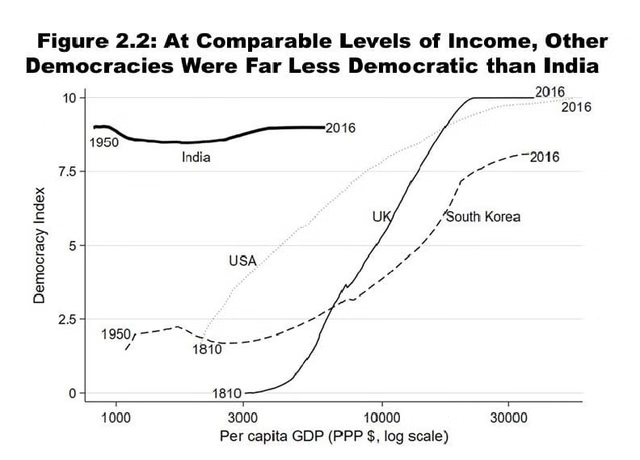
India chose differently. We got universal franchise in 1950 when the majority of the population was overwhelmingly illiterate and poor, and it came with a structural consequence that can be understood using public choice theory: in low-information electorates where public goods are difficult to monitor and credit, politicians have a powerful incentive to substitute visible, divisible, excludable benefits — targeted transfers to identifiable communities — for invisible, indivisible, non-excludable goods like roads, ports, and education quality.
Put plainly: a chief minister who builds a highway that benefits everyone gets diffuse, untraceable gratitude. A chief minister who announces a caste-specific scholarship scheme, a religious endowment, or a reservation quota creates a direct transactional relationship with a vote bank.
The second strategy is rationally superior for electoral survival. The first is rationally superior for national development. Indian politics has, for seventy-five years, optimised for the second.
The engineering state rewards construction. Indian electoral democracy rewards patronage distribution. Both systems are internally rational. But only one of them builds a great power.
The extremely diverse and heterogeneous nature of the Indian population exacerbates vote-bank politics. For the initial decades after independence, Congress mastered a political style that managed SC, ST, OBC, and Muslim communities as separate vote blocs instead of weaving them into a common civic fabric. Policies meant as temporary correctives gradually hardened into patronage networks, empowering intermediaries more than ordinary citizens.
What emerged was vote-bank politics, a steady fragmentation of the public interest, and a culture where politicians forgot about long-term goals and focused merely on winning elections.
India might be called an "election engineering state", because democracy and elections, especially the first-past-the-post system, make elections the holy grail of Indian society. To contrast India with China: while the Indian politician is busy with jati samikaran and Form-20 analysis, the Chinese politician ramps up manufacturing and builds high-speed rail (sometimes to nowhere).
PIL Culture and the Rent-Seekers' Republic
Buchanan's public choice theory explains the core dysfunction: organised interest groups beat diffuse citizens because concentrated gains fund campaigns while dispersed losses go uncoordinated.
India's licence-permit-quota raj institutionalised this. Every state permission became a rent, every rent a constituency, every constituency a veto on reform. Karthik Muralidharan talks about "concentrated benefits and diffused costs of bad policies" in detail in his book Accelerating India's Development: A State-Led Roadmap for Effective Governance.
Our civil service and bureaucracy are proceduralist too. The IAS officer's default response to risk is the file-noting equivalent of "please refer to committee". Wang's diagnosis of the lawyerly society — process over outcomes, procedure as an end in itself — should be uncomfortably familiar to anyone who has tried to obtain an environmental clearance, register a new business in multiple states, or get a highway project past a district court stay.
No institution better illustrates India's slide into proceduralism, mirroring the United States, than the Public Interest Litigation system. It has been captured by legally sophisticated interest groups who can file a PIL in any of 25 High Courts, secure a stay lasting years, at minimal cost.
Behind each case sits a civil society ecosystem of NGOs, activist lawyers, and academics whose Marxist intellectual inheritance treats every market transaction as extraction and every industrial project as oppression. This worldview directly shaped the Forest Rights Act, the 2013 Land Acquisition Act, and an environmental clearance regime that has killed projects or led to cost overruns worth hundreds of crores.
PIL was designed to give the voiceless access to justice. It has become the most powerful instrument available to organised, English-speaking, legally sophisticated interest groups to veto projects that the voiceless majority would benefit from most.
The Hindutva Alternative: A Different Vision of National Interest?
The BJP-RSS ecosystem offers something Congress structurally could not: a vision of national interest partially independent of clientelism. Its governing instinct, translated into policy, has been more consistently developmentalist than the Congress model it replaced. Direct Benefit Transfer bypassed intermediary networks that had captured social spending for decades. PM-KISAN, Ujjwala, Ayushman Bharat, and Jan Dhan represented delivery mechanisms less dependent on political brokerage than their predecessors.
By treating the Hindu middle class and aspiring poor as a unified constituency rather than always focusing on competing caste sub-groups managed through differential patronage, the BJP created political room to take decisions that cut across caste lines. Land acquisition, labour reform, and infrastructure investment are slightly easier when your coalition does not depend on the patronage networks they disrupt.
This is not an unconditional endorsement. PIL culture remains intact. The BJP runs its own patronage operations that constrain rapid industrialisation, but these are part of electoral arithmetic.
Caste politics is a reality the BJP cannot ignore, but Hindu identity at its most potent transcends caste. The party's long-term bet must be that Hindu consolidation gradually displaces sub-caste clientelism, because a party that reverts to caste arithmetic state by state will become, over time, indistinguishable from what it replaced.
Building a genuine manufacturing ecosystem requires a generation of uninterrupted, consistent, obstacle-free production and a politically predictable environment. Within the constraints of a democratic setup, a unified Hindu vote bank remains one of the few solutions to build something formidable.
The Book and Its Mirror
Wang is honest about what the engineering state achieves. Guizhou, one of China's poorest provinces, has better infrastructure than New York State at one-fifteenth the income. The Beijing–Shanghai high-speed rail is the only system in the world to recoup its capital cost through ticket revenues. China reduced global solar panel prices by 90 per cent. These are the outputs of a state that decided construction is the primary activity of government and organised its incentives accordingly.
The cost is equally clear. The engineering state evicts people, locks cities in lockdown, and destroys companies by regulatory fiat.
India cannot replicate this model. Not by choice, but by constitution. The engineering state's efficiency is somewhat inseparable from its authoritarianism. India might never build at China's speed because of its democratic setup.
But dysfunction is not the only alternative. The obstacles were built by bad incentive design, by a political culture that rewarded fragmentation, by an intellectual establishment that obstructed progress for virtue-signalling. These things can be changed. They are changing — slowly, imperfectly, and unevenly — at least in some areas.
The questions that remain are: is the change fast enough, sustained enough, and deep enough to produce a genuinely capable Indian state? And most importantly, will our ruling class develop a good vision for the future?
Dan Wang wrote a book about China, but every serious Indian should read it, because the book is not just about China. It is a book about what it means for a state to build, and what is lost when a state forgets. Reading Dan Wang should produce, at minimum, an unease about how much slower we are moving than we need to.
Satendra Thakur is a Policy Consultant. He can be found on X at @Satendra_x.
 Join our