Books
Iron Man: Reading Sardar Patel Through A Memorial Archive, Not A Biography
Mohini
Dec 25, 2025, 11:25 AM | Updated 11:25 AM IST
Life and Works of Sardar Vallabhbhai Patel (1953). Parshotam Das Saggi, (Ed.). Overseas Publishing House. Pages: 278. Price: Rs.1833.
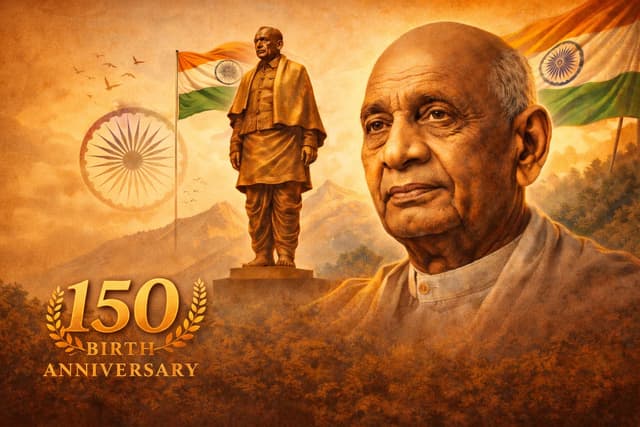
As India commemorates the 150th birth anniversary of its “Iron Man”, Sardar Vallabhbhai Jhaverbhai Patel, the inquisitive mind naturally drifts back to ponder upon the active years of Sardar’s political life and the picture of post-independent India.
There is no better way to immerse oneself in this stream of reflection than by flipping the pages of Life and Work of Sardar Vallabhbhai Patel. Written just three years after Patel’s death, the book is not a typical linear biography but rather a mosaic, carefully constructed by multiple hands and voices, assembled by the Sardar Vallabhbhai Patel Commemoration Committee and edited by its General Secretary, P.D. Saggi, in 1953.
It belongs to a unique post-independence genre, what might be termed a memorial archive, which sits at the intersection of politico-historical documentation and public mourning, where history and homage are integrated together to craft a national legend. The book is intended as “a nation’s homage”, as conveyed clearly on the title page itself, both as an attempt to pay a eulogical ode to the great statesman and to provide moral instruction for a country just beginning to revel in its freedom.
It opens with a foreword by C. Rajagopalachari, whose invocation of Patel as “Lakshmana to Gandhi’s Rama” sets both the tone and the intent. This is not a detached historical analysis but rather a devotional and civic offering, a way to immortalise the man who had by then left his mortal form.
Following this, the book unfolds in concentric thematic layers rather than chronological order. At its centre are two framing pieces that act as the core of the corpus: Patel’s “Recollections” (pp. i–iii), a short autobiographical meditation written in 1949, and Saggi’s “Portrait of a Patriot” (pp. iv–xii), an editorial essay that combines biography with political appraisal.
Around these, the documentary and commemorative sections are developed with over 30 pages of “Tributes” from contemporary statesmen such as Rajendra Prasad, Nehru, Radhakrishnan, and princes like Karansingh; a “Photo-Chronicle” capturing Patel’s public life; selections of thematic extracts from his writings under rubrics such as Bardoli Satyagraha, Education, Independence, States, and Swadeshi; and a substantial collection of his speeches, twenty-five in total, ranging from “The Rowlatt Bill” to “Produce and Distribute Equitably”.
The concluding section, “Biographical Sketches”, gathers twenty-one essays by his contemporaries, such as K.M. Munshi, G.V. Mavalankar, and Allan Campbell-Johnson, each offering a unique slice of his personality, whether a moral portrait, administrative analysis, or personal memory. Such a fragmented structure demands that readers mentally rearrange its parts to grasp the complete portrait of a man who forged a nation from 562 fragmented princely states.
The Making of the Sardar: Early Days
The book opens with Patel’s autobiographical “Recollections”, which reveal intimate dimensions of his childhood. Born on October 31, 1875, in Karamsad, Gujarat, a village Patel describes with much affection, he was the middle child, neither privileged eldest nor pampered youngest, left free to cultivate “the usual independence, initiative, and resources of a middling”.
His childhood anecdotes and stories, at times full of childish mischief and rebellion, foreshadow his inclination towards resisting injustice as well as collectivising action. They depict his internalisation of the maxim that would define his future leadership: “If there is something to be done, why wait for others? Why not me?”
Saggi’s “Portrait of a Patriot” makes this textbook narrative of inevitable greatness more nuanced. Saggi notes that Patel was no precocious revolutionary from the outset. The future Sardar initially kept aloof from Gandhi for two years after the Mahatma established his base in Ahmedabad.
As a successful barrister, Patel was “critical of everything” with “a lawyer’s mind” and took his time to test the waters. Saggi observes that he “first got on, then got honour, and then got honest”, a progression that acknowledges Patel’s pragmatism as the primary guide of his nationalist transformation.
From Bardoli to National Integration
The 1928 Bardoli Satyagraha marks a significant point in Patel’s political journey, providing him with the platform for a unique synthesis of Gandhian ethics and organisational efficiency. The book devotes substantial space to this campaign, recognising it as Patel’s political laboratory, where he perfected the techniques that would later integrate India.
When the British raised land revenue by 30 per cent despite famine conditions, Patel organised 87,000 peasants into “one compact unit”, refusing to pay the increased tax. The government tried everything: seizing lands, auctioning property, and imprisoning resisters. “17,000 men and 40,000 buffaloes were locked up in a small, insanitary house for over three months,” the book records. Disease and stench ravaged them, and yet not a single peasant flinched.
The inculcation of such steely resolve can be largely attributed to Patel’s rhetorical genius and his ability to mould the psychology of the masses. He taught patience: “Let them break open your house and your locks, let them take away all your belongings, and suffer them to do it smilingly. Do not lose your temper.”
Yet his remarkability lies in his coupling of this Gandhian counsel with a harder-edged call for action: “Give up your wedding festivities, a people at war with a mighty government cannot afford to indulge in these pastimes.”
The use of military metaphor here, by telling people that they are at “war”, is deliberate. It serves to remind the masses that the struggle is ultimately theirs to fight, reframing satyagraha not as an effort led by one leader but as a call for change arising from the collective will, realised through discipline and efficiency. This transformation of Gandhi’s moral philosophy into military-style organisational discipline depicts how he earned his well-deserved title of “Sardar” (commander).
Yet Bardoli is also the junction where the book’s multiple perspectives reveal a crucial tension. Gandhi accepted the government’s eventual compromise terms. The Sardar, who had “spurned” the governor’s earlier offers, now had to acquiesce to Gandhi’s decision. This pattern, Patel as organisational tactician balanced by Gandhi’s strategic patience, repeated throughout their partnership.
If Bardoli tested Patel’s organisational genius, the integration of 562 princely states after independence proved his supreme achievement. The book dedicates extensive coverage to this “bloodless revolution unprecedented in history”, with contributions from princes themselves testifying to Patel’s extraordinary diplomatic skill.
Here, the book’s contributors evoke a plethora of metaphors: Sardar as “General at every critical moment, when the Rubicon has been crossed and boats burnt”, as “India’s Bismarck”, and as “the master architect in the building of the national edifice”. The consolidation of over 560 states, dealing with obstinate princes raised for a life of royal indulgence, is recounted as a near-miraculous feat.
The scale of the challenge dares one to imagine it. These states ranged from Hyderabad, larger than France, to tiny territories of a few square miles. Their rulers wielded absolute power backed by British paramountcy. Many harboured fantasies of independence, while religious tensions divided Hindu and Muslim rulers.
To prevent India from being torn into shreds, Patel deployed exemplary strategic acumen. His response to each state was based on an appraisal of its contextual realities, depending on which he deployed a calibrated mix of persuasion, pressure, and, if necessary, force.
With Junagadh, where the Nawab wanted to join Pakistan despite opposition from the majority population, Patel simply waited until internal contradictions collapsed the regime. With Hyderabad, where the Nizam’s intransigence threatened communal war, Patel unleashed “police action” that subdued the state in six days and then, with remarkable sagacity, made the same Nizam the constitutional Rajpramukh (Governor) of Hyderabad.
This diplomatic combination recurs in testimonies from multiple Rajpramukhs. Digvijaysinhji Jadeja of Jamnagar, renowned as the Good Maharaja in Poland, writes, “He was a man who saw years ahead and had the organising abilities to prepare for years ahead.” Yuvaraj Karansingh of Kashmir, the only son of Maharaja Hari Singh, notes, “His advice and guidance were constantly sought by us all.”
Patel, Nehru, and the Roads Not Taken
The book’s handling of the Patel–Nehru relationship, often sensationalised in the media, is remarkably mature, acknowledging both ideological differences and the ultimate unity of vision.
Throughout the book, multiple contributors juxtapose the policy differences: Nehru’s idealism versus Patel’s pragmatism, Nehru’s socialist sympathies versus Patel’s acceptance of private enterprise, and Nehru’s internationalism versus Patel’s security-focused nationalism.
Allan Campbell-Johnson, observing the two, notes that while Nehru was a “man of the world”, whose “world reputation and world outlook” extended abroad, Patel “deliberately confined himself to the tasks that involved surveillance of domestic politics”, prioritising the task of nation building.
Despite these differences, the testimonies uniformly emphasise mutual loyalty, trust, and commitment to the shared vision of a united India. For Nehru, Patel was “a friend and colleague and comrade on whom one could invariably rely”. Digvijaysinhji records that Patel was heard mentioning on his deathbed, “We should take care of Nehru, because Nehru will be extremely grieved by the passing away of the Sardar.”
Their relationship’s complexity stems from complementary temperaments rather than ideological opposition. As G.B. Pant observed, “If Panditji is India’s sublime inspiration, Sardar is its great discipline.” The book suggests, rightly, that India needed both, and that Patel’s willingness to serve rather than rule, despite perhaps enjoying greater organisational support within the Congress, represents one of modern India’s foundational political settlements.
The Hidden Patel: Vulnerability and Humour Behind the Iron Facade
The book’s most refreshing moments emerge when the narratives pierce Patel’s stern exterior to reveal the “motherly qualities” beneath. While the public knew him as the “Iron Man”, “stern to his enemies” and a man who “commanded universal love”, the biographical sketches reveal a far more complex emotional architecture.
Gandhi’s experience, based on his joint imprisonment with Sardar, is especially moving: “I never knew him to possess motherly qualities. If the slightest thing happened to me, he would be out of his bed. He superintended every detail in connection with my comforts.”
This tenderness extended beyond Gandhi. Rajkumari Amrit Kaur writes, “However worried and depressed one was when one went to the Sardar, one came away from him cheerful and filled with hope.”
His relationship with his daughter, Maniben, also provides a notable glimpse into his personal life. While Pattabhi Sitaramayya sees her as a “virgin vigil”, the perfect picture of devotion and sacrifice, other observers like Campbell-Johnson recognise her political acumen, strategic influence, and direct involvement in “all the Sardar’s official and top-secret activities”.
Patel also had a penchant for humour. Saggi notes that he “enlivened politics with humour” and enjoyed risks. When the plane carrying him to Jaipur crash-landed, he dismissed it as “just a variety of entertainment”, offering a glimpse of his dark humour.
Limitations and Lessons
Despite its commemorative richness and testimonial detail, the book’s chief strength also proves to be its biggest limitation. Its proximity to events and the surge of raw emotion that guided its commissioning naturally inhibited its framing as a holistic, well-rounded work. As a result, the volume suffers from what historians call “presentism” and from an inability to separate eulogy from analysis.
Moreover, Patel’s personal vulnerabilities are presented almost entirely through tribute or anecdote, usually mediated by public personas: his daughter, his closest colleagues, and his principal adversaries. Rarely is there mention of weakness or self-doubt. The Iron Man’s softness is preserved as sacrosanct legend, shielded from fuller and more complicated scrutiny.
The book records, in the voice of Pattabhi Sitaramayya, that Patel died with “no home, no property, and no assets” except “24 lakh rupees” left to the nation and the Bardoli Ashram. Yet this could not be farther from the truth.
He died with his home in every nook and corner of the nation he forged with his hands. His property was the immeasurable love blooming in the hearts of followers, friends, and foes alike. His greatest asset was a united India.
As Dr Rajendra Prasad noted in his tribute, Patel’s achievements “will be written in letters of gold and will occupy an immortal place in the history of India”. Seventy-two years later, that verdict has only grown stronger.
What this book preserves, in all its fragmented and polyphonic richness, is not merely the record of nation building but the human complexity of the builder himself. Thus, on this 150th birth anniversary, we honour not a distant saint but a complex political genius who relished the ability to “get the best of life” even amidst challenge and sacrifice.
 Join our