Books
Neither Feminist Nor Socialist: The Pragmatist Nationalism Of Kamladevi Chattopadhyay
Sanish Kumar
Mar 07, 2026, 07:15 AM | Updated Mar 06, 2026, 12:27 PM IST
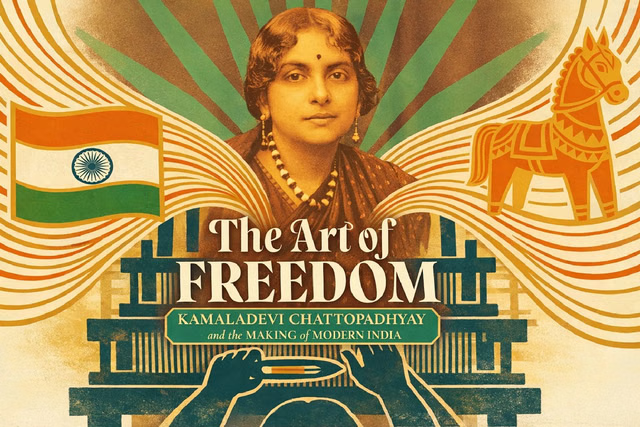
The Art of Freedom: Kamaladevi Chattopadhyay and the Making of Modern India. Nico Slate. 4th Estate India. Pages: 368. Price: Rs 528.
Kamladevi Chattopadhyay, a prominent advocate of women's rights during the Indian freedom struggle, was an Indian in the truest sense. While advocating for almost all kinds of female rights, she declined to call herself a "feminist" and called it a Western construct that ignored the sufferings and plights of poor women in colonies. Her extensive love for Indian art and craft also reflected her rooted Indianness.
Indian Lives series editor Ramachandra Guha describes Kamladevi as a "feminist among the nationalists, a socialist among the feminists, and a pragmatist among the socialists." But the vast contributions of Kamladevi resist any attempt to bracket her under a single tag. Kamladevi Chattopadhyay: The Art of Freedom by Nico Slate is an extensively researched work on all facets of her life, including her personal life, which was equally tumultuous as her political life during the national movement.
Kamladevi is widely known to have persuaded Gandhi to open the Salt Satyagraha for women's participation. The book also explores her ideas, as presented in her various publications over the years. While discussing her views on women's rights, nationalism, intersectionality, and solidarity among what would later be called third-world countries, the author effectively presents her ability to link one issue with another.
Her contributions to the promotion of Indian handicrafts as the head of the Indian Handicrafts Board, and to advancing "third world feminism" on international platforms such as the International Alliance of Women, all find detailed mention in the book.
A Born Rebel: Both in Politics and Personal Life
The book begins with the introduction of Kamladevi's innately rebellious attitude, which she borrowed from her mother, Girijabai Dhareshwar. Girijabai was from a wealthy landowning family in Mangalore. She held great concern for the suffering of Indian women due to traditional gender norms.
Girijabai played a key role in the establishment of the Mahila Sabha, the first women's organisation in Mangalore, in 1911. It was connected with nationwide women's organisations such as Bharat Stree Mandal and Bharat Mahila Parishad, and carried out cultural activities and discussions on political and social topics. Kamladevi was profoundly influenced by her mother in her defiance of norms that made women disabled in the social sphere.
Kamladevi's personal life was as eventful, or one may say tumultuous, as her political life. Even though Kamladevi maintains silence about her personal life in her texts, the author made an arduous effort to cover it in the book.
She was married into a wealthy family when she was just eleven. What unfolded after was dramatic. Just over a year later, her husband died, and she became a child widow. Widows were expected to live a secluded and solitary life. This was not so for Kamladevi, her mother, and her husband's father, Nayampali Subbarao, a well-known progressive figure from Mangalore. She continued her studies and carried on her love for art.
Kamladevi got remarried to Harindranath Chattopadhyay, a poet and playwright and the brother of Sarojini Naidu, in 1920. The marriage stood as a direct defiance against prevalent regressive social stigma: she bucked the conventions of widowhood and overrode the boundaries of caste, region, and language by marrying into a Bengali Chattopadhyay family.
Kamladevi and Harin were drawn together by their shared love for arts and theatre. She accompanied Harin to London and enrolled at Bedford College. However, her second marriage also did not prove very helpful. Harin's womanising character became a hindrance in their married life, and they started distancing themselves. In the early 1930s, Kamladevi decided to file for a divorce, though with a heavy heart.
Once again, it highlights Kamladevi's advocacy of women's agency over social norms. Ups and downs marked her personal life in her relationship with her husband Harin, her son Rama, and even her mother Girijabai.
Kamladevi remained silent and avoided publicly discussing her personal experiences and relationships in her texts and memoir. However, Nico Slate argues that her personal encounter with societal conservatism had an immense influence on her disregard for child marriage and rejection of social taboos against widow remarriage. Her personal interest in theatre influenced her advocacy for freedom of expression and creativity, especially for women.
A Truly Indian Conception of Women's Empowerment
Kamladevi became the first Indian woman to run for a legislative seat when she contested the Madras Provincial Legislative Assembly election in 1926. Although she lost by a narrow margin, she established herself as a prominent voice for women, alongside Sarojini Naidu and Margaret Cousins.
She then went on to become the first secretary of the All India Women's Conference (AIWC) in 1927. The AIWC would become the most influential women's organisation in pre-independence India, hosting a range of socio-economic and political discussions related to women, apart from advocating for women's education in law, medicine, social science, and fine arts through scholarships.
Raising the minimum age of marriage had been among the chief agendas of the AIWC since its inception. Kamladevi spearheaded the AIWC's campaign in support of the Sarda Bill, drafted by Har Bilas Sarda, a legislator and former judge, to raise the age of marriage, and the Gour Bill, introduced by Sir Hari Singh Gour, to raise the age of sexual consent. She pioneered the AIWC's effort to advance progressive legislation to reform unwanted traditions in Hindu society.
In 1945, Kamladevi submitted her statement to the Hindu Law Committee in support of divorce rights, inter-caste marriage, and the daughter's right to a share in the father's property.
Kamladevi voiced almost all the concerns related to women's empowerment in India. At a meeting of the Bengal Social Reform League in Calcutta in the late 1920s, she emphasised that women's advancement should not be limited to ending child marriage or the purdah system. It was about bringing psychological and attitudinal change in society towards women, the only way to achieve real social reform.
However, she, like Sarojini Naidu, declined the label of "feminist" for herself, calling it an essentially Western idea. She considered the prevailing conception of feminism to be narrow in approach and unsuitable for the context of women in Indian society.
She posited that "feminism," as used in the West, had become a battle of the sexes and a conception of male antagonism, often pitting women against men rather than against the patriarchal institutions themselves. Kamladevi emphasised that the collaboration of men was requisite to weave a successful women's movement.
She skilfully invoked history to instil a sense of responsibility towards society by emphasising that women in the Vedic period were active and freely participated in social and political life on the subcontinent. In the author's analysis, "she walked a fine line, challenging patriarchy without besmirching Indian society."
Her deviation from radical Western feminism also reflected the political necessity of the time, since the Indian struggle against colonial authority was numerically dominated by prominent male personalities such as Jawaharlal Nehru, Sardar Patel, and Mahatma Gandhi.
An All-Round Nationalist
Some call her a feminist, while some label her a socialist. However, "pragmatist nationalist" seems the most appropriate term for Kamladevi. She kept her nationalist view rooted in experiential pragmatism above anything else, always linking other issues like the women's movement and social justice to the Indian struggle for independence.
Her expansive cosmopolitan conception of the "indivisibility of freedom," that no one could be truly free if, anywhere in the world, any section of society remained oppressed, linked the Indian freedom struggle with other anti-colonial sentiments around the world. Expressing her support for the anti-apartheid movement in Africa, she advocated for partnership among the Eastern countries to fight for independence, the right to self-determination, and recognition.
Highlighting the immorality of imperialism by Western powers, she told the AIWC delegates in 1944 that "the world cannot be divided into islands of slavery and freedom," and everyone should have independence.
The book mentions an incident of 26 January 1930 that displays Kamladevi's heroic nationalism and refutes the colonial government's allegation that she was a communist. A massive crowd was celebrating the Congress's proclamation of Purna Swaraj, and some communists tried to replace the raised Indian tricolour with the hammer and sickle. Kamladevi saw it as a defilement of "India's honour" and ran to defend it. Her hands were bruised in the struggle, but all she cared about was the protection of the Indian flag from being replaced with a communist flag.
Kamladevi's nationalism extended beyond her engagement in anti-colonial theatre during the 1920s and 1930s; she also actively voiced the Indian cause through her speeches and writings on an international stage.
After Partition, addressing refugee rehabilitation became the first and most critical challenge for the newly independent nation. Kamladevi established the Indian Cooperative Union (ICU), which played a vital role in creating the town of Faridabad for homeless refugees who arrived in India with nothing.
Built on the cooperative model, Faridabad quickly developed into a thriving community. This initiative not only demonstrated her compassion for the refugees but also provided India with a model of community-based development that later inspired government-led community projects launched in 1952, reaching approximately seventeen thousand villages.
Aestheticism Rooted in Heritage
Despite the tragedies surrounding her life, both political and personal, Nico Slate argues, Kamladevi's sense of aestheticism was never blurred.
In 1944, during the Bengal Famine, Kamladevi was leading a local women's group doing relief work in Bankura. Outside a modest house, she was struck by the beauty of two terracotta horses and brought them back to Delhi. In the years ahead, the Bankura horse would become a symbol of India's craft renaissance.
For her, art is "not the luxury of the rich few, it is the life-giving force that touches all ordinary things of everyday common use with its vitality, transforming them into sublime things of joy." (p. 198)
In her AIWC presidential speech in 1944, she highlighted the need for training women in handicrafts for the benefit of the economy and the advancement of women's creativity, which can express the aesthetic dreams of humankind in delicate creations.
Kamladevi linked the struggle for beauty to the struggle for freedom by highlighting how the cultural conquest of India was closely intertwined with its political and economic enslavement. She, like many anti-colonialists, argued that the handicraft industries were systematically destroyed by the British in order to have a larger market for their industrial goods.
Her love for handicrafts was also closely bound up with her vision of self-sustaining communities and cooperatives. Kamladevi highlighted the decisive role of the cottage and handicraft industries in thickly populated Indian villages in driving out unemployment and poverty.
The practical application of her idea of handicrafts to promote community development was evident in the refugee camps in Delhi, which the ICU, under her leadership, was driving. Women in those camps were trained in embroidery, tailoring, weaving, and stitching. The ICU controlled the famous government department store, the Central Cottage Industries Emporium (CCIE), a national and international market where refugees could sell their handmade sarees, shawls, scarves, and other goods.
Apart from the ICU and CCIE, she helped establish other key institutions to empower artisans and sustain their arts: the Cottage Industries Board, the All India Handicrafts Board, the Crafts Council of India, and the National Crafts Museum.
An Unalloyed Analysis
The book presents an unalloyed revisiting of Kamladevi's life, politics, and ideas through arduous investigative research. What makes it particularly engaging is its comprehensive presentation of her life and its all-encompassing, careful analysis of her experiences.
There is no shortage of sources for reconstructing her life. Kamladevi was herself a passionate writer and published many of her writings, including her memoir, Inner Recesses, Outer Spaces, in 1986, which holds valuable details about her life. However, she primarily focused on her public engagements and was reserved about her private life, in both her memoir and interviews.
This is where the book truly distinguishes itself from other works on Kamladevi. Throughout the text, Nico Slate seeks to highlight the impact of her personal experiences on her advocacy of women's rights, her love for art and theatre, and the promotion of handicraft heritage rooted in her minimalistic aestheticism.
A not-so-significant snag that caught my attention is the author's evident prejudice when he mentions the Delhi Assembly bombing incident, when Kamladevi was observing the proceedings from the gallery. The author seems to disapprove of the "careful and calculated" radical action taken by Bhagat Singh and Batukeshwar Dutt, despite Kamladevi herself having a positive impression of the incident.
However, this minor quibble does not undermine the book's overall significance, which derives from the author's rigorous attempt to revisit the sources associated with Kamladevi's personal and political life and present a fair and objective analysis of her life and politics.
 Join our