Books
Our Cities Have A New Address: The Suburbs
Deepesh Gulgulia
Nov 08, 2025, 01:26 PM | Updated 01:43 PM IST
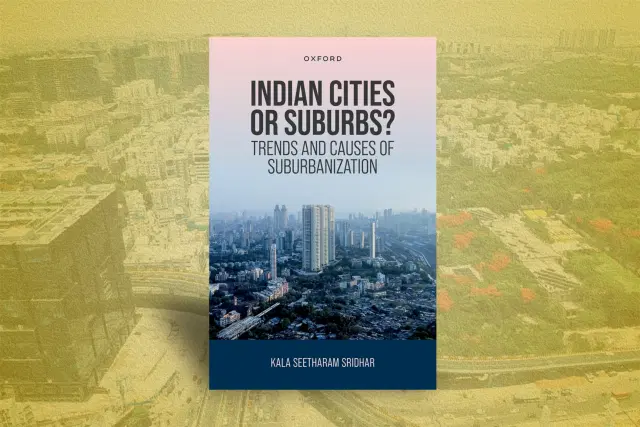
INDIAN CITIES OR SUBURBS: Trends and Causes of Suburbanization. Prof. Kala Seetharam Sridhar. Oxford University Press. Pages: 384. Price: Rs 1397.
When I first picked up Kala Seetharam Sridhar’s Indian Cities or Suburbs? I planned a straightforward book review. After further reading, I realised this was not a conventional book at all but a giant dataset. The experience upended my approach. Rather than a traditional review, I realised an op-ed driven by the book’s data would better serve readers.
The numbers in Sridhar’s research are striking. Using granular satellite data, she finds that the majority of urban Indians already lived outside city cores decades ago, and that share has only grown. On average across 112 cities, 64 per cent of the urban population was “suburban” in 1975, soaring to 82 per cent by 2015.
In other words, four out of five city dwellers today live in areas beyond the historical centre. Even a city like Bengaluru (Bangalore), defined in the study as beyond a 2 km radius of its downtown, had 89 per cent of its people living outside the core in 1975, rising to 95 per cent by 2015. The trend is clear: urban India has been sprawling outward for decades.
This outward spread has flattened our cities’ density gradients, a complex term that simply means people are no longer packed tightly at the centre with sparse outskirts. Instead, populations are more evenly spread. In 1975, Chennai’s population density fell sharply as you left the centre, declining about 15 per cent per kilometre. By 2015 that drop was only around 11 per cent per kilometre. In technical terms, Chennai’s density gradient “flattened” from (-0.16) to (-0.11) over four decades, meaning the city’s population thins out much more gently now as one moves outward.
Sridhar finds similar changes elsewhere. In fact, the steepest population density slope among Indian cities declined from 0.59 in 1975 to just 0.05 by 2015, a dramatic levelling. City centres still have more people per square kilometre than fringes, but that difference is far smaller than it used to be. For newcomers, the takeaway is simple: our metros are no longer one compact core but broad pancakes of people.
The Metropolitan Footprint Doubles
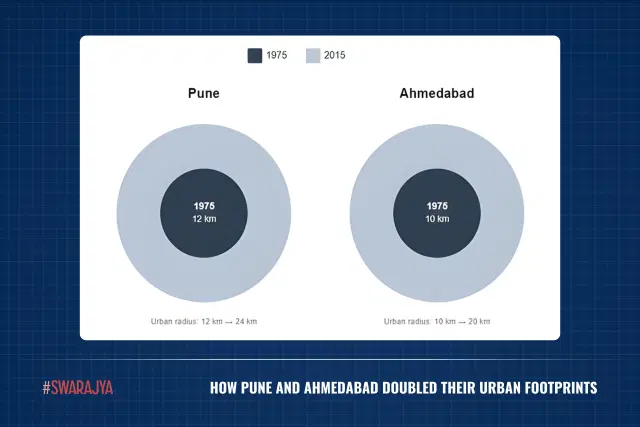
Numbers aside, what does this sprawl look like on a map? Sridhar’s analysis of satellite imagery shows cities physically spreading their footprints, often doubling in radius. Consider Delhi: in 1975, the Delhi urban agglomeration’s populated extent was roughly a 10 km radius; by 2015 the metro spanned over a 20 km radius, more than twice as wide.
Mumbai’s built-up radius stretched from 15 km to 30 km in the same period. Even historically dense Kolkata grew from about 14.5 km to 23.5 km. Chennai, the capital of Tamil Nadu, expanded from an 18 km radius to roughly 30 km. In short, our largest metros have swelled to cover areas several times larger than before 1980.
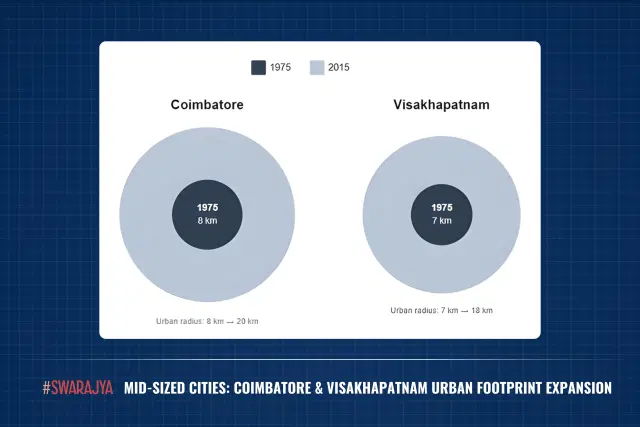
This pattern is not limited to megacities. Mid-sized cities have ballooned too, though from smaller bases. In Andhra Pradesh, Visakhapatnam’s urban radius grew from about 7 km to nearly 18 km, and even a tier-2 city like Guntur doubled from 3 to 6 km.
Some smaller cities saw explosive proportional growth. Guwahati’s footprint almost tripled, from roughly 5 km in 1975 to 15 km by 2015. On the other hand, certain towns barely budged. Vijayawada’s radius crept from 6.0 to 7.4 km. But the overall picture is one of outward expansion across the board.
Jobs Follow People: The Polycentric City
One might assume that even if people live in far-flung suburbs, jobs remain concentrated in downtowns, the classic “commuter city” model. But Sridhar’s data suggests employment, too, has been suburbanising, though unevenly. Only 21 per cent of Bengaluru’s jobs are located within a 2 km radius of its city centre, meaning nearly 79 per cent of employment is now outside the traditional core.
In 1980, most economic activity in cities like Ahmedabad was clustered in a few central business districts (CBD). By 2010, those districts’ share of total jobs had fallen sharply. In Ahmedabad, the old CBDs accounted for 83 per cent of jobs in 1980 but only 69 per cent by 2010 as employment migrated outward. The city became polycentric, sprouting 28 secondary job hubs by 2018.
A similar story is playing out in other metros: Mumbai’s newer commercial zones in Bandra or Navi Mumbai, Delhi’s Gurgaon and Noida boom, all hint at jobs dispersing.
Crucially, Sridhar’s research also drills down into smaller cities, especially in Karnataka, offering a rare detailed look at employment patterns outside the big metros. The findings are fascinating. Some mid-tier cities have surprisingly dispersed job layouts, while others remain tightly centralised.
For example, Hubballi-Dharwad (the twin city in North Karnataka) had an extremely flat job density gradient of about (-0.06) in 2011, indicating jobs were almost evenly spread rather than all crammed downtown. Coastal Karwar was even more extreme, with essentially no central dominance, showing a gradient around (-0.03), likely because its jobs stretch along the highway and naval base.
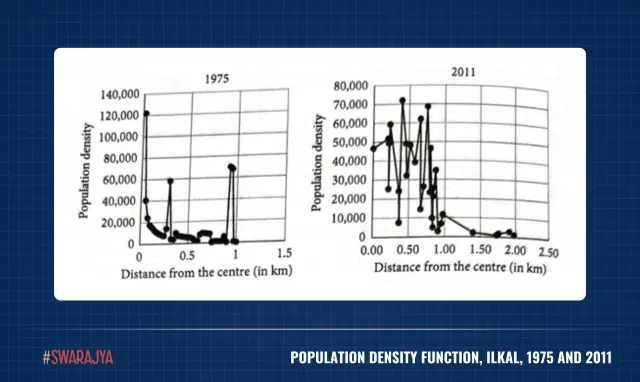
In contrast, Ilkal, a small town famous for sarees, was found to be highly centralised. Its job density drops off so steeply that it registered the sharpest employment gradient (2.04) among 43 Karnataka cities studied. In Ilkal, nearly all employment is crammed in the core bazaar area, a pattern more akin to a traditional town. Mysuru and Shivamogga fell somewhere in between. Their employment density slopes, around –0.5 to –0.8, show moderate central concentration.
What this means is that larger cities in India are increasingly polycentric, developing multiple business districts, while many smaller towns still have a single dominant centre.
The suburban train you board in Mumbai or the tech park on the outskirts of Bengaluru are proof that jobs are no longer all downtown. People are living in the suburbs and working there in greater numbers.
Indeed, Bengaluru’s own job dispersal is clear: only one-fourth of the city’s employment lies in the old centre, within 2 km, the rest in outer zones. That said, the pattern is not uniform everywhere. Local geography, infrastructure (a highway in Karwar’s case), and city planning can produce different outcomes. But broadly, the logic of suburbanisation, cheaper land, new business parks, special economic zones and similar developments has pulled employment outward along with residences.
The Cost of Sprawl: Services Cannot Keep Up
Perhaps the most sobering insights from Indian Cities or Suburbs? come from what happens after a city sprawls: can everyone still get basic services? To find out, Sridhar and colleagues conducted an extensive survey of 1,500 households across Bengaluru’s core and periphery, comparing access to water, sanitation, schools, and healthcare. The findings confirm what many urban migrants learn the hard way: living in the far suburbs often means making do with fewer services.
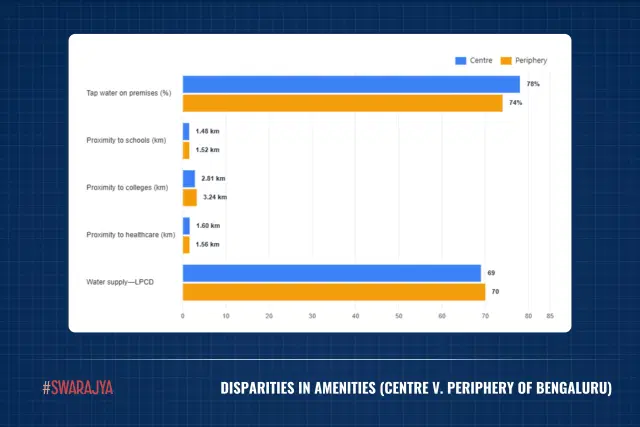
Take water supply. The Government of India’s benchmark for urban water provision is 135 litres per person per day (LPCD). In reality, Bengaluru struggles to meet even half that. Citywide, households get only around 70 LPCD on average, and this average masks disparities. In well-serviced central wards, 78 per cent of households have access to piped water, whereas in the outer wards that share is much lower. The book’s survey found a significantly smaller fraction; barely half of suburban homes, by my own estimate, had a direct supply.
In short, if you live in the new BBMP outskirts, you are likely relying on borewells or tankers. Both central and peripheral residents were getting only around 70 LPCD, a severe shortfall from the 135 LPCD norm, but peripheral communities do not even have the same infrastructure coverage to start with.
Education and healthcare tell a similar tale. A centrally located Bengaluru ward typically has a school or college within a kilometre or so. In peripheral wards, schools are fewer and farther between, and families often travel much longer distances to reach quality educational institutions.
Health facilities are even more starkly divided. In core areas, over 70 per cent of households can access a hospital or clinic within 1 km, usually meaning a short drive or even a walk to a doctor. In the outskirts, fewer clinics exist, and many residents have to go 5–10 km for a government hospital, pushing them to depend on smaller private clinics. Indeed, the survey noted most households, even in poorer outer areas, end up preferring costlier private medical care due to the paucity of nearby public clinics.
The end result is clear: service deficits are rife in the suburbs. From patchy water supply and longer commutes for a school or doctor to inadequate sewer lines and waste collection, India’s city governments have simply not extended services at the pace at which people have extended the city’s boundaries.
Bengaluru’s case is illustrative but not unique. Similar inequities likely exist in the peripheral wards of Delhi, Mumbai and other booming metros. The book’s data-driven approach puts hard numbers to what many urban families intuitively know. A newly developed layout on the urban fringe might offer affordable housing, but the residents often face an everyday grind for basic amenities that their friends in older parts of the city take for granted.
Limitations of the Book
Sridhar’s book is a trove of information, but it is also important to acknowledge its limitations and context. First, much of the analysis relies on satellite-derived data up to 2015. That means the last decade of urban changes, from new metro lines and flyovers to post-2015 real estate booms, is not captured. The suburbanisation trends likely continued, but we do not see them in this dataset.
Second, Sridhar adopts the classic monocentric city model to measure density gradients; she operationalises ‘central city’ as only a 2 km circle around a chosen point. This is a pragmatic choice, not a claim that Indian CBDs (Central Business Districts) are that small.
Outside-India formulas, such as the US metropolitan statistical area definitions or the 5-mile CBD buffers used in Chinese studies, simply do not fit Indian realities. Every country has its own morphology, regulatory regime, and commuting patterns, so there is no one-size-fits-all definition of a city centre. By that yardstick, even residents 3 km from Connaught Place or Chennai’s Marina Beach areas well inside municipal limits were labelled suburban.
This method is a clever way to get consistent measurements across more than 100 cities, but it is not how most of us usually distinguish city versus suburb. In reality, many areas considered “city proper” fall outside the 2 km core. So, the absolute percentages (82 per cent suburban, etc.) should be taken in the context of that definition. The key insight is the change over time, not the precise value.
Another quirk is the use of GHSL (Global Human Settlement Layer) satellite data. While it is wonderfully granular and free, it does not always line up with official city boundaries or ward data. In some cases, it might over- or under-estimate populations at the fringes.
The book itself notes that city boundary changes can confuse such analysis. For instance, when many suburbs were merged into city limits in the 1990s, it mathematically boosted “central” population density in some datasets without any real-world shift. There are also cases such as Ilkal, flagged as an anomaly, where the GHSL-based method found extremely high centralisation for both people and jobs, perhaps due to how the town’s built-up area was recorded.
These issues do not negate the findings, but caution is warranted in interpreting them. The broad patterns, such as cities sprawling and density gradients flattening, are robust; the exact numbers might differ under another definition or data source. Crucially, the data in Indian Cities or Suburbs? stops at 2015, which begs an update, especially after the pandemic and work-from-home trends that could reshape urban form in ways still unfolding.
Where Do We Go from Here?
Our governance structures have not kept up with metropolitan expansion. Big metros often fragment into dozens of municipalities and villages around the core city. This patchwork makes planning and service delivery disjointed. We need empowered metropolitan authorities or councils that can coordinate across city and suburb boundaries.
For example, creating a unified transport authority to plan metro, bus, and road networks for the whole urban agglomeration, or a common zoning regime for the region. Governance reform also means strengthening peri-urban local bodies, giving them the capacity and finances to provide urban services. Today’s suburban town councils should be tomorrow’s well-run city governments, not neglected stepchildren of the big city next door.
The data on service deficits calls for an “infrastructure first” approach to expansion. Instead of letting people move in and then playing catch-up on roads, pipes, and cables, new urban extensions must be planned proactively. This could mean identifying future growth zones and investing in trunk infrastructure ahead of time, extending metro lines, building ring roads, and laying water and sewage lines before populations explode. It is a strategy China and Singapore have followed in many cities: build the transit and utilities to guide where the city will grow.
An infrastructure-first approach can also include mandating developers to contribute, for instance, requiring large housing projects in the outskirts to include provisions for water, sewage treatment, and community facilities from the outset. The goal is to avoid the current scenario of “build houses first, scramble for utilities later.”
One reason suburbs boom is that building in the urban core has been so difficult. Outdated regulations, such as low Floor Area Ratios and rigid heritage rules, often prevent densification of inner cities. The result is that growth leapfrogs outward into empty land because that is easier than redeveloping a derelict mill in town. We need brownfield incentives to reverse this.
Simplify approvals and offer tax breaks for redeveloping unused or underused urban land within city limits, such as old industrial plots, defunct warehouses, or large bungalows that could be apartment blocks. At the same time, discourage reckless greenfield sprawl by imposing higher infrastructure impact fees on far-flung developments. By making it more attractive to build “up and in” rather than “out and out”, cities can accommodate population growth without endlessly extending their boundaries. It is time to fill in the doughnut hole and revive the cores so that suburbs grow by choice, not because the city pushed everyone out.
We should consider a bold new deal for those living on the urban fringe: a Suburban Service Guarantee. Just as rural areas have a right to certain basic services, city suburbs should be guaranteed a minimum urban service standard. This could be a charter stating that any newly incorporated urban area or ward must receive, within five years, universal piped water, sewage systems, all-weather road connectivity, a primary health centre, and a government school within reasonable distance. The guarantee would push authorities to budget and plan for essential services whenever a city expands its limits or when an erstwhile rural settlement becomes urban.
It flips the script: instead of citizens chasing the municipality for water or garbage pickup, the municipality is obliged to ensure these services keep up with growth. The Suburban Service Guarantee could be backed by state or central funding tied to urban reforms, much like the Smart Cities Mission, creating accountability so that no part of a city gets left behind as it expands.
As I finished this book, one thing was very clear: the future of Indian cities lies in how we manage the suburbs. We must not view them as accidental overflow, but as integral parts of the metropolis deserving planned infrastructure and services. The task now for policymakers and city leaders is to catch up with the reality on the ground. India’s urban story is being written in the suburbs; it is time to give that story the thoughtful planning and visionary policy it urgently needs.
Deepesh Gulgulia is a Policy Consultant and a Lawyer.
 Join our