Books
Secularism In Theory, Persecution In Practice: What Neeta Nair's 'Hurt Sentiments' Gets Wrong
Shubham Srivastav
Mar 04, 2026, 09:00 AM | Updated Mar 02, 2026, 04:18 PM IST
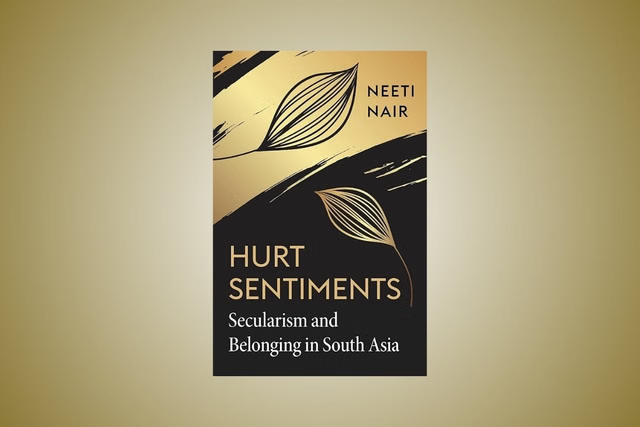
Hurt Sentiments: Secularism and Belonging in South Asia. Neeti Nair. Harvard University Press. Pages: 333. Price: Rs 699.
What is it like to be a minority in India, Pakistan, and Bangladesh, all of which share a chequered past? How does one make sense of secularism when minorities, particularly in Pakistan and Bangladesh, are facing systemic persecution and recurring episodes of mob violence?
Recent weeks, marked by some of the most barbaric and gruesome killings of Hindus and other minorities, highlight the gap between normative ideals and lived realities. This perhaps forces a troubling inquiry and raises the question of whether an existential crisis is looming over minorities in Pakistan and Bangladesh.
These questions are directly connected with secularism and state ideology in South Asia. A book that seeks to examine the South Asian variant of secularism in a comparative vein, with a focus on "hurt sentiments" and minority belonging, must be read not only as a historical inquiry but as an intervention into ongoing debates and the asymmetry between secularism in theory and in practice.
Hurt Sentiments by Neeti Nair is a comparative historical study of how secularism and claims of hurt sentiments shaped the state ideologies of India, Pakistan, and Bangladesh. Nair situates the book within the turbulent historical and political terrain of these nations with markedly different constitutional, political, and ideological commitments.
Drawing on both primary and secondary sources, including archival materials, constitutional debates, news reports, editorials, cultural controversies, legal cases, and a personal interview, Nair traces the evolution of the project of secularism in these nations, the political implications of claims of hurt sentiments, and how minorities negotiate belonging within India, Pakistan, and Bangladesh.
As Nair notes, the book aims to "analyze the trajectory of the subcontinent's religious minorities and the national projects of state-led secularism and building an Islamic State [...] in a comparative vein." (p. 3)
Nair is concerned with the fate of nations in which both the secularism project and the making of laws are shaped by claims of hurt sentiments. She presents secularism as a contested state ideology evolved through conflict, historical rupture, and negotiations, and accordingly poses certain fundamental questions in the introduction:
How did religious minorities fare in these lands that were divided in their name? Did the 40 million Muslims who remained in what became India find representation in electoral institutions such as Parliament? If Pakistan were to be a homeland for Muslims, and later an "Islamic State," would its religious minorities be represented in institutions such as the National Assembly? How did its Constitution guarantee Muslims and non-Muslims fundamental rights such as equality of status and freedom of thought, expression and belief? (p. 3)
The Project of Secularism in India, Pakistan, and Bangladesh
Nair stresses the need for definitional clarity on "secularism" in the South Asian context as opposed to the Western construct. The Western construct puts secularism in watertight compartments that advocate a rigid separation of religion and state. Nair argues that India, Pakistan, and Bangladesh practise a South Asian variant that is neither anti-God nor anti-religion but that respects all religions.
But what actually is this South Asian variant, in theory and in practice? And how was it shaped across India, a constitutional democracy; the Islamic Republic of Pakistan, the pillars of which rest on Islam as the state religion; and Bangladesh, which is inherently Islamic but claims to be a secular state?
The secularism project was formalised in India with the enactment of the Constitution. Although the term "secular" was officially added to the Preamble through the Constitution (Forty-Second) Amendment Act, 1976, secular ideals were enshrined in the Constitution ab initio. Sovereignty, democracy, republicanism, justice, liberty, equality, and fraternity formed the bedrock of the Indian Constitution. Rule of law, constitutionalism, constitutional morality, equality before law, prohibition of discrimination, equality of opportunity, and protection of fundamental rights formed the ideals that the executive, legislature, and judiciary are supposed to uphold.
Nair argues that "Gandhian secularism, forged in the fires of partition, strove to build an India where Hindus, Muslims, Sikhs, Christians, and Parsis could belong in equal measure." (p. 5) And so they not only belong equally; India gives every religion a sense of belonging to thrive fearlessly.
On the question of minority safeguards, Nair claims that "in 1947 it was not partition as much as the Gandhi murder trial and Godse's defence statement in the following year that resulted in the lack of minority safeguards in the Indian Constitution." (p. 6)
To substantiate this claim, Nair examines the debates of the Constituent Assembly on separate electorates and argues, in the first chapter, "Gandhi's Assassination, Godse's Defense, and the Minority Question," that the demands of Muslim minorities for separate electorates or reservation and those of other minorities for joint electorates were not accepted. Nair calls this a politics of Muslim abandonment wittingly adopted by the Congress at the defining moment of the drafting of the Constitution.
Nair argues that political safeguards in elected bodies, such as separate electorates, weightage, reservation of seats in the legislature or proportional representation, and reservation in the services, were reduced and eliminated from the final draft, even as religious minorities' rights to religious and cultural expression were protected in the fundamental rights section, giving India its reputation for tolerance and pluralism. (p. 71)
Sardar Vallabhbhai Patel, who was the chairman of the Advisory Committee on Minorities, in his address to the Constituent Assembly on 26 May 1949, made certain pertinent points as to why certain political safeguards like reservations were removed from the final draft. He termed the demand for a separate electorate as communal electorate and against the secular and democratic framework of India, and thus said:
For a community to think that its interests are different from that of the country in which it lives, is a great mistake. Assuming that we agreed today to the reservation of seats, I would consider myself to be the greatest enemy of the Muslim community, because of the consequences of that step in a secular and democratic State... But there are some people who worked for separation, who claimed all throughout their lives that the two nations are different and yet claim to represent here the remaining "nation"... In this country we want the atmosphere of peace and harmony now, not of suspicion but of trust. We want to grow. India today is suffering from want of blood. It is completely anaemic. Unless you put blood into its veins, even if we quarrel about concessions or reservations, we will get nothing. We have to build up this country on solid foundations.
What this reveals is that during the foundational moment, India focused on fostering peace and harmony by practising the ideals of Vasudhaiva Kutumbakam (The World is One Family), Sarva Dharma Sama Bhava (Equal Respect for All Religions), and Ekam Sat Vipra Bahudha Vadanti (Truth is One; Sages Call it by Various Names).
What about Pakistan, then? Nair traces the foundational moment and ideological character of the Islamic State of Pakistan in Chapter 3, "Debating the 'Islamic State' in Pakistan."
Pakistan was partitioned from India on religious lines and therefore some leaders intended that the state ideology be theocratic, in nature and in practice. During the debates in the Constituent Assembly of Pakistan, Maulana Mufti Mahmood of the Jamiat-i-Ulema-i-Islam, a political entity known for its fundamentalist and extremist stance, proclaimed, rather warned:
I would say that on the eve of the establishment of Pakistan, we had declared in unequivocal terms that the official religion of the State would be Islam and that those who did not like the fact would be well to make their exit. (p. 189)
This religious ideology got translated into political and state ideology, and the tenets of Islam became the governing philosophy.
Nair, more often than not, cites Jinnah's first address in the Constituent Assembly of Pakistan, wherein he declared unequivocal support for religious minorities:
You are free to go to your temples, you are free to go to your mosques or to any other place or worship in this state of Pakistan. You may belong to any religion or any caste or creed; that has nothing to do with the business of the state. (p. 149)
But this stance was limited to debates inside the thin-walled Constituent Assembly of Pakistan; in practice, no safeguards were offered. Unlike India, the newly formed Islamic State was not a constitutional democracy.
Although Pakistan passed the Objectives Resolution in March 1949, having Islamic clauses deriving from God's sovereignty over the universe and emphasising the state's role in enabling Muslims to order their lives in accordance with Islam, it was only in 1956 that Pakistan adopted its first Constitution.
Nair highlights the enabling clause of the Objectives Resolution: "There will be no enactment in the House which is repugnant to the fundamental principles of the Holy Quran and the Sunna and provisions will be made for the citizens to live their lives on the basis of Islamic equality and brotherhood." (p. 166)
Syed Khalilur Rahman, in his analysis, found it indisputable that Pakistan was established as a laboratory for Islamic ideology. Bhupendra Kumar Dutta of the Pakistan National Congress articulated his apprehension explicitly:
[It] would not be so if the remaining millions of followers of faith other than Islam could somehow be disposed of. If you call it "Islamic", you assign the near about a crore of non-Muslims in the state a subordinate position to the limit of obliteration. The position they are faced with is that either they remain here as serfs or zimmis or clear out... To the common people, both Muslims and non-Muslims, Islamic State has only one meaning. It has no place for any non-Muslim. The non-Muslims, if they choose to remain here, have only to wait for conversion to Islam. (p. 168)
This suggests the uncertainty about the fate of minorities in Pakistan.
Nair then turns to the creation of Bangladesh and what shaped its becoming a democratic and secular nation, in Chapter 4, "Islam and the Secular in Bangladesh and Pakistan." The Bangladesh case presents a normative problem: what did Bangladeshi secularism entail, and could it deliver to minorities?
In this chapter, Nair offers a different perspective, tracing the shifts in ideology that marked East Pakistan's gradual disengagement from West Pakistan, how East Pakistanis engaged with the rhetoric of Islamic brotherhood, and how secularism, an ideology associated with the Awami League, evolved in this deeply religious land.
A country forged in 1971 as the result of a crucible of bloodshed was soon declared a secular country. During the foundational moment, Bangabandhu Mujibur Rahman declared secularism as the state policy of Bangladesh:
Our secularism is not against religion. Muslims can practice their religion; the state has no power to stop them. Hindus can practice their religion; no one has the power to stop them. Buddhists can practice their religion; no one has the power to stop them. Christians will practice their religion; no one can stop that. Our only qualm is using religion as a political weapon. (p. 225)
Bangladeshi secularism was not against religion but claimed to respect all religions and safeguard their interests. Tajiuddin Ahmad, the first Prime Minister of Bangladesh, declared Bangladesh a secular state wherein, unlike Pakistan, protections would be accorded to minorities:
We should like to reiterate here that what we have already proclaimed as the basic principles of our state policy, i.e., democracy, socialism, secularism, and the establishment of an egalitarian society, where there would be no discrimination on the basis of race, religion, sex or creed. (p. 221)
In later years, Islam became the state religion of Bangladesh as well. Although one of the pillars on which Bangladesh was formed was secularism, in subsequent years it was gradually diluted. Today, Bangladesh, with the same political character, sits alongside Pakistan as a state antithetical to minorities' existence.
Hurt Sentiments, Hate Speech, Blasphemy, and Uneven Evaluations
Since the book is written in a comparative vein and a substantial part deals with hurt sentiments, hate speech, and blasphemy, it becomes necessary to evaluate critically whether the author treats the subject matter with objectivity and describes all sides of the debate evenly.
When do religious sentiments get hurt, who decides sentiments have been hurt, and what happens after sentiments are deemed hurt? These are questions pertinent to the debate but remain unanswered by the author in the larger scheme of the book.
Nair presents India's case as one marred by clashes between Hindus' hurt sentiments and the freedom of speech and expression. She cites examples such as the ban on books written by Aubrey Menen and other authors who misappropriated and twisted the tales of the Ramayana. Nair further cites the example of Sahmat's exhibition Hum Sab Ayodhya, which faced the ire of Hindus for depicting a misappropriated Ram Katha and an objectionable poster from the controversial Dasaratha Jataka.
However, in India, it is not the majority alone that makes claims of hurt sentiments. Before and after the Partition, minorities alike have invoked such claims. Some even go further, taking the law into their own hands and justifying killings as "justice" enunciated by God. Recent examples include the gruesome killings of Kanhaiyalal in Udaipur and Kamlesh Tiwari in Lucknow.
Nair's narrow approach leads her to argue that it is Hindus' hurt sentiments that shaped the political sphere and state ideology in India. When she cites examples of books banned for hurting Hindu sentiments, she omits cases wherein claims were made of hurting Muslim sentiments, such as the ban on Ram Swarup's Understanding Islam Through Hadis.
Although Nair debates the ideology of Pakistan and Bangladesh, there is an uneven evaluation in comparison to India. The case of Punjab Religious Book Society vs. the State, a fictitious short story Sard Lash, and the recent ban on Amar Sonar Bangla, a composition of Rabindranath Tagore, for being anti-Islamic are very few examples from Pakistan, while the history of Pakistan is full of cases of Muslim hurt sentiments. Further, the author cites no case from Bangladesh.
What history suggests is that when sentiments allegedly get hurt in Pakistan and Bangladesh, things get worse. Pakistan, since its inception, has been a safe harbour of Islamic terrorism, fundamentalism, and extremism, while Bangladesh has become one over the years. This has shaped the internal politics of both nations and therefore cannot be ignored in the context of the book.
Although Nair does not examine the role of fundamentalism and extremism in shaping the ideological character of Pakistan and Bangladesh, as she does in the case of India, readers need to have an understanding of it.
How Are Minorities Actually Faring in India, Pakistan, and Bangladesh?
The discourse on secularism and minorities is futile without analysing how minorities are actually faring in these three countries, because the position today is starkly different in Bangladesh and Pakistan as compared to India.
In 2024, the Economic Advisory Council to the Prime Minister of India released a report titled "Share of Religious Minorities: A Cross-Country Analysis (1950–2015)" that gives a thorough cross-national descriptive analysis of minority status worldwide between 1950 and 2015, as measured by shifting proportions of national populations over 65 years.
The report highlights that in Bangladesh in 1971, Hindus made up the second-largest portion of the population at 23 per cent. Buddhists and Christians were the next two largest groups at 0.66 per cent and 0.17 per cent respectively. Bangladesh's Hindu population fell to 8 per cent in 2015, a 66 per cent loss, in a world where minorities grew by 22 per cent on average. This steep decline highlights the extent of the demographic shock that Bangladesh's Hindu population experienced over the 65-year span. While the Christian population rose to 0.53 per cent, the Buddhist population stayed steady at 0.63 per cent.
With regard to Pakistan, the report highlights that between 1950 and 2015, despite Bangladesh's formation in 1971, Pakistan's Muslim population grew by 10 per cent, from 84 per cent to 93 per cent. The Hindu population in Pakistan experienced demographic shocks, with their proportion decreasing from 13 per cent in 1950 to just 2 per cent in 2015. This represents a staggering 80 per cent decline, against a global average minority growth of 22 per cent.
India is a silver lining in this regard. Between 1950 and 2015, the proportion of the majority Hindu population fell by 7.82 per cent (from 84.68 per cent to 78.06 per cent). The percentage of Muslims rose from 9.84 per cent in 1950 to 14.09 per cent in 2015, a 43.15 per cent rise. The Christian population increased by 5.38 per cent, from 2.24 per cent to 2.36 per cent. The proportion of Sikhs rose by 6.58 per cent, from 1.24 per cent in 1950 to 1.85 per cent in 2015. Even the proportion of Buddhists increased noticeably, from 0.05 per cent in 1950 to 0.81 per cent.
This is the state of affairs in what the author calls "an age of rampant Hindu majoritarianism." Minorities are not only accorded equal status alongside Hindus but their interests are also protected within the constitutional framework. If at all it were about hurting sentiments leading to the persecution of minorities and their position getting diminished and undervalued, the steep decline of minority populations in Pakistan and Bangladesh tells altogether the other story.
While many factors may be responsible for the demographic change, systemic persecution is one of the factors largely responsible for the decline.
Final Word
Nair's comparative intervention reveals that the secularism project in India, Pakistan, and Bangladesh was shaped not only by constitutional ideals but also by historical ruptures and political anxieties. Although she stresses the South Asian variant of secularism that respects all religions, Pakistan and Bangladesh, in comparison to India, mark a stark departure from the principle.
Nair's assessment of hurt sentiments appears to be more critical of India than of Pakistan and Bangladesh. In this way, the book suffers from an uneven evaluation. Nair succeeds in outlining the normative ideals of secularism but falters on the analytical assessment of praxis between "what is" and "what ought to be."
Nair offers a timely yet incomplete inquiry on a subject that operates not only in theory but in practice as well. Despite its limitations, the book is a decent read for anyone interested in studying India, Pakistan, and Bangladesh in a comparative vein on the subject of secularism and majority-minority politics.
 Join our