Books
The Long Game Exposed: How 'Termites' Maps Ideological Warfare
Gargi Joshi-Goyal
Dec 21, 2025, 11:02 PM | Updated 11:02 PM IST
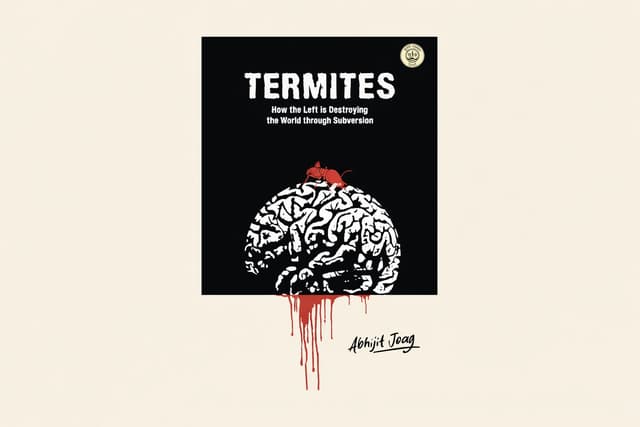
Termites: How the Left is Destroying the World through Subversion. Abhijit Joag. Suruchi Prakashan. Pages: 284. Rs 499
Abhijit Joag, author of Asatyamev Jayate on the distortion of Indian history, turns in Termites to a larger civilisational question: how Marxist and post-Marxist ideas have evolved, migrated and embedded themselves in culture, law and everyday vocabulary, and what that means for Bharat.
I picked up the book almost thinking, “I already know that Left is Destroying the World.” After finishing it, I can say without hesitation: even if you think you already know this subject, you still must read this book. The value of Termites lies not merely in its stance, but in its historical mapping, its intellectual genealogy, and its close tracking of how ideological revolutions elsewhere mirror patterns unfolding in India today.
Joag does not just warn the reader; he equips the reader, with case studies and recurring patterns showing how every communist experiment, no matter how “new” or “reformed”, has ended in bloodshed, anarchy and cultural erasure.
A Book About Patterns, Not Opinions
Joag’s argument does not rest on stray quotations or sensational claims. He shows that every time Marxism reinvented itself and promised to be humane, scientific and just, the result was censorship, destabilisation, economic decay and violence. Revolutions, he argues, begin not with guns but with the destruction of memory, mockery of faith and systematic dilution of cultural confidence. Before a Marxist revolution kills people, it first kills pride.
A key thread here is Critical Theory. Joag explains how classical Marxism, built on worker versus capitalist, failed when workers preferred progress over permanent revolution. Rather than abandon the ideology, its architects recast culture itself as a form of capital. Society was sliced into cultural groups, each assigned degrees of “oppression” or “privilege”, and pushed into conflict. The battlefield shifted from factories to culture – the arena we now inhabit.
He then offers a timeline from European revolutions to Soviet strategies, Maoist experiments and Western cultural wars, and maps these methods onto India. The “normal” academic environment, routine derision for Hindu traditions and the constant guilt drilled into us about our civilisation suddenly look like part of a familiar script. What appears spontaneous activism often reveals itself as strategic destabilisation; what is sold as “liberation” frequently turns out to be slow civilisational corrosion.
A Warning from History
One of the book’s strongest contributions is its clear explanation of ideological subversion. Drawing on Soviet intelligence frameworks, Joag describes how nations are made to rot intellectually and culturally from within. Like termites hollowing wood, the attack remains invisible until the structure collapses.
He outlines four stages: demoralisation, where citizens are convinced their civilisation is worthless; destabilisation, where real or manufactured identity divisions are inflamed; revolution, where institutions are captured and reshaped; and normalisation, where dissent is silenced and the new order is presented as inevitable.
He also shows how the Left has learnt to use democratic mechanisms against democracy itself. Elections, courts, universities and media are entered, captured and then used to delegitimise opponents, all while speaking the language of rights and freedom. It is a long game; the pattern becomes obvious only when structures begin to crumble. The book helps readers recognise this process early enough not to become unwitting instruments in it.
When Revolution Comes Disguised as Progress
Another major strength of Termites is its focus on language. Every ideological takeover speaks in the vocabulary of justice: gender equality, minority rights, workers’ welfare, individual freedom. None of these causes is wrong. Yet, once captured by Marxist activists, they become instruments of permanent agitation rather than genuine reform. Across nations, the revolution appears as compassion but demands absolute control.
Joag’s discussion of intersectionality on p.137 is a telling example. The idea claims that two people fighting for the same cause may not be at the same level of oppression, and that the “more oppressed” must take precedence. Once narrative-makers assign these tags, truth and merit become irrelevant. If a group has been successfully branded oppressed, whatever its members do or say stands pre-justified. Thus a “lower caste” man can trump a “higher caste” woman, even though the same framework insists women are oppressed and men are oppressors. Caste overrides gender; the goal is not justice but a self-adjusting conflict engine.
On p.144 Joag cites Thomas Sowell’s critique of this oppressor–oppressed lens. When the world is always seen only through that binary, conflicts never resolve because labels never expire. Those marked as oppressors are trained to feel permanent guilt; those marked as oppressed can rationalise hatred or even crime as the inevitable result of injustice. On p.160 Joag shows how success is recast as a product of “privilege” and failure as proof of “social injustice”, especially in the minds of children. Entitlement grows, focus shifts from equal opportunity to equal outcome and individuals learn to depend on an all-powerful state to correct “unfair” results.
Interpretation and Sources
Coming from a background of reading Meenakshi Jain and J Sai Deepak, I am used to dense primary citations and very clear boundaries between fact and inference. Termites does provide extensive references, especially in the early chapters on Marx and Engels, whose backgrounds, personal conduct and open contempt for civilisations like ours are quoted with chilling effect. It matters to know who these men were, because their ideas still command unearned reverence.
At the same time, Joag is more willing than some scholars to weave interpretation into the narrative. Often this helps, drawing out connections that a casual reader might miss. In a few places, though, the conclusions might have been left more open for readers to infer. In such a contested field, it is important for readers to stay aware of where quotation ends and commentary begins, so that critics cannot dismiss the underlying research as “agenda” without engaging with it.
Joag also exposes the knowledge-production machinery sustaining this ideology. On p.206 he describes dubious research papers, thick with fashionable jargon, which create confusion rather than genuine understanding. This “fake science” wraps weak claims in technical language and peer-review prestige, intimidating dissenters into silence.
A Civilisational Lens: Why Bharat Must Pay Attention
Societies that collapsed into simple oppositions – proletariat versus bourgeoisie, church versus science – were easier to capture. India has historically accommodated diversity without erasing difference, held contradictions without rigid dogma and sustained spiritual plurality without a central church.
It is precisely this resilience that ideological movements seek to fracture. A civilisation rooted in Dharma cannot be easily forced into oppressor–oppressed boxes, so it must first be confused, mocked and stripped of confidence. Joag contrasts a rights-obsessed society, where everyone fights for “my rights” and an external authority must mediate constant conflict, with a duty-oriented Dharmic society, where one person’s duty becomes another’s right. He also warns that if our civilisational anchors are successfully attacked, India’s multiple identities – language, caste, sub-caste, sect, even family traditions – can become fault lines even sharper than those in the West.
The attack on the family, analysed on p.162 and p.196, fits this pattern. In the name of individualism, communities and families are weakened, leaving individuals emotionally, morally and spiritually isolated. Joag backs this with striking statistics on how hollow American society has become after these ideas spread. Extreme individualism, perverted feminism, sexual revolution and transgenderism form, in his view, a four-pronged assault that has pushed the Western family to the brink. The same combination is now being exported to societies that blindly imitate America.
Lessons From the West, Guidance for the Future
Termites is most useful when it treats Western experience as a warning, not a model. For example, Joag’s analysis of “perverted feminism” traces where the movement began, who its early leaders were and how their ideas evolved into the agenda visible today. He does not deny the need to address injustice against women; instead, he shows with data how this ideological strain, when imported into Bharat as “women’s empowerment”, often deepens fractures. If we truly care about women, we must address their concerns in a Dharmic, context-sensitive way rather than by copying a movement that has already damaged other societies.
Modern activism, he notes, is often less about debate than intimidation. Drawing on Alinsky’s Rules for Radicals, Joag shows how ridicule, double standards and constant redefinition of words are used to control discourse. Cancel culture, coordinated media campaigns and on-ground violent radicals together create a climate where most people, who still know right from wrong, realise what was happening only after the damage is done. Reading this book trains the eye to recognise these manoeuvres earlier.
Education and information control complete the picture. Joag explains how Marxist ideas enter curricula, training and academic jargon, and on p.234 he describes how Big Tech now strangles free speech while pretending neutrality. Overall, the book gives a roadmap of where Bharat will end up if these patterns go unchallenged.
Conclusion: A Necessary Read
Termites is not merely a book about why Left ideology is harmful. Many already sense that. Its real contribution lies in showing how the harm is done: by tracing roots, mapping global patterns, unpacking ideas like culture as capital, and revealing how language, “science” and institutions are weaponised long before any open revolution.
If you think you understand Marxism and modern progressive movements, this book will deepen that understanding by exposing their evolution. If you feel prepared to debate them, Termites will show you how debates themselves are structured and manipulated. Above all, it sharpens clarity – about history, about language and about the stakes for Bharat’s civilisation. At this moment, that clarity is not a luxury. It is a duty.
 Join our