Books
We, The People Of India: Who Really Made India's Constitution?
Shubham Srivastav
Dec 26, 2025, 07:30 AM | Updated Dec 25, 2025, 09:03 PM IST
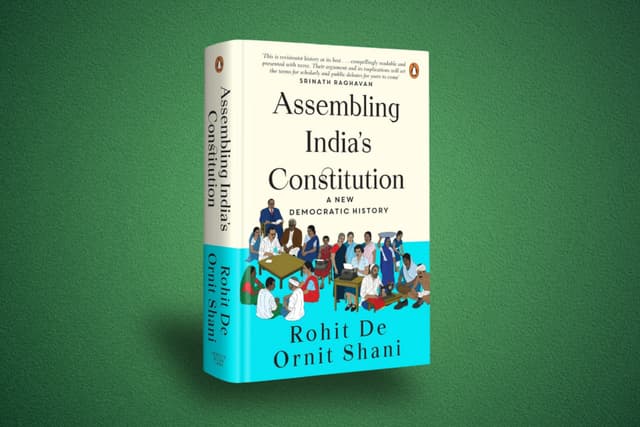
Assembling India’s Constitution: A New Democratic History. Rohit De and Ornit Shani. Penguin Random House India. Pages: 324. Price: Rs 799.
History has not one but many different episodes, and every episode has its own culmination point. Those events or episodes leave an indelible mark on the conscience of a nation, making it extremely necessary to keep revisiting those defining moments, not just for the sake of history but to emphasise the importance of the efforts of the people who made them possible. That very point sets the stage for the next episode.
Constitution-making was a defining moment, profoundly created to mark a transition from ‘colonial India’ to ‘sovereign, republic and democratic India’. But how exactly did we arrive at the culmination point, namely the enactment and adoption of the Constitution of India, that too for India as one geographical entity?
After centuries of struggle and suffering under incessant attacks from Islamist and colonial forces, India was on the brink of finally attaining independence and being recognised as a newly established polity that would be sovereign and have its own Constitution enacted by the people and for the people. However, even before India had formally attained independence in 1947, deliberations on the Constitution of India had already begun as part of the Cabinet Mission Plan of 1946.
In Assembling India’s Constitution: A New Democratic History, Rohit De and Ornit Shani present a revisionist history of India’s constitutional project by revisiting, recalibrating, and retracing India’s foundational moments, at a time when India celebrates the seventy-fifth anniversary of the adoption of the Constitution of India. Divided into six chapters, the book is not just another historical account of the making of the Constitution of India.
Typically, one would assume that, in order to help readers understand the constitution-making process, the authors would have limited themselves to the voluminous debates of the Constituent Assembly. However, to the readers’ surprise, the book marks a radical shift from a conservative approach and offers an alternative story by moving beyond the Constituent Assembly debates and focusing on ‘we, the people’ who engaged intensely with the making of the Constitution.
In the words of the authors:
This book offers an alternative story. It explores the making of the Indian Constitution as it emerged outside the Constituent Assembly, driven by diverse publics across the breadth and length of India’s territory and even beyond it. By turning our gaze away from the Constituent Assembly, Assembling India’s Constitution, offers a new history and a new paradigm for understanding the making of the Constitution.
‘We, the people’ and the constitution-making
The book opens by narrating the anxieties and concerns of the Moshalchi community, which lived in Char Balasia village of Bengal, about their future in the proposed Constitution of India. Standing on the brink of the Partition of India and Pakistan, they were unclear whether their future lay on Indian soil or East Pakistan soil.
While they professed and practised Islam, they were considered and treated as outcasts by the Muslim community, and their marginalisation and social status added to their apprehensions about the future. With the hope that they would achieve stability and have their identity recognised and rights crystallised, eighty Moshalchi, on behalf of over 2,000 families, wrote a letter in May 1947 to the President of the Constituent Assembly of India, which read as follows:
The Country is now on the threshold of momentous constitutional change. We did not press for justice so long as everything was in a fluid state. But now it is high time that the authorities should take stock of the situation and mete out even-handed justice. In the future constitution we should be treated as a separate community, and there must be provisions for separate representation for us in the legislature…so that our own culture and tradition may be maintained.
Having extensively researched archival materials, the authors bring forth voluminous evidence of public participation in constitution-making through letters addressed to the Constituent Assembly, conferences, talks, and resolutions that communicated demands and constitutional visions to the Assembly.
One such example is from early 1947. When the Constituent Assembly first convened, three weeks later the newly formed Adiwasi Gond Vidyarthi Mandal held its first conference at Nagpur and passed a resolution with sixteen demands regarding ‘aboriginal students’ and the provision of educational facilities for them. This resolution was sent to the Secretary of the Constituent Assembly.
The authors’ toiling efforts in undertaking extensive research by moving beyond traditional constituent power theory and offering readers an untold story are commendable. However, the assertions made in the introductory chapter, that ‘the so-called constitution makers had a vested interest in erasing this public effort to emphasise the importance of their own labour’ and that ‘we write at a time when the Indian constitutional order has been under considerable strain. Executive aggrandisement, judicial abdication and constitutional amendments have weakened long-standing institutional practices and expectations since 2014’, are devoid of merit. No explanation or evidence is provided in later parts of the book to corroborate these claims.
One Constitution, One Constituent Assembly, but different constitutional actors
The end result was the Constitution of India, debated at length for about three years in the Constituent Assembly and the sub-committees formed within it. In popular understanding, the most well-known constitutional actors engaged in constitution-making were the members of the Constituent Assembly.
Rohit De and Ornit Shani introduce readers to various underrated constitutional actors who were also actively engaged in the constitution-making process, albeit from outside the Assembly. These actors belonged to all walks of life. Even institutions such as the executive and the judiciary from various states and provinces actively engaged in constitution-making.
From Nalinkanta Barkakati’s letter to tribal demands, the authors make it clear that there was neither a clear beginning point nor an ending point in people’s desire to communicate their constitutional visions to the Constituent Assembly. Barkakati, writing from Gauhati in Assam, was concerned about the future Constitution, the design and substance of which were being deliberated in Delhi. He therefore wrote a letter on 8 January 1947 to the President of the Constituent Assembly of India, demanding a right for voters to recall an elected representative by providing for a vote of no confidence against the representative. (p. 23)
In another anecdote, Kotu Ram, an elected legislative assembly member from Bannu, a valley in the hills of Waziristan in the North-West Frontier Province, sent a printed memorandum in August 1946 to the Constituent Assembly calling for the abolition of untouchability. He believed this was the only path to avoiding Partition. Another individual, Sujit Chatterjee, suggested that ‘the brutal system of death sentence (hanging) should be abolished’. (pp. 27–30)
A few hundred women members of the All India Women’s Conference assembled in December 1945 to draft a charter of women’s rights that would serve as a constitutional basis for the future Constitution of India. They demanded complete civic, political, and economic equality through the charter and subsequent conferences. Along similar lines, the Scheduled Castes Student Federation also put forth demands seeking the safeguarding of their rights in the Constitution of India. (p. 35)
Balkan-ji-Bari-Akhil Hind Balak Sangh, an organisation working for the protection and promotion of child rights, held a child welfare conference in May 1947 in Bombay. It approved a Charter of Indian Children’s Rights and subsequently forwarded it to the Constituent Assembly. (p. 38)
Figures such as F. D. Melton and Narendra Singh Singhi made the Constitution a public affair. The former applied to become a member of the Constituent Assembly, while the latter sought information regarding the role of the Jain Sabha in securing due recognition in the Advisory Committee. (p. 64) Organisations representing all major religions and denominations wrote to request representation in the Advisory Committee.
Under Chapter 4, De and Shani discuss the emerging state and the Constitution, and how ‘the Indian Constitution that was being drafted in Delhi would not only transform the relationship between individuals and the state, but was also poised to create a new map of power, transforming the relationship between existing state agencies and new authorities…They were not mere spectators, passively following the constitution-making process, but actors who actively sought to influence, change, subvert, or resist the emerging constitutional order through both public and private channels’. (p. 165)
Undoubtedly, the organs of the colonial state had to play a significant role in the post-independence polity, as the success of the future Constitution of India required a smooth transition. Their active role in the constitution-making process therefore shaped the discourse. The legislature, executive, and judiciary all engaged and deliberated to secure their rights and interests.
Chapter 6, titled The Horizons of India’s Constitutional Imagination: Tribes and Constitution Making, provides a detailed account of constitutional activities in tribal areas, through which tribal communities aimed to secure self-determination and forms of sovereignty. While the authors successfully present examples from the Garo Hills, the Khasi tribes, and the Mizo tribes to show how they engaged with constitution-making, their conclusion that ‘the Constitution’s final provisions for the administration of tribal areas, which were set in the Fifth and Sixth Schedules, ultimately found new ways to exclude tribal people from India’s democratic transition’ lacks merit and proof. The authors fail to account for the political scenarios of the period, which were influenced by communists. (pp. 270–272)
Princely constitutionalism and the constitutional paradox
The third chapter, titled Competing Constitutionalism: The Princely States and the Constitution, reveals that constitutionalism simultaneously took place in the Constituent Assembly and in the princely states. This aspect has largely been ignored in studies of India’s constitution-making, despite the fact that there were as many as seventy-five states that framed their own constitutions. Some of these were finalised and formalised even before the Constituent Assembly of India convened on 9 December 1946.
Even before India attained independence on 15 August 1947, Rajadhiraj Sahib, the ruler of Shahpura State in the Rajputana region, gave assent on 14 August to the twenty-four-page Shahpura State Constitution Act, 1947. This Act established a fully responsible government based on universal adult franchise, with executive, legislative, and judicial powers exercised through the State Council, the State Assembly, and the courts respectively. A notable feature of this Constitution was a section on ‘Fundamental Rights including general directions of State Policy’. On the very next day, however, the ruler of Shahpura signed the Instrument of Accession to the Dominion of India. (p. 106)
On similar lines, the Rana of Theog, a very small state in the Himalayas, dethroned himself and granted independence to his people on 15 August 1947 by forming a Council of Ministers elected by the people with full power and authority. This marked the beginning of the transition to self-rule in the state. Further, as early as 1931, the ruler of the Rampur State had granted his subjects nine fundamental rights, including the right to private property, freedom of assembly and speech, freedom of religion, and equal rights and responsibilities. (p. 108)
There were around seventy-five states that framed their own constitutions, but more than 286 small states entered into covenants of merger for the creation of a Union of States and made provisions to establish constituent assemblies to frame constitutions for them. What was common among all these states was their practice of constitutionalism and engagement with constitutional reforms and constitution-making processes.
The authors further address the question of constitution-making in the princely states and how these states were integrated into India. These were two processes that occurred simultaneously but in different spheres, with different actors and motivations. The authors categorically argue that merger did not result solely from charismatic negotiators or brute military force. They state that:
Constitutionalism was still alive and well in the princely states in the years immediately before and after independence. Their incorporation with India under a unitary constitution was far from finalised. The dynamic constitutionalism in the states challenges the suggestion that paramountcy was a “political fiction”, that the states were doomed to fail, and the notion that their integration transpired solely through personal negotiations or threats of violence. Paradoxically, we argue the constitutional processes in the princely states were fundamental to the subsequent successful merger of the states and to the making of the Indian Union….The making of a unified Indian constitution thus transpired by efforts to work through and mitigate constitutional discrepancies, rather than through reliance on force.
These findings may not hold ground because Jinnah not only objected to the policy of accession but also publicly announced that he would guarantee the independence of states in Pakistan. If the states were primarily concerned with independence and apprehensive about losing it through merger with the Dominion of India, the accession of Travancore, Jaisalmer, and Bikaner suggests otherwise.
In the resolution passed at the Princes’ meeting on 29 January 1947, it was stated that:
the entry of the states into the Union of India…shall be on no other basis than that of negotiation, and the final decision shall rest with each state; that their participation in the constitutional discussions in the meantime will imply no commitments in regard to their ultimate decision; that the constitution of each state, its territorial integrity, and the succession of its reigning dynasty in accordance with the custom, law and usage of the state, shall not be interfered with by the union.
V. P. Menon, in his book The Story of the Integration of the Indian States, has dealt in great detail with how the states were integrated. If the authors’ assertion that ‘the constitutional processes in the princely states were fundamental to the subsequent successful merger of the states and to the making of the Indian Union’ were true, how does one explain the fact that the Travancore government framed its own constitution and communicated its decision not to accede to India, yet later accepted the Instrument of Accession and Standstill Agreement after Menon’s assurance?
Similarly, if the authors’ claims hold, how does one explain the fact that Jinnah signed a blank sheet of paper and gave it to Maharaj Hanwant Singh of Jodhpur, saying ‘you can fill in all your conditions’, yet the Maharaja of Jodhpur and the Maharaja of Jaisalmer did not accede to Pakistan and ultimately joined India? Readers seeking real insight into the integration of the states must read Menon’s account alongside this book to understand whether there truly was a constitutional paradox or whether the issue ultimately revolved around the perils of Partition on religious lines.
The final statement
Assembling India’s Constitution seeks to address foundational questions. Who were the real protagonists of Indian constitution-making? Who shaped the discourse around the future Constitution of India and influenced its design and substance? The book is the result of extensive research and study. By moving beyond Constituent Assembly debates and delving into archival materials, it offers an alternative revisionist history that places ‘we, the people’ at the centre of the constitution-making process.
While the book was intended as a historical account, analogies drawn in various parts with post-2014 events such as the Sabarimala judgment, CAA protests, and the ‘possibility of drastic constitutional changes if the incumbent government retained power with an overwhelming majority in the 2024 Indian general elections’ diminish its intellectual neutrality.
Under Chapter 3, Competing Constitutionalism, a section titled ‘Federating India: Princely Constitutionalism and the Integration of States’ (p. 137) begins by discussing the lively constitution-making in the princely states as a conundrum for the Indian Constituent Assembly. It then quotes Sardar Patel: ‘once paramountcy lapsed, it became open to any Prince or any combination of Princes to assume independence and even to enter into negotiations with any foreign power and thus, become islands of independent territory within the country’.
The footnote attributes this statement to Constituent Assembly debates of 26 November 1949. However, evidence suggests that this statement was not made by Sardar Patel on that date in the Constituent Assembly but by the President of the Constituent Assembly. The idea behind this attribution, or error, is unclear and is not expected in a work of this nature.
Despite certain contestable claims and debatable interpretations, Assembling India’s Constitution: A New Democratic History by Rohit De and Ornit Shani is a worthwhile read for those seeking to explore the history of constitution-making in greater depth. The book does not settle the debate but broadens it by questioning who the true protagonists of constitution-making in India were.
India’s constitutional imagination was not shaped solely within the walled structures of the Constituent Assembly but travelled across the length and breadth of the nation. The book is relevant not only for readers interested in legal and constitutional history but also for interdisciplinary academic research.
 Join our