
Business
India's Advance Pricing Agreements (APAs) Have A Waiting Problem
Swarajya Staff
Feb 26, 2026, 11:45 AM | Updated Mar 02, 2026, 09:17 AM IST

For the Government of India, enhancing the "ease of doing business" is a core mission, particularly for multinational enterprises (MNEs) engaged in extensive cross-border transactions.
Central to this effort is the Advance Pricing Agreement (APA).
By providing upfront clarity, APAs minimise litigation risks for MNEs and foster a stable tax environment. That predictability is crucial for long-term business planning, a key consideration for foreign investors.
Ultimately, a robust APA framework serves as a strategic tool to position India as a preferred destination for foreign direct investment (FDI).
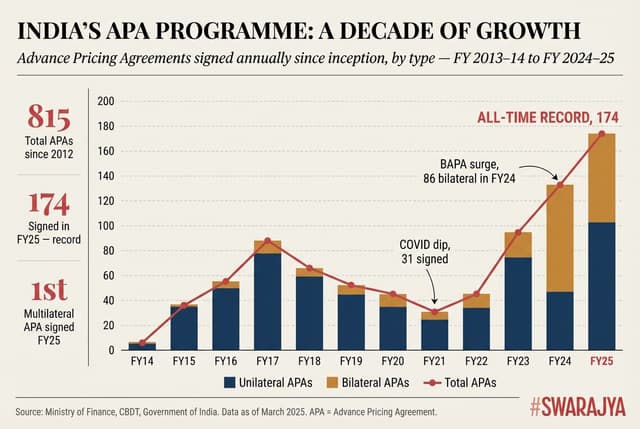
The Central Board of Direct Taxes (CBDT) signed a record 174 Advance Pricing Agreements with Indian taxpayers in FY25, the highest number finalised in a single financial year since the programme's inception.
An APA helps taxpayers and tax authorities agree on how to price transactions between related companies in different countries. Introduced under the Finance Act, 2012, it came into effect on 1 July that year.
The agreements cover three types of arrangements: unilateral APAs (UAPAs), bilateral APAs (BAPAs), and the first-ever multilateral APA (MAPA).
With FY25's signings, the total number of APAs concluded since the programme began has reached 815, comprising 615 UAPAs, 199 BAPAs, and 1 MAPA, according to the official release.
Beneath the headline numbers, however, is a waiting problem.
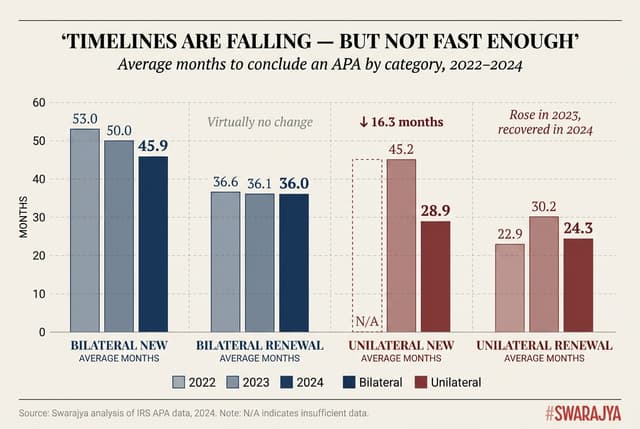
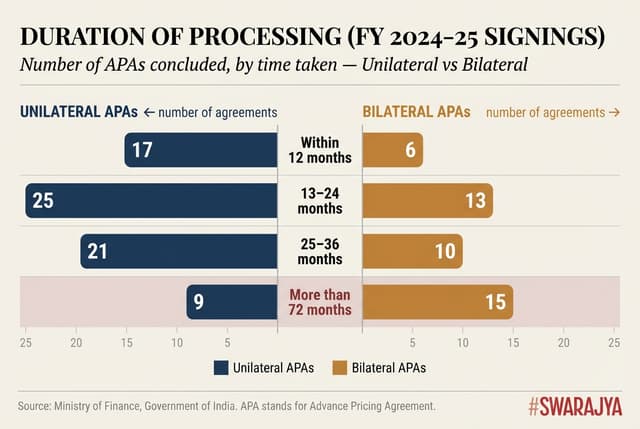
Data shows that the average time to completion for new APAs remains between 40 and 50 months. Renewals take an average of 36 months.
For a mechanism designed to deliver certainty before disputes arise, that is a long time to wait.
What Is an APA and How Does It Work?
When a multinational company operates in India, it constantly transacts with its own group entities abroad: paying a parent company for services, licensing technology from a subsidiary, or selling goods to a related distributor. The question that haunts every such transaction is: what is the right price?
Tax authorities in India and in the foreign jurisdiction each have an interest in that answer, and they do not always agree. The result, historically, has been years of litigation, double taxation, and uncertainty that makes long-term business planning difficult.
An Advance Pricing Agreement is the mechanism designed to prevent that dispute from arising in the first place.
It is a legally binding contract between the tax administration and a taxpayer that determines, in advance, the Arm's Length Price (ALP), or the methodology for calculating it, for international transactions.
In plain terms: before the transactions happen, both sides agree on how they will be priced. The agreement covers a period of up to five years, giving companies a window of tax certainty that no court ruling can replicate.
"India's transfer pricing regime was introduced in 2001, and the APA programme followed in 2012. Historically, multinational corporations entering India operated largely as cost centres rather than revenue-generating entities," says Fatema Hunaid, Partner and Asia Pacific TP Leader at Grant Thornton Bharat.
As the focus shifted toward profit attribution, transfer pricing scrutiny intensified. India emerged as one of the most litigated jurisdictions globally on transfer pricing matters, which is precisely what prompted the need for a preventive dispute-resolution mechanism like APAs.
Three types of agreements exist under the programme. A Unilateral APA (UAPA) is struck between the CBDT and the Indian taxpayer; it provides domestic certainty but does not prevent double taxation on the foreign side.
A Bilateral APA (BAPA), negotiated between India's Competent Authority and a treaty partner jurisdiction, is the preferred instrument for most MNEs since it eliminates double taxation in both countries simultaneously.
A Multilateral APA (MAPA), the most complex arrangement involving India and multiple treaty partners, was signed for the first time in FY 2024-25, a milestone that marks the programme's growing reach.
A Record Year, By the Numbers
The upward trajectory in APA signings has been sustained over the past three years, with FY25 representing a clear peak. The CBDT can enter into these agreements for a period of up to five years.
Processing time, however, remains a critical concern.
Understanding the Process
The APA process is detailed and multi-layered, with no fixed statutory timeline anywhere in it.
"The process begins with filing an APA application along with prescribed fees and extensive documentation about the company, its transactions, functions, assets, and risks," Fatema explains.
"This is followed by a comprehensive questionnaire from the department, sometimes running to 100 or more questions, seeking granular information on products, services, employees, pricing models, and business structures."
Multiple rounds of follow-up queries are common. Once documentation is reviewed, the process moves to site visits — typically boardroom interactions to validate submissions, along with operational walkthroughs and employee interviews that can run half a day or longer.
Thereafter, discussions shift to selecting the transfer pricing method, benchmarking margins, credit periods, and other commercial terms. Even at this stage, further clarifications may arise.
In some cases, taxpayers withdraw entirely if the proposed margins are not commercially viable.
No single stage is inherently slow. The cumulative effect, however, is a drawn-out process that is defeating the very purpose of the mechanism.
Structural Challenges: Manpower or Design?
The APA process faces both a staffing problem and a structural one, though the evidence suggests the latter is more decisive.
As per reports, there are only five dedicated APA teams across the country: two in Delhi, one each in Mumbai, Bengaluru, and Gurgaon.
Frequent officer transfers compound the scarcity. Officers are often moved within a year of being assigned, forcing companies to re-explain their submissions from scratch to incoming officers who may re-examine issues anew.
"New officers may re-examine issues from the beginning, requiring companies to restart discussions. This lack of continuity contributes significantly to delays," notes an industry expert.
Yet staffing numbers alone do not explain the gap. As per reports, India completed 50 APAs with 19 officers but took approximately 5.17 years per case. China, with 23 officers, finished 35 APAs in about 2.08 years. The problem, in other words, is not simply headcount; it is the time taken per case.
"This needs a radical shift in approach, given its importance under the current global scenario, especially for India," the expert adds.
Transparency and internal coordination present a third layer of difficulty. Sharing of information is limited, restricting greater clarity for all stakeholders involved in the process.
"It is also about coordination between teams within the department. At times, the percentage fixed during negotiations differs from what is finally recorded in the file. This leads to a new set of discussions and negotiations during the process. Thus, streamlining is very important to enhance efficiency," the expert adds.
There is no statutory deadline for concluding APAs, and nearly half of the applications remain pending.
"Ideally, given the detailed process, including documentation, site visits, and negotiations, an APA should be concluded within 24 months," Fatema says.
Reforms for Time-Bound Clarity
Despite record APA signings, the system still does not resolve disputes quickly enough to deliver the predictability that is the entire point of having APAs.
Experts broadly agree that the priorities are structural continuity, transparency, better inter-team coordination, and streamlined processes that reduce the cumulative burden at each stage.
Recent government measures signal some recognition of the problem. The Union Budget 2026 includes transfer pricing safe harbour amendments that carry meaningful implications for the APA pipeline.
The proposal introduces a unified category for information technology services, combining software development, IT-enabled services, knowledge process outsourcing, and contract R&D, with a common safe harbour margin of 15.5 per cent.
The eligibility threshold for safe harbour applications has been raised from ₹3,000 million to ₹20 billion, which is expected to remove most IT services companies from the APA queue altogether.
On the APA side directly, unilateral APAs relating to IT services are proposed to be fast-tracked with a target timeline of two years, extendable by six months on taxpayer request.
This introduces, for the first time, a fixed timeline where none previously existed.
These are welcome steps, but they are sector-specific. India's APA caseload spans pharmaceuticals, manufacturing, financial services, and consumer goods — sectors where transfer pricing complexity is high and where predictability matters just as much. Similar structured timelines are needed for other industries.
On structural continuity, the two-year mandate may itself create a behavioural shift.
The same team should ideally handle a case at least through the site visit and finalisation stages, to ensure consistency and prevent knowledge loss.
"The government order to complete the deal within two years is likely to create a sense of urgency, as officers may now want to finish the process before they get transferred or reassigned. Otherwise, with changing teams, it would be difficult to successfully meet the two-year timeline," Fatema notes.
India's APA programme has earned its record. Fifteen years in, it is producing numbers that would have seemed ambitious at launch. The next phase must focus on qualitative efficiency. The record signings of FY25 are a foundation.
Without time-bound certainty across sectors, not just IT, the promise of APAs — to deliver predictability and prevent disputes before they begin — remains only partially fulfilled.
 Join our