Commentary
Adani-Embraer Deal Raises the Question: What Could HAL Have Been?
Raghavan S Rao
Jan 10, 2026, 08:50 AM | Updated Feb 03, 2026, 07:12 PM IST
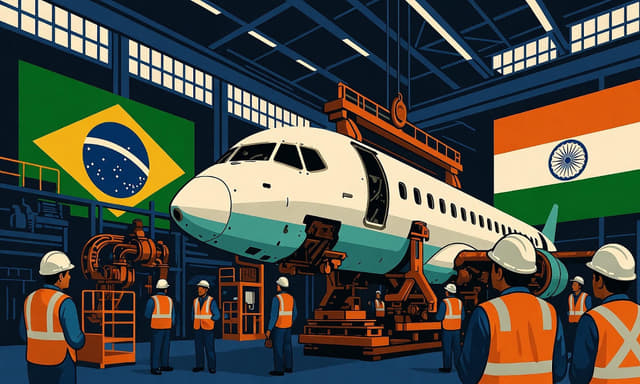
In December 2025, the Adani Group signed a memorandum with Brazil's Embraer to establish India's first commercial aircraft assembly line.
The facility will assemble regional jets designed in São José dos Campos, using components manufactured in Embraer's global supply chain. India will provide the assembly facility; Brazil will likely provide the aircraft, the intellectual property, the certification expertise, and the global market credibility.
This is assembly work, not manufacturing, and certainly not design—typically representing 15-20% of an aircraft's value. After 85 years of aerospace activity in India, this is what arrival looks like.
The deal invites an uncomfortable comparison.
Brazil, with a GDP roughly half of India's and a population one-sixth the size, has built the world's third-largest commercial aircraft manufacturer. Embraer's regional jets carry passengers across 70 countries, dominating a market segment that neither Boeing nor Airbus adequately serves. India, with its 1.4 billion people, $3.7 trillion economy, and eight-decade aerospace heritage, has produced precisely zero commercial aircraft that any airline outside the subcontinent would purchase.
Hindustan Aeronautics Limited was founded in 1940—nearly three decades before Brazil established Embraer in 1969. India had the head start, the technical workforce, and the institutional foundation. Brazil, emerging from military dictatorship with little more than an aeronautics institute, came from behind to become a global aerospace power.
This is not a story about inherent capability. India's space programme reaches Mars; its software engineers build products used worldwide; its manufacturing sector produces everything from pharmaceuticals to automobiles for global markets. This is a story about institutional choices and policy architecture—choices that could have been made differently, and still can be.
HAL could have become what Embraer became. It possessed the foundation, the talent, and the time. Understanding why it did not, and what specific decisions led to this outcome, matters for India's future industrial ambitions in sectors from semiconductors to electric vehicles. The mistakes are identifiable; more importantly, they are correctable.
Two companies, one head start, opposite outcomes
The numbers tell a stark story. Embraer, the world's third-largest commercial aircraft manufacturer, delivered 9,000 aircraft to customers across 70 countries, generating $6.4 billion in revenue in 2024 with a firm order backlog of $26.3 billion.
HAL, with its eight-decade heritage, produces primarily for a single customer—India's armed forces—and has never successfully developed a commercial aircraft for the global market. Its revenue of approximately $3.6 billion comes 95% from defence contracts, with exports constituting a mere 1% of sales.
Embraer's E-Jet family dominates the 70-150 seat regional jet segment that neither Boeing nor Airbus adequately serves. HAL's Regional Transport Aircraft programme, initiated in 2007 as a joint venture with the National Aerospace Laboratories, remains in the design phase nearly two decades later. The company's last complete passenger aircraft was the licence-built HS-748 Avro, production of which ceased in 1988.
The paradox deepens when one considers starting conditions. Walchand Hirachand founded Hindustan Aircraft Limited in Bangalore in 1940, envisioning indigenous aircraft manufacturing for a nation then under colonial rule.
By the time Brazil established Embraer in 1969, HAL had already produced fighters, trainers, and transports—albeit mostly under licence from foreign manufacturers. India possessed the institutional head start, the technical workforce, and the strategic intent. Brazil, emerging from military dictatorship, had primarily an aeronautics institute and a prototype.
Brazil's deliberate climb from assembler to innovator
Embraer's trajectory reveals a carefully orchestrated industrial strategy rather than accidental success. The Brazilian government laid the foundations decades before the company existed, establishing the Instituto Tecnológico de Aeronáutica (ITA) in 1950, modelled after MIT. This created a pipeline of aerospace engineers who would form Embraer's core workforce—founder Ozires Silva himself was an ITA graduate and former Air Force officer.
The early years followed a familiar pattern: licensed production of Italian trainers, development of light aircraft, and steady government contracts. The EMB-110 Bandeirante, a 15-21 seat turboprop, became Embraer's first commercial success, designed specifically for Brazil's challenging geography and underdeveloped regional airports. Crucially, the company began exporting by 1975—just six years after founding.
The transformational moment came with privatisation in 1994. Facing near-bankruptcy during Brazil's economic crisis, Embraer was sold to a consortium of private investors for $295 million, inheriting $215 million in debt. The government retained a "golden share" providing veto power over strategic decisions but withdrew from operational management.
What followed was a restructuring that would have been impossible under state ownership. New management introduced risk-sharing partnerships with global suppliers, reducing Embraer's R&D burden from 30% to approximately 5% of revenue. The company pivoted decisively toward commercial aviation, identifying an underserved market segment between turboprops and large narrowbodies. The timing proved fortuitous: American regional airlines were shifting from turboprops to jets precisely as Embraer launched the ERJ-145 family in 1996.
The E-Jet programme, launched in 1999, cemented Embraer's position. Development costs of approximately $850 million were shared with tier-one suppliers including GE, Pratt & Whitney, and Honeywell. By designing aircraft around a 2+2 seating configuration—eliminating the dreaded middle seat—Embraer created a passenger experience advantage that competitors could not easily replicate. More than 1,900 E-Jets now fly with over 80 airlines worldwide, achieving a mission completion rate of 99.9%.
India's captive market trap
HAL's evolution followed a fundamentally different logic. Nationalised in 1964, the company became the sole supplier to India's armed forces—a captive market that guaranteed revenue but eliminated competitive pressure. When the Indian Air Force needed fighters, HAL assembled Russian MiGs under licence. When it needed trainers, HAL built British Hawks. The institutional incentive was to fulfil government orders, not to develop products that could compete internationally.
This model produced capable technicians and functioning aircraft, but not innovation. HAL has assembled 660 MiG-21s, 272 Su-30MKIs, and 82 Hawk trainers—impressive numbers that mask a troubling reality. Licensed production transfers assembly skills, not design capability. When India attempted indigenous development, the results were discouraging.
The Tejas Light Combat Aircraft programme, sanctioned in 1983 to replace ageing MiG-21s, achieved initial operational capability in 2015—a development cycle of 32 years, due to sanctions and delayed fund release for full scale engineering and development.
Tellingly, when the government established the Aeronautical Development Agency (ADA) to design the Tejas, it drew talented engineers from HAL's Aircraft Research and Design Centre. HAL did possess research capability—showing these engineers could flourish after leaving for an organization structured around indigenous development rather than licensed production.
Policy divergence as destiny
The contrasting outcomes reflect deliberate policy choices rather than inherent national capabilities. Brazil combined long-term state investment in institutions with market discipline through privatisation and export orientation. India maintained state ownership and domestic protection, creating an environment that discouraged efficiency and innovation.
Several specific policy differences proved decisive. First, export focus versus domestic captivity: by 1989, half of Embraer's $1 billion revenue came from exports, forcing the company to meet international quality standards. HAL's guaranteed domestic contracts created no such pressure—indeed, the company's monopoly position meant that even chronic delays did not result in lost business.
Second, privatisation versus continued state ownership: Embraer's 1994 privatisation introduced profit-driven management, enabled flexible international partnerships, and provided access to private capital markets. HAL remains 71.6% government-owned, subject to bureaucratic procurement processes, unionised workforce constraints, and political interference in management decisions. A 2025 consulting exercise to restructure HAL acknowledged that its order backlog had grown to eight times annual revenue—a dysfunction that private ownership would not tolerate.
Third, risk-sharing versus government funding: Embraer's business model distributes development costs and risks among global suppliers who become stakeholders in the programme's success. HAL's projects depend on government sanctions and cost-plus pricing, creating incentives that favour cost escalation over efficiency.
Fourth, niche focus versus overreach: Embraer strategically avoided competition with Boeing and Airbus, dominating a segment those giants neglected. HAL attempts to span the full aerospace spectrum—fighters, helicopters, trainers, transports, engines—spreading resources across too many programmes while achieving leadership in none.
Fifth, dividends versus R&D investment: HAL, as a profitable state-owned enterprise, pays substantial dividends to the government and shareholders—dividends that could have funded long-term research and development. While Embraer's risk-sharing model reduced its direct R&D burden to around 5% of revenue, the company and its partners collectively invested heavily in design capability, certification expertise, and technological advancement. HAL's underinvestment in R&D created a vicious cycle: without indigenous design capability, India remained dependent on foreign aircraft and technology transfers, mortgaging strategic autonomy in defence aviation. A nation that cannot design and build its own military aircraft remains vulnerable to supply disruptions, technology denial, and external pressure during geopolitical crises. The dividend cheques to the finance ministry came at the cost of long-term technological sovereignty.
Brazil's state support was neither absent nor naive. The development bank BNDES has provided approximately $26.3 billion to finance Embraer aircraft exports since 1997. Government contracts provided a steady base during difficult years. But support came with expectations of commercial success and international competitiveness, not merely domestic self-sufficiency.
The Adani deal as diagnosis
The December 2025 agreement between Adani Aerospace and Embraer to establish a final assembly line for E-Jets in India encapsulates the consequences of these divergent paths. After 85 years of aerospace activity, India welcomes a Brazilian company to establish its first commercial aircraft assembly facility—and welcomes not manufacturing capability, but assembly.
The distinction matters enormously. Final assembly typically represents 15-20% of an aircraft's value, involving joining pre-manufactured fuselage sections, wings, and engines sourced from Embraer's global supply chain. The core intellectual property—aerodynamic design, fly-by-wire systems, engine integration, certification expertise—remains in São José dos Campos. India gains industrial activity and jobs, but not the technological capability that would enable indigenous aircraft development.
The deal follows a pattern established by Tata's partnership with Airbus for C-295 military transport production, where 85% of structural assembly work occurs in India but fundamental design capability remains European. These arrangements represent progress for India's aerospace ecosystem—but progress measured in assembly integration rather than closing the core technology gap.
Embraer's senior executives have noted that India needs 500 regional aircraft over the next two decades, a market that neither HAL's perpetually delayed Regional Transport Aircraft nor any other indigenous programme can serve. The company is filling a gap that Indian policy created.
Lessons from a lost generation
The Brazil-India aerospace divergence offers insights that extend beyond aviation. Countries with similar ambitions in semiconductors, electric vehicles, and artificial intelligence face analogous choices about state ownership, market discipline, and technological development.
The Brazilian experience suggests that effective industrial policy combines patient institutional investment with commercial accountability. The ITA-DCTA-Embraer triangle created capabilities over decades, but privatisation forced their commercial application. Protection without competition breeds complacency; exposure to international markets, though painful, drives improvement.
India's experience demonstrates that head starts can be squandered through institutional arrangements that reward compliance over innovation. HAL's technically capable workforce, operating within a system designed for licence production and guaranteed contracts, never developed the entrepreneurial instincts that international competition would have demanded.
The late Ashok Nayak, former HAL chairman, once observed that the company faced "a pampered workforce where welfare has primacy over professionalism." This was not a failure of individual engineers but of the system that employed them. Embraer's workforce, facing potential bankruptcy in 1994 and constant competitive pressure thereafter, developed different instincts.
As Indian airlines order 1,800 aircraft from Boeing and Airbus—none from HAL—and as Adani prepares to assemble Brazilian jets on Indian soil, the aerospace paradox stands as an expensive lesson. India's engineering talent, demonstrated in space exploration and software development, was never the constraint. The constraint was policy architecture that treated aerospace as a defence procurement programme rather than a commercial industry requiring market discipline.
Brazil, starting later but choosing differently, built the world's third-largest aircraft manufacturer. India, with every advantage of time and talent, built a government contractor. The distinction between those two outcomes contains decades of industrial policy lessons that extend far beyond aviation—lessons that emerging economies pursuing technological self-reliance would do well to study carefully.
A public policy consultant and student of economics.
 Join our