Commentary
Adani Wants India To Build Its Own AI. Here Is What That Would Take.
Raghavan S Rao
Jan 04, 2026, 09:07 AM | Updated Feb 03, 2026, 07:12 PM IST
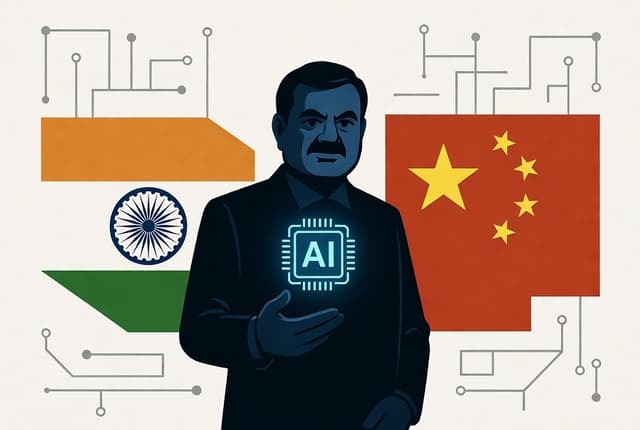
In December 2024, Gautam Adani stood at a new artificial intelligence centre in Baramati and made a declaration that sounded like common sense but carried revolutionary implications. "A nation of 1.4 billion people," he said, "cannot afford to place its jobs, data, culture, and collective intelligence at the mercy of foreign algorithms." India needed its own AI. India needed sovereignty over the technology that would reshape its economy, its governance, its future.
He was right. But what would getting there actually require?
Adani did not elaborate, and perhaps he did not need to. The statement was aspirational, a direction rather than a blueprint. But blueprints exist. Across the Himalayas, China has spent a decade building precisely what Adani described—an AI ecosystem that owes nothing to Silicon Valley, that competes with the best American laboratories, and that has begun exporting its models to the world. To understand what sovereign AI demands, India need only study what China has done. The picture is more strange, more instructive, and more daunting than most Indian observers realise.
Begin with a single week in May 2024, because what happened then reveals the nature of the machine. A startup called DeepSeek, barely a year old and almost unknown outside specialist circles, released a new model called V2. The model was good—competitive with anything from Alibaba or ByteDance—but what caught attention was the price: API access at $0.14 per million tokens, when the market rate was ten times higher.
Within five days, Zhipu AI, one of China's most celebrated startups, slashed its prices. ByteDance followed, matching DeepSeek exactly. Then Alibaba cut Qwen from $1.10 to $0.07 per million tokens—a 94 percent reduction announced within hours of ByteDance's move. Baidu, not to be left behind, made two of its models entirely free.
This was not normal competition. This was an industry trying to destroy its own margins, companies undercutting each other so aggressively that profitability seemed beside the point. Chinese media called DeepSeek the "Pinduoduo of AI," after the e-commerce platform notorious for racing rivals to the bottom. But here is the detail that made the whole episode strange: DeepSeek, despite triggering the collapse, remained profitable. Its efficiency was real. Everyone else was bleeding cash to keep up.
What allowed the system to absorb this violence without fracturing? The answer lies in who funds whom.
Alibaba, which slashed prices to compete with DeepSeek, is also an investor in Moonshot AI, one of the Six Tigers—the billion-dollar startups that represent China's next generation. Tencent backs multiple Tigers while running its own competing models. When Baichuan raised $687 million in 2024, the investors included Alibaba, Tencent, and Xiaomi—three companies that compete with Baichuan directly—alongside state-backed funds from Beijing, Shanghai, and Shenzhen.
The dragons fund the tigers that are trying to eat them. This sounds like madness until you understand the logic: when everyone is invested in everyone else, price wars do not destroy the industry. They accelerate it. Margins collapse, but capability advances. The weakest players die, but the ecosystem grows stronger. And because state funds expect strategic outcomes rather than quarterly returns, startups can absorb losses that would kill a company dependent on impatient venture capital.
The Six Tigers themselves represent something unprecedented—Zhipu AI, Moonshot AI, MiniMax, Baichuan, StepFun, and 01.AI, each valued above a billion dollars, each founded between 2019 and 2023, each led by founders under forty. They emerged almost simultaneously, as if the ecosystem had decided to produce a generation of challengers all at once.
Several were founded by executives who left the dragons: Baichuan's Wang Xiaochuan came from Sogou, MiniMax's founders from SenseTime, 01.AI's Kai-Fu Lee from Google and Microsoft. The dragons did not try to prevent this exodus. They invested in it, because they understood something that most Indian business houses do not: in a fast-moving technological race, the spawn of your competitors might become your greatest assets, and the knowledge they carry will circulate back eventually.
That circulation depends on a pipeline, and China's runs from two universities with the efficiency of a conveyor belt. Tsinghua and Peking sit at one end; the AI industry sits at the other.
Zhipu AI did not merely recruit from Tsinghua—it spun directly out of Tsinghua's Natural Language Processing laboratory, founded by two professors who decided their research belonged in the market. Moonshot AI's founder, Yang Zhilin, studied at Tsinghua before completing his PhD at Carnegie Mellon and returning to build. The Tigers recruit fresh graduates in waves, dozens at a time, often before they have defended their dissertations. DeepSeek's 200-person team consists largely of researchers just a few years out of university.
But the pipeline has a third node that outside observers often miss: state research laboratories operating at the frontier without commercial pressure. The Beijing Academy of Artificial Intelligence publishes foundational research and releases models openly. The Shanghai AI Laboratory collaborates with universities and companies alike. Zhejiang Lab, established by the provincial government in partnership with Zhejiang University and Alibaba, conducts work that flows freely between academic papers and product development.
These labs do not compete with private companies—they supply them. A researcher might train at Tsinghua, spend years at BAAI, then join a Tiger or found a startup, carrying knowledge accumulated across all three institutions. The system does not leak talent. It circulates talent, and each rotation adds capability.
This makes China's embrace of openness less paradoxical than it first appears.
In Silicon Valley, AI companies guard their models obsessively; OpenAI keeps GPT-4's architecture secret, Anthropic does the same with Claude, on the theory that moats are built from things rivals cannot see. China's leading companies have rejected this logic almost entirely. DeepSeek releases its models under MIT licence. Alibaba publishes Qwen under Apache 2.0. Baichuan, Zhipu, MiniMax—one after another, the Tigers have followed, until by late 2025 Chinese open-source models accounted for nearly 30 percent of global large language model usage, up from barely one percent a year earlier.
Why give away your best work? Robin Li of Baidu put it simply: "When the model is open-source, people naturally want to try it out of curiosity." Alibaba argues that open Qwen drives developers toward Alibaba Cloud, where the real revenue lies.
But the deepest answer came from Liang Wenfeng, DeepSeek's founder, in one of his rare interviews: "In the face of disruptive technology, closed-source moats are temporary. Even OpenAI's closed approach can't prevent being overtaken." His company's advantage, he argued, was never any particular model but the culture that produced it. "We anchor our value in our team—our colleagues grow through this process, accumulate know-how, and form an organisation and culture capable of continuous innovation. That's our moat."
If he is right, then openness costs nothing, because you are not giving away your advantage. Your advantage was never the model. It was you.
The gambit is working internationally in ways that would have seemed implausible two years ago. Brian Chesky, Airbnb's CEO, revealed that his company favours Qwen over ChatGPT for customer service because it is "fast and cheap." Chamath Palihapitiya, the venture capitalist and former Facebook executive, moved his company's workflows to Moonshot's Kimi because it was "way more performant." Of the top five trending models on Hugging Face, the developer platform where engineers discover tools, four are now Chinese. The open-source strategy has become an export strategy, and the exports are finding buyers who care more about cost and performance than geopolitical origin.
What kind of organisation produces this? DeepSeek offers one answer: about 200 people, most of them fresh graduates, working in Hangzhou for a company with no external investors, no quarterly targets, and no conventional management.
There are no KPIs, no weekly reports, no internal competitions pitting teams against each other. "We generally don't pre-assign roles," Liang has explained. "The division of labour emerges organically." Researchers form groups around promising ideas; anyone with a hypothesis can access the training cluster without approval; meeting rooms have two entrances and open doors, deliberate architecture meant to encourage serendipitous collision.
The company rejects candidates with more than eight years of experience—"We need people who are extremely passionate about technology, not people who are used to using experience to find answers." This sounds like a Silicon Valley fantasy, but DeepSeek's results suggest it is real: the model that triggered the 2024 price war came from this team, as did the R1 model that shocked global markets in January 2025, reportedly trained for $6 million against OpenAI's $100 million.
But DeepSeek is not typical, and the ecosystem does not require everyone to operate this way.
Much of China's AI industry runs on something closer to the opposite: the notorious 996 schedule, nine in the morning to nine at night, six days a week. Alibaba, Huawei, ByteDance, JD.com—all have been accused of enforcing these hours despite legal prohibitions. Employees have died. At Pinduoduo, a 22-year-old collapsed after extended overtime; another committed suicide days later. ByteDance lost a 28-year-old who collapsed at the company gym after what colleagues described as exhausting shifts.
The system tolerates both extremes—DeepSeek's radical autonomy and ByteDance's brute-force intensity—because both produce results. What it does not tolerate is the assumption that AI development can proceed at a comfortable pace.
American policymakers believed they could impose that pace from outside by cutting off China's access to advanced chips. Beginning in 2022, the United States implemented increasingly severe export controls, attempting to deny Chinese companies the GPUs required to train large models. Nvidia's H100, the industry's workhorse, became contraband. China would have to make do with hobbled hardware—or so Washington assumed.
DeepSeek's response revealed something strategists had not anticipated. Unable to obtain H100s, DeepSeek trained on the H800, a chip Nvidia designed specifically to comply with export rules, with reduced memory bandwidth and other limitations meant to handicap exactly the kind of training DeepSeek wanted to do.
It did not matter. DeepSeek's engineers developed custom communication frameworks to work around the constraints. They pioneered mixture-of-experts architectures that activated only a fraction of parameters for any given query. When R1 launched, matching OpenAI's reasoning benchmarks, it had been trained on hardware American officials considered insufficient for frontier AI. The constraint had forced efficiency innovations that might never have emerged otherwise.
China still cannot manufacture the most advanced chips at scale—Huawei's Ascend 910C achieves perhaps 80 percent of H100 performance, and SMIC's 7-nanometre process remains years behind TSMC—but the assumption that export controls would halt progress has proven false. They changed the nature of progress. They did not stop it.
Behind all of this stands money at a scale India has never concentrated on a single technological goal.
The Chinese government launched a national venture capital guidance fund in 2025 with one trillion yuan—approximately $138 billion—allocated to emerging technologies including AI. State-led funds committed $8.2 billion specifically to startups. Municipal governments from Beijing to Shenzhen run their own investment vehicles, their own research laboratories, their own talent incentive programmes.
Private investment matches this intensity: China spent 890 billion yuan on AI in 2025, $125 billion, representing 38 percent of global AI investment. Alibaba alone has committed 380 billion yuan over three years to cloud and AI infrastructure.
These figures translate into runway for startups, compute for training runs, salaries that keep researchers from emigrating. DeepSeek can operate without external investors because High-Flyer, its parent hedge fund, generates enough profit to fund years of research. Moonshot can reach a $3.3 billion valuation because Alibaba and Tencent see strategic value beyond near-term returns. Zhipu can absorb American sanctions because state-backed funds from Hangzhou regard its survival as a municipal priority.
This, then, is what Adani was asking for—whether he knew the full scope or not.
Sovereign AI is not a company or a government programme but an ecosystem where competition and cooperation become almost indistinguishable, where companies that slash each other's prices also fund each other's research, where state and private capital blend into a unified system for producing technological capability.
India has none of this infrastructure.
There is no equivalent to the Tsinghua pipeline; the Indian Institutes of Technology produce world-class talent, but that talent disperses to Google in Mountain View, to OpenAI in San Francisco, to Microsoft in Seattle. Studies suggest that between 36 and 62 percent of top IIT graduates leave India. China circulates its talent within the system; India exports its talent to systems that compete against it.
There is no patient capital structure; Indian venture capital operates on Silicon Valley timelines, expecting returns within seven to ten years, while the entire IndiaAI Mission commands $1.25 billion over five years—less than Alibaba spends on AI infrastructure in a single year. There is no network of dragons investing strategically in tigers, no state laboratories feeding research into commercial products, no culture that tolerates both radical autonomy and 996 intensity as long as results emerge.
And there are no chips.
The GPUs that train frontier models require fabrication at process nodes India cannot approach. The most advanced semiconductor plant India has announced will manufacture at 28 nanometres, a technology from 2011. The H100 is built at 4 nanometres. TSMC, the Taiwanese foundry that makes Nvidia's chips, spent decades and hundreds of billions of dollars building its capabilities. China, despite massive state investment, still cannot match TSMC's leading edge. India is not yet seriously attempting to.
This matters because sovereign AI ultimately depends on sovereign compute: a country that cannot manufacture advanced chips must import them, subject to the export policies of foreign governments, the pricing decisions of foreign corporations, and supply chains that can be disrupted by geopolitical conflict at any moment.
None of this makes sovereign AI impossible for India. The talent exists—Indian engineers lead AI teams across American technology, demonstrating capability that would flourish given the right conditions at home. The capital exists in principle, scattered across family offices, sovereign wealth funds, and corporate treasuries that have not yet found reason to concentrate. The ambition exists, as Adani's speech demonstrated.
But the gap between ambition and ecosystem is measured in decades and hundreds of billions of dollars. China began building its machine in the mid-2010s. The price wars, the open-source exports, the billion-dollar Tigers—these are outputs of a system that took ten years to construct and that continues to compound on itself. India, if it starts now and commits fully, might have a functioning version by the mid-2030s, by which point China's machine will have evolved further still.
Adani spoke of sovereignty. China has shown what sovereignty costs: the fusion of state and private capital, the tolerance for competition so brutal it looks like self-destruction, the openness that seems to contradict competition but actually accelerates it, the university pipelines and state laboratories and patient investors and punishing work cultures and architectural innovations born from foreign constraint.
It is a machine with many moving parts, and no single part works without the others. India can study this machine. India can admire it or critique it. But the path to sovereign AI runs only through building—slowly, expensively, and with full knowledge of what the destination requires.
A public policy consultant and student of economics.
 Join our