Commentary
Celebrating Our Colleague, Aravindan Neelakandan
Arush Tandon
Dec 12, 2025, 12:45 PM | Updated Dec 18, 2025, 10:37 PM IST
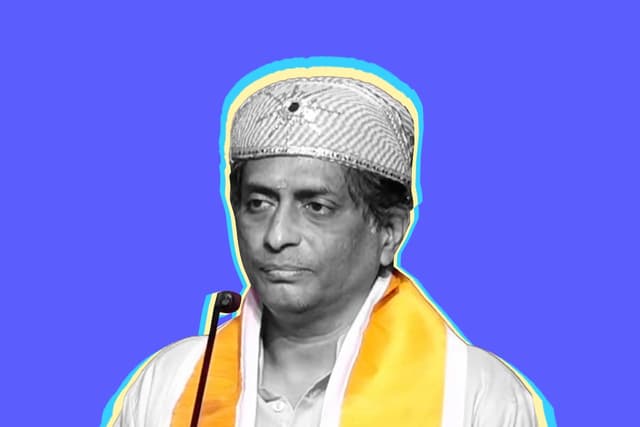
Swarajya Contributing Editor, Aravindan Neelakandan, was conferred an Honorary Doctorate by the Indus University, Ahmedabad, on 6 December.
The Director of the University’s Centre for Indic Studies, Ram Sharma, had this to say on the conferment: “We have been following his works for many years now, since the publication of Breaking India and his writings on Swarajya. He can write on multiple subjects with rigorous research and present them in a manner that can be understood even by lay readers. This has been going on for a long time, consistently. Though he writes for a daily and monthly magazine, his rigour is that of an academic”.
This happy occasion gives us an opportunity to celebrate the colleague and writer that Aravindan Neelakandan is.
The article that follows is a profile of him both from the vantage point of a reader who looks forward to his next article with eagerness, and a colleague who looks forward to his interventions in team meetings.
Aravindan Neelakandan’s enduring value as a writer and a cherished colleague can be broken down into the following constituent parts:
–The clarity of his views
–The depth of his ideas
–The breadth of his interests and rigour of his research
–His ability to express complex ideas in easily understandable form
–Humility
His views
At a time when most people tend to go with the flow or march with the zeitgeist, Aravindan continues to be a man of strong likes and dislikes. Except that is not from the point of view what is good or bad for him singularly but what is good or bad for the Hindu society at large.
The most clear example of this trait are his views and writings on caste. ‘Hindu survival is not possible without Hindu unity→Hindu unity is not possible till caste discrimination exists’. Most contemporary authors hold this belief but Aravindan goes even further and consistently underlines that caste discrimination, in and of itself, is an inhumane practice that should not have been a part Hindu society in the past and should not be one today.
It is not an exaggeration to say that no other Indian or Indian-origin public intellectual believes in this as strongly as Aravindan. It is the intensity of his belief in this principle that leads him to argue, even to the chagrin of many of his readers, that Hindu spiritual and political leadership are not doing enough to eradicate caste discrimination while effusively praising those who did so in the past or are doing that currently.
Recent examples? His article on a Sangh institution that trains priests from all castes or a recent favourite of mine–this poignant, semi-fictional story based on the Gandhian freedom fighter, P.S. Krishnaswamy Iyengar.
The depth of his ideas
Outside of academia and the medical fraternity, it would be hard to find an intellectual who is studying a subjective discipline like consciousness as objectively as Aravindan Neelakandan. Do also note that writing on ‘consciousness’ can easily stray into proclaiming the superiority of ‘Eastern spiritual knowledge’ over ‘Western materialist tendencies’ but Aravindan strays clear of these pitfalls and engages with the latest research findings and theses on merit.
The point is better made by examples than any description.
In this article, Aravindan speaks with the Indian-origin scientist Subhash Kak who had published a paper which claimed that the universe is not three-dimensional but e-dimensional. At first look, this argument might appear too technical and esoteric to follow for lay readers but in the piece Aravindan breaks it down step by step. By the end of the piece, any serious reader would feel that she understands the fundamentals of Prok Kak’s argument. Aravindan not only absorbs complex physics here, he absorbs it enough to be able to re-express it in an accessible form for Swarajya readers.
Even while Aravindan approaches the cutting edge research on consciousness, he doesn’t let go off his grounding in the scriptural commentaries on the subject. Take this review of Donald Hoffman’s The Case Against Reality as a case in point. Hoffman literally argues as an academic that the sensory world is NOT what we see it as. Aravindan’s review of the books begins with the Sthanumalayan temple of Suchindrum, Tamil Nadu, and concludes with the 735th name of the Goddess in the Sri Lalitha Sahasranama. The genius of Aravindan dawn upon the reader when both these reference points appear completely organic to the subject-matter of the review even though the book being reviewed does not mention them.
Third. And this is arguably his best writing when it comes to the subject of consciousness and/or neural sciences. In 2017, Arun Shourie came out with a book on Swami Ramakrishna Paramhamsa and Ramana Maharishi which argued that their states of samadhi were in fact commonly observed neural anomalies. Aravindan’s rebuttal and review of it, respectful but frank and direct in its calling out of Shourie’s agenda, is a lesson in literary criticism.
If Shourie uses neural science for his cause, Aravindan counters him using neural science itself while highlighting how Shourie completely disregards Indic frameworks to study the subject. By the end of the review, you would be convinced that you are better off reading Aravindan’s review of Shourie’s book rather than the book itself.
Breadth of interests, rigour of research
Aravindan is one of India’s very few genuine multilingual public intellectuals, writing prolifically in both Tamil and English. In his articles and books, he covers topics as wide as: Tamil politics; Hindu society, scriptures, history, physics, medical science, evolutionary biology, archaeology, travelogues, literature, cinema, retro comics, and others.
In each of these topics, the one common strand is that if Aravindan has made a claim, you can ‘take it to the bank’, so to speak.
Time for another example. In June 2017, a major daily published from southern India claimed that there was now sufficient evidence to assign an out-of-India geographic origin to the ‘Aryans’. Naturally, Aravindan Neelakandan wrote a rebuttal, in which he first traced the incorrect claim to its source and then disproved it on its merit.
The newspaper in question carried a response to the responses to the original piece. (Swarajya itself had carried more than one response). For reasons not known, while this hoary daily appeared to address all other responses, it completely ignored the one by Aravindan. Whether it was due to their inability to respond, or some other handicap, we don’t know.
What we do know is that Aravindan has put something in words, you can verify with the highest relevant authority.
This, in my humble opinion, is Aravindan’s greatest contribution to the Indic/Hindu/Right Wing cause. For long, this ecosystem has been synonymous with exaggerated claims printed on pamphlets. Aravindan was in many ways the pioneer in bringing an academic rigour, and hence credibility, to the words and messages of this ecosystem.
And that brings us to the next point.
His ability to express complex ideas in easily understandable form
There is form and there is subject. There is idea and there is expression. Aravindan deserves to be lauded not only for his expression but for the choice of his ideas he chooses to express.
For example, Aravindan strongly warns against getting into the debate of the historicity of our epics and Puranas. That would be entering a framework designed to favour the Abrahamic worldview and interests. Rather, he asks his readers to go beyond a superficial understanding of our Puranas and engage with them at a deeper level.
The following is perhaps my favourite passage from all of Aravindan’s writings: “It should be remembered that the Puranas are not fictional or exaggerated stories of the past. They are not past histories. Though they may or may not contain what happened in the historical or physical time. The bifurcation we see between mythology and history in the Euro-centric academia is a result of the history-centric approach of the expansionist religious systems of Christianity and Marxism. The Puranas can be understood as very similar to the ‘dreamtime’ (Tjukurpa) of Australian aborigines. Tjukurpa is actually not a primitive mythological past time as understood by colonialists and missionaries, but an ever-present spiritual reality that regenerates itself and thus connects the past, present, and future. This matches the definition Yaska (seventh-century BCE) gives for Purana – that, in it the old becomes new.”
In a few words, he not only reveals the futility of the history-centric approach to Puranas but also explains in easy-to-follow language how one should approach the Puranas instead.
Richard Feynman is believed to have remarked once that “If you can't explain it simply, you don't understand it well enough”. Going by this reference, how well do you think Aravindan understands his subjects of writing?
Humility
It would not be difficult for a writer of Aravindan’s talents and achievements to display a certain aloofness from the rest of the team at Swarajya and to younger colleagues like myself. Yet, and with due respect to other colleagues and seniors, Aravindan remains arguably the most accessible team member. If he can, he will answer a call at any time of the day, and when given a deadline, will keep you posted on it almost with the nervousness of an intern who is at his first job.
All of this he manages even as he fulfills the responsibilities of a householder. Someone with his knowledge can easily develop an air of indifference to his relations but that is not Aravindan. I wouldn’t want him to read this but we know how much any development on his family front affects him either way. He cares intensely for his loved ones even as he writes intensely in the service of the culture and civilisation we share.
A short profile barely covers the depth and breadth of the intellectual that is Aravindan. Besides, we have not even yet mentioned his writings in Tamil. But we are certain that just like Indus University gave us the opportunity to celebrate our colleague, other institutions would do so as well, and then we will continue our discussion from where we are leaving it here.
Aravindan Neelakandan: a profile
Education and Background: Born in 1971 in Tamil Nadu, Neelakandan completed a postgraduate degree and M.Phil. in Economics from Madurai Kamaraj University and an M.Sc. in Psychology from Madras University.
Career: Neelakandan began writing for the online magazine Thinnai, where he wrote on Indology, science, and culture. He has also worked on cultural conservation and rural development projects in villages and rural communities, engaging with Indian Knowledge Systems and local ecological traditions.
Publications
Breaking India (2011) - co-authored with Rajiv Malhotra
Wonder Fern Azolla (2008) - co-authored with Dr. Kamalasanan Pillai, endorsed by Dr. M. S. Swaminathan
Green Agricultural Technologies (2013) - part of VK-Nardep initiatives
Hindutva: Origin, Evolution and Future (2023) - published by BluOne Ink
A Dharmic Social History of India (2025)
Kadavulum 40 Hertzm (2002) - Tamil anthology of science articles
Indhiya Arithal Muraigal (2015) - on Indian Knowledge Systems in Tamil
Aazhi Perithu (2013) - work on Vedic philosophy
Kashipath (2019) - e-book published by Swarajya Magazine, travelogue from Bengaluru to Kashi
Tamil short story collection
C++ programming textbook for SISI Computer Training Academy (late 1990s)
UNESCO-WaSH Projects
'Conserving Water through Science and Tradition'
'Renewable Energy: An Introduction'
Other Works
Conceptualized sustainable agriculture panels for Gramodaya Park Exhibition for Vivekananda Kendra
Prepared publications on Vedic wisdom and the Aryan Invasion Theory
Assisted Michel Danino in editorial work
Created educational content for Rameshwaram Green Project under UNICEF-WaSH
 Join our