Commentary
India's Real Energy Bottleneck Is Governance, Not Gigawatts
Anuj Gupta
Feb 11, 2026, 03:18 PM | Updated 03:21 PM IST
India's power sector has achieved what seemed impossible a decade ago. The country moved from chronic power deficit to power surplus. Distribution companies recorded a 110 per cent growth in profit in 2025 compared to the previous year.
One Nation, One Grid, One Frequency was achieved in 2013, synchronising India's regional power grids into a single national grid, leading to the creation of the world's largest synchronous electricity networks. Over 36 crore LED bulbs were distributed under UJALA scheme generating annual savings of more than ₹19,000 crore in consumer electricity bills. LED prices have fallen by 82.5 per cent since 2014, accelerating the adoption of energy-efficient lighting.
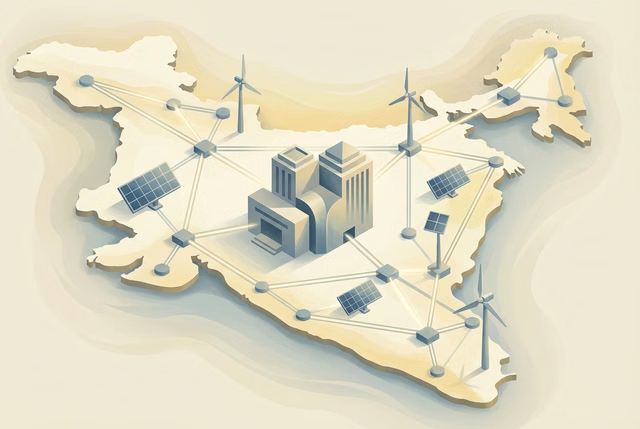
India's renewable energy ambitions are now being held back less by technology or capital, and more by institutional coordination failures. As the country approaches 500 gigawatts (GW) of renewable capacity, execution has become the real bottleneck.
China added 278 GW of solar in 2024 alone, nearly ten times India's annual renewable additions. In a global AI race defined by energy availability, this gap in coordination is a strategic risk India cannot afford.
Focus on Collaboration
The ministries of Power and Renewable Energy have delivered important wins independently. The Power Ministry is responsible for grid stability and transmission planning, while the Renewable Energy Ministry drives renewable capacity targets and project development. But for nearly seven years, the two ministries have operated in parallel when energy transition demands that they function as one coordinated system.
In 2025, less than three-fifths of the planned transmission network was commissioned. Power Grid Corporation of India Limited, which reports to the Power Ministry, builds transmission infrastructure, while the Renewable Energy Ministry drives renewable capacity and power purchase agreements. Because these move on separate timelines, generation often outpaces grid readiness.
Today's auctions reward how quickly capacity can be added, even when transmission, storage, and land clearances are missing. The result is power generation that the grid cannot absorb.
Auctions should instead be based on grid readiness, allowing only projects with confirmed evacuation, storage, and land approvals to bid. This would force capacity addition to move in step with grid infrastructure, instead of the infrastructure coming up later. The fix is structural, not incremental.
From Single Window to Single Approval
India's "single window" system still forces renewable energy developers to navigate over 100 approvals across departments; what the sector needs is single approval, not a single submission point. Currently, environmental, land, grid, state no-objection certificates, and forest permissions move on separate tracks, slowing execution.
Single approval would place decision-making with one nodal authority, replacing today's fragmented clearances with a single application, a defined timeline, and clear accountability. This would require departments to cede individual veto power, a reform that is administratively difficult and politically contested, but necessary if execution timelines are to meaningfully improve.
China deployed more wind and solar capacity in 2024 than the rest of the world combined, not because of superior technology, but because planning, approvals, land allocation, and grid expansion moved in sync.
India has executed similar coordination-heavy reforms before. The nationwide LED rollout and the Goods and Services Tax (GST) reform both worked because they dismantled silos, aligned incentives across institutions, and enforced unified systems at scale.
At least 14 major inter-state transmission projects remain stalled due to unresolved right-of-way disputes. The approvals cut across multiple departments, with no single authority accountable for resolution. Establishing more committees will not fix this. What is needed is institutional consolidation with clear accountability.
A Federal Coordination Body
A GST Council-style body for renewable energy brings Centre and States to the table with real decision-making authority. It resolves land disputes, harmonises regulations, and aligns industrial incentives with grid infrastructure, thereby leading to better utilisation, lower costs, and faster timelines.
The GST Council demonstrated that federal coordination could work when political will exists. In energy, responsibilities are split: states drive industrial siting and incentives, while the Centre plans transmission and renewable capacity. These decisions move in parallel, not together. This results in industries choosing locations without regard to grid capacity, while existing infrastructure remains either underutilised or congested.
The central government should demonstrate this in NDA-governed states first. If coordination cannot work where political alignment exists, it will not work anywhere. It is crucial to prove the model, then scale it.
What Next?
The global AI race is increasingly shaped by access to reliable and scalable power. For India, the binding constraint is no longer ambition or capacity targets, but the speed at which institutions convert plans into operational outcomes.
The next phase of India's energy transition will be determined by whether governance systems can move from parallel functioning to coordinated execution. The measure of success will not be headlining targets, but delivery timelines, utilisation rates, and the ability to absorb new capacity without friction.
Anuj Gupta is the India MD of policy consulting firm BowerGroupAsia.
 Join our