Commentary
The Light They Couldn't Extinguish: How Thiruparankundram Deepam Row Exposed The DMK
Rohini A V
Dec 11, 2025, 06:45 PM | Updated 06:45 PM IST
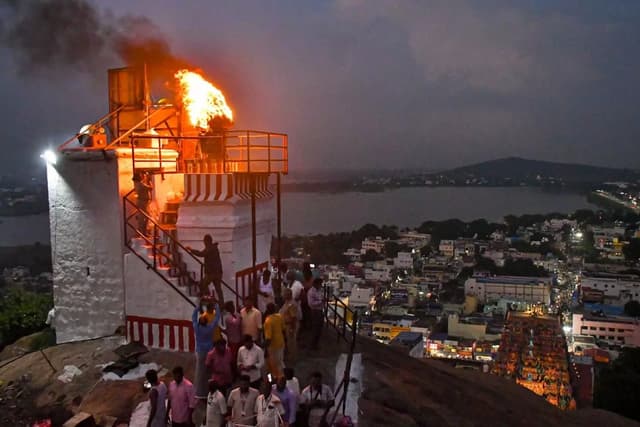
In the sacred geography of Tamil Nadu, the hill of Thiruparankundram holds a place of primordial importance. As the first of the Arupadaiveedu (the six abodes of Lord Murugan), it is here that the warrior-god married Deivanai, symbolizing the union of divine grace and earthly valour.
For centuries, the lighting of the Karthigai Deepam atop this hill has not been merely a ritual; it is a celestial assertion of the deity’s presence, a beacon of Dharma visible for miles around Madurai.
Yet, in late 2025, this simple act of devotion became the epicentre of a fierce legal and political battle, unmasking the Dravida Munnetra Kazhagam (DMK) government's deep-seated hostility towards Hindu sentiments.
The controversy surrounding the lighting of the Deepam at the Deepathoon (lamp pillar) atop the hill is not just a local dispute; it is a microcosm of the Dravidian ecosystem’s relentless siege against Hindu spaces.
The Historical Wound: A Temple Under Siege
To understand the present conflict, one must look at the history of the hill itself.
The Subramaniya Swamy temple dates back to the Sangam era, rooted in the ancient spiritual soil of Tamil Nadu. In contrast, the Sikandar Badusha Dargah, located atop the hill, is a much later construction, with records suggesting its origins or expansion between the 13th and 17th centuries.
The juxtaposition of a Dargah on a hill sacred to Murugan is not a symbol of "harmony" as the secularists claim, but a historical wound of appropriation common to many Hindu sites in India, a structure built as a sign of dominance over the native faith.
The legal status of the hill was settled over a century ago. In a landmark civil suit (O.S. No. 4 of 1920), the courts declared that the entire hill belongs to the Subramaniya Swamy Devasthanam, with the exception of the specific plot occupied by the Dargah and a small grove.
This position was reaffirmed by the Privy Council in the 1930s.
Despite this indisputable legal title, the temple administration, often browbeaten by the secular state apparatus, gradually ceded its rights. The traditional spot for lighting the Deepam, the Deepathoon near the summit, was abandoned in favor of a "compromise" location to appease the Dargah committee, effectively turning a Hindu festival into a hostage of minority veto.
The Verdict: Justice G.R. Swaminathan’s Clarion Call
This year, devotees refused to accept the dilution of their traditions. A writ petition was filed seeking permission to light the Deepam at its rightful place, the Deepathoon.
The case came before Justice G.R. Swaminathan of the Madurai Bench of the Madras High Court, a judge known for his erudition and refusal to bow to political correctness.
On December 1, 2025, upholding the rights of the devotees, Justice Swaminathan directed the authorities to light the lamp at the Deepathoon. His judgement was rooted in the 1920 decree: if the land belongs to the temple, the temple has every right to conduct its rituals there.
The judgement was a breath of fresh air. It stripped away the layers of administrative lethargy and "secular" cowardice. Justice Swaminathan noted that the Deepathoon stands some distance away from the Dargah and that lighting a lamp there causes no injury to anyone. He rightly identified that the "law and order" excuse was merely a euphemism for the state's unwillingness to protect Hindu rights against potential mob violence from the other side.
The 'Communal Unrest' Bogey
The DMK government’s response was predictable. Instead of facilitating the court order, the state administration, led by the HR&CE department (which ironically exists to protect temple interests), vehemently opposed it.
Their primary argument was that lighting the lamp would cause "communal unrest." This is the standard operating procedure of the Dravidian state: blame the victim.
By arguing that a Hindu ritual on Hindu land would cause riots, the DMK government essentially admitted that it cannot control radical elements who might take offence at a Hindu lamp. It validates the "heckler's veto," where the threat of violence by one community is used to deny the fundamental rights of another.
If the mere lighting of a lamp on a temple hill is a provocation, one must ask: Is "communal harmony" in Tamil Nadu so fragile that it requires the suppression of the majority's faith to survive?
State Repression: The Crackdown on Devotees
When the administration dragged its feet, Justice Swaminathan issued a second, more stinging order on December 4. Seeing that the Tamil Nadu police were acting as agents of the ruling party rather than officers of the law, he directed the Central Industrial Security Force (CISF) to provide protection to the devotees lighting the lamp.
This triggered a panic in the DMK camp. The sight of central forces protecting Hindus from the state police was an optical nightmare for the ruling dispensation.
On the day of the Deepam, the state machinery went into overdrive, not to light the lamp, but to stop it. The Tamil Nadu police, defying the spirit of the court's direction, barricaded the hill using the newly implemented Bharatiya Nagarik Suraksha Sanhita (BNSS) provisions.
Devotees who attempted to ascend were treated like criminals. Hundreds were detained; saffron-clad bhakts holding lamps were shoved into police vans. The visuals of the police blocking the path to Lord Murugan’s abode while protecting the exclusivity of the Dargah painted a stark picture of the Dravidian state.
The Twin-Pillar Strategy: Appeasing Two Minorities
This incident is not an aberration; it is a continuation of the DMK’s foundational ideology. The party’s hostility towards Hinduism is not random; it is a calculated strategy to consolidate a vote bank comprising two specific minority groups, each with a distinct anti-Hindu agenda.
On one hand, the DMK protects the interests of radical Islamists. The Thiruparankundram Dargah is a classic example: a structure built on a sacred hill as a symbol of historical conquest is now protected by the "secular" state, while the native temple is denied its ritual rights. The DMK ensures that the "sensitivities" of this group are prioritised over the legal property rights of the Hindu deity.
On the other hand, the DMK’s ideological ecosystem provides cover for aggressive proselytising by Christian missionary groups. While the Dargah represents the physical occupation of Hindu space, the missionary agenda represents the spiritual occupation of the Hindu mind.
The DMK’s rhetoric against "Sanatana Dharma" and their systematic mockery of Hindu rituals align perfectly with the missionary goal of detaching Tamils from their spiritual roots to facilitate conversion. By weakening Hindu institutions like the Thiruparankundram temple and demoralising devotees, the DMK serves the dual purpose of keeping the Islamist vote bank happy and the conversion machinery oiled.
From E.V. Ramasamy (Periyar) breaking idols of Lord Ganesha to the modern-day "Sanatana Dharma eradication" conference attended by Udhayanidhi Stalin, the chain is unbroken. The party systematically targets the Hindu faith while bending over backwards to accommodate Abrahamic demands.
The Attack on the Judiciary: The Impeachment Move
Unable to digest a judgement that upheld Hindu rights, the DMK and its allies in the INDI Alliance have now turned their guns on the messenger. In a move that reeks of desperation and intolerance, they have initiated a motion to impeach Justice G.R. Swaminathan.
MPs from the DMK and its partners from the Congress-led INDI Alliance have signed a notice for his removal, citing "judicial overreach" and "acting like a political leader." This is the ultimate irony. When judges open courts at midnight to hear pleas for terrorists, they are hailed as guardians of liberty. But when a judge upholds the property rights of a temple and the religious rights of Hindus, he is branded a "saffron judge" and threatened with impeachment.
This move is a direct assault on the independence of the judiciary. It is a message to every judge in Tamil Nadu: "Fall in line with the Dravidian narrative, or we will come for you." The INDI Alliance, which cries "death of democracy" at the drop of a hat, is now effectively trying to bully the judiciary into submission because a verdict did not suit their minority-appeasement politics.
The Thiruparankundram issue has clarified the fault lines in Tamil Nadu. On one hand stands a state apparatus that views Hindu piety as a law-and-order problem and actively collaborates with forces that seek to erase Hindu history, both the physical encroachers and the spiritual converters. On the other hand, the devotees are no longer willing to accept second-class citizenship in their own sacred spaces.
Justice Swaminathan’s judgement was a flicker of hope, a legal recognition that "secularism" cannot mean the erasure of Hindu history. The DMK’s reaction, from the police crackdown to the impeachment threat, shows they are rattled.
They extinguished the lamp on the hill this year, but in doing so, they have ignited a fire of awakening in the hearts of millions. The Deepam will eventually be lit, for the darkness, no matter how powerfully it flows from the corridors of Arivalayam, cannot hold back the light forever.
Rohini A V is a political consultant and a brand strategist.
 Join our