Commentary
The Machine Is The Message: Why Democracies Reward Vote-Harvesting And Why The BJP Should Not Apologise For It
Goblipura Subbaramiah
Feb 15, 2026, 08:39 AM | Updated Feb 27, 2026, 12:51 PM IST

“I seen my opportunities, and I took ‘em!”
So declared George Washington Plunkitt, a stalwart of New York's infamous Tammany Hall political machine, in a series of unvarnished interviews at the turn of the 20th century.
Plunkitt, a millionaire who started with nothing, was unapologetic about his wealth, famously distinguishing between "honest graft" and "dishonest graft." Dishonest graft was for amateurs - blackmail, theft, vice. Honest graft was the work of a professional: seeing where a new park or bridge was going, buying up the land, and selling it to the city at a handsome profit. It was, in his eyes, simply good business, the reward for foresight and political intelligence.
Plunkitt and his Tammany Hall brethren were not philosophers. They were not, in the modern sense, ideologues. They were mechanics of power. They understood a fundamental truth that today's well-manicured, seminar-attending, think-tank-haunting political class pretends to forget: democracies, in their raw, unadulterated form, are not debating societies. They are arenas of competition where the most effective machine for aggregating votes and distributing rewards wins. Sustained victory is not a matter of having the most elegant manifesto, but the most efficient machinery.
For this, the Bharatiya Janata Party (BJP) is often condemned. It is accused of building a formidable electoral machine, a leviathan that dispenses patronage in the form of welfare and harvests votes in return. The liberal-left establishment, which for decades presided over its own creaking, leaky, and ultimately dysfunctional patronage network - one that would make Plunkitt blush with its brazenness - now cries foul. They are joined by a certain type of conservative, the kind who believes politics should be a clean, gentlemanly contest of ideas, untainted by the grubby business of transactional politics. The kind who would rather lose nobly than win effectively.
They are both wrong. And their wrongness is not merely a matter of opinion; it is a matter of historical and structural fact.
The BJP should not be ashamed of its machine. It should be proud of it. It has built a 21st-century vote-harvesting apparatus that is not only electorally successful but is, in fact, the only viable civilisational alternative to the balkanising, self-destructive politics of "Jitni Abadi Utna Haq" (JAUH) - a demand for rights proportional to population. The choice before India is not between a machine and no machine. The choice is between a machine that delivers development to all, and a machine that vivisects the nation into a thousand warring factions. Anyone who tells you otherwise is either naive or lying.
The Iron Law of Democratic Dominance
Let us dispense with the romanticism that clouds our understanding of democratic politics. Public choice theory, a lens tragically underutilised in Indian political analysis, teaches us that politicians are rational actors seeking to maximise their power, which in a democracy means maximising votes. Voters, in turn, are not disembodied spirits seeking philosophical truth; they are rational actors seeking to maximise their own utility. A political party that can create a durable coalition by delivering tangible benefits to a large and identifiable group of voters will, all else being equal, defeat a party that offers only abstract principles.
This is the iron law of democratic dominance. As the economist Mancur Olson argued in The Logic of Collective Action, political action is plagued by the problem of collective action. It is easier to organise small groups with concentrated interests than large, diffuse groups. A successful political machine overcomes this by creating a large group - the electorate - and delivering to them concentrated, individualised benefits. The cost is dispersed across the entire tax base, while the benefit is felt directly in the pocket or the home of the voter. This creates a powerful incentive for loyalty.
The selectorate theory of Bueno de Mesquita and his colleagues formalises this further. In any political system, the leader's survival depends on keeping the "winning coalition" - the minimum group of supporters needed to stay in power - satisfied. In a democracy, this winning coalition is large, which means the leader must provide public goods and broad-based welfare. The party that does this most effectively, most visibly, and most consistently wins. Not once. Not twice. But for decades.
Every single party that has achieved sustained electoral dominance in a democratic context has done so by building such a machine. They become, in essence, a state within a state, a parallel structure for resource allocation that bypasses the formal, often sclerotic, bureaucracy and delivers directly to the citizen. The party becomes synonymous with the state's ability to provide. Ideology serves as the narrative glue, the justification for the machine's existence, but the machine itself runs on the fuel of patronage and performance.
The International Evidence: A Gallery of Winners
One need not look far for proof. The history of modern democracies is a history of dominant-party machines. Consider the evidence.
Sweden's Social Democrats: The Folkhemmet Machine
From 1932 to 2006, with only brief interruptions, the Swedish Social Democratic Party (SAP) governed Sweden. They built the most comprehensive welfare state in the world - the folkhemmet, or "people's home." This was not mere altruism. It was a political masterstroke of the highest order.
By creating a system of universal benefits - healthcare, pensions, education, and unemployment insurance - the SAP made a vast majority of the population direct beneficiaries of its rule. For over half a century, their vote share hovered comfortably above 40%, a staggering achievement in a multi-party proportional representation system where most parties struggle to cross 25%. At their peak in 1940, they commanded nearly 54% of the vote. Even in the 1970s and 1980s, as other European social democratic parties were faltering, the SAP held firm above 43%.
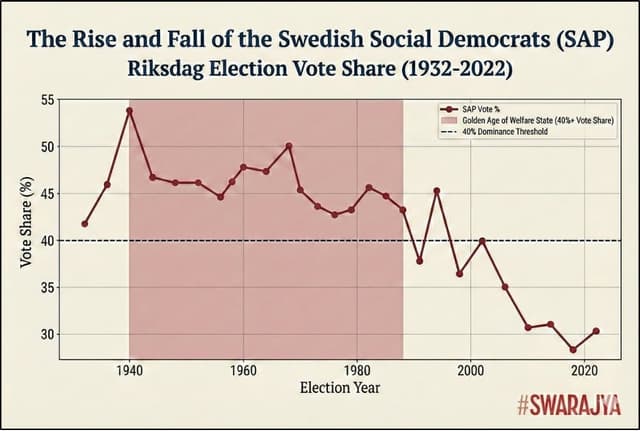
The machine was the welfare state, and the welfare state was the machine. It created a self-perpetuating cycle: the SAP delivered benefits, the grateful voters returned them to power, and they expanded the benefits further. Swedish public spending rose from around 30% of GDP in the early 1960s to over 60% by the late 1980s. Every percentage point of that increase represented a new thread in the web of dependency that bound the voter to the party.
Only with the maturation of the welfare state and the rise of new political cleavages - primarily around immigration and the emergence of the Sweden Democrats - did this dominance begin to fray. By 2018, the SAP had fallen to 28.3%, its lowest since universal suffrage. The lesson is not that the machine failed, but that it eventually ran out of new benefits to offer. The machine's decline was not a refutation of the model; it was a testament to its power - it took entirely new social forces to dislodge it.
Franklin D. Roosevelt’s New Deal: The Original American Machine
The Democratic Party's dominance in the United States from 1932 to the late 1960s was not an accident. It was the direct result of FDR's New Deal. Programs like Social Security, unemployment benefits, and massive public works projects created a new relationship between the citizen and the federal government. For the first time, millions of Americans - urban workers, farmers, ethnic minorities - saw the government as a direct provider of economic security.
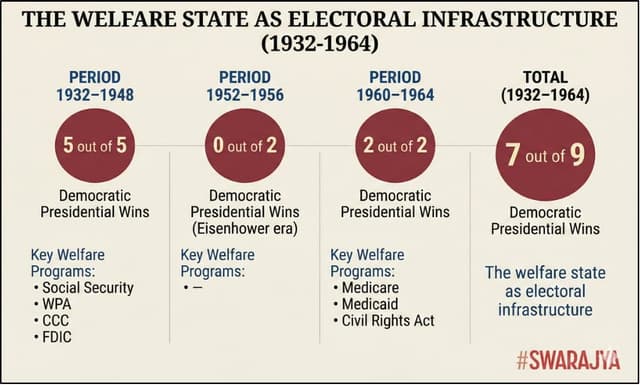
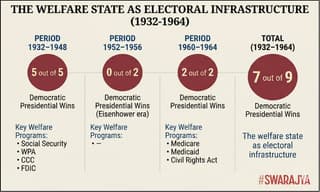
This forged a powerful and lasting political coalition. The numbers speak for themselves: the Democrats won seven out of the nine presidential elections held between 1932 and 1964. In 1936, FDR won 46 out of 48 states. By 1936, some 75% of Black voters had switched to the Democrats, up from barely 25% in 1932, driven almost entirely by the tangible benefits of New Deal programs. The party of Jefferson and Jackson became the party of the welfare state, and in doing so, it built a machine that the Republicans, with their ideology of limited government, could not match for a generation.
Japan's LDP: Pipelines of Pork
For over half a century, from 1955 until 2009, the Liberal Democratic Party (LDP) ruled Japan with only one brief interruption in the 1990s. Its machine was different from the Swedish or American model, but no less effective. The LDP perfected the art of "pork-barrel politics," creating what scholars have called a "construction state." It channelled massive government spending into infrastructure projects, particularly in over-represented rural constituencies. These "pipelines of pork" delivered concrete benefits - roads, bridges, dams - to specific communities, ensuring their loyalty.
The LDP's machine was a clientelistic one, a complex network of factions (habatsu), local politicians, and interest groups all bound together by the flow of government contracts and subsidies. At its peak, Japan's public works spending was among the highest in the developed world, creating a powerful incentive for loyalty. It was not pretty, but it was brutally effective. The LDP did not need to win hearts; it won wallets.
From Mexico's PRI, which ruled for 71 years by incorporating peasants and workers into its corporatist structure, to South Africa's ANC, which has maintained its grip on power since 1994 by combining the legitimacy of a liberation movement with the delivery of social grants to over 28 million recipients, the story is the same. Sustained power in a democracy requires a machine. Full stop.
The Congress Machine: India's Original Sin
Before we turn to the BJP, let us be honest about the machine it replaced. The Indian National Congress ran the original Indian vote-harvesting machine for decades - and a spectacularly corrupt one at that.
The Congress model was the classic middleman machine. Government resources flowed from Delhi through a chain of intermediaries - state leaders, district bosses, block-level functionaries, local strongmen - each of whom skimmed a share before the remnants reached the intended beneficiary. Rajiv Gandhi himself admitted in 1985 that only 15 paise of every rupee spent on development actually reached the poor. The rest was consumed by the machine's own metabolism.
But the Congress machine was not just inefficient; it was communal to its core. Its operating logic, particularly after the 1970s, was the careful management of vote banks defined by caste and religion. The Muslim vote bank was its crown jewel - cultivated not through genuine development but through symbolic gestures, communal polarisation (the Shah Bano reversal being the most infamous example), and the strategic deployment of riot-and-relief cycles. The Christian vote bank in the Northeast and Kerala operated on a similar logic of institutional patronage through missionary networks and educational institutions. A section of the Scheduled Castes was kept in the fold through the promise of reservation and the threat that any alternative would be worse.
This machine has not disappeared. Wherever the Congress remains competitive - in parts of Karnataka, Rajasthan, Telangana, Kerala - it continues to operate as a communal vote-harvesting apparatus. The INDI Alliance's embrace of JAUH is not a new departure; it is the logical culmination of the Congress model, stripped of its Nehruvian pretensions and stated plainly. The mask has simply slipped.
The Conservative Dilemma and the Significance of Trump
This brings us to the conservative's dilemma. Right-of-centre parties, particularly in the Anglo-American tradition, have often been ideologically allergic to machine-building. Their belief in limited government, fiscal prudence, and individual responsibility runs counter to the logic of mass patronage. They prefer to win on ideas, not on handouts. They would rather write a white paper than knock on a door. The result is that they often win elections, but they rarely achieve the kind of sustained dominance seen by their social democratic or machine-style counterparts.
The current collapse of the UK's Conservative Party is a case in point. After 14 years in power, they were annihilated in 2024, reduced to a rump of 121 seats - their worst result since 1906. They had failed to build any lasting machine. Their attempts at "levelling up" were piecemeal and performative. They had no large, identifiable group of voters who saw the Tory party as essential to their well-being. They governed as managers, not as machine-builders, and they were discarded the moment the management was found wanting.
The American Republican Party pre-Trump, faced a similar structural problem. Ronald Reagan won a landslide in 1984 on the power of his ideas and his personality, but he did not build a machine. The party remained a coalition of business interests, social conservatives, and foreign policy hawks, held together by a shared ideology but lacking a direct, transactional relationship with a mass base of voters. The Republicans could win the presidency, but could not hold Congress for sustained periods. They debated beautifully but organised poorly. They had intellectuals; the Democrats had precinct captains.
Donald Trump represents a genuine and significant break from this tradition. He is the first Republican leader in the modern era to instinctively grasp that the genteel, debate-club conservatism of the Republican establishment is a recipe for permanent minority status. His entire political style is that of a party boss, not a policy wonk. He demands personal loyalty above all else. He uses rallies to create a sense of direct, unmediated connection with his followers. He doles out endorsements and punishments based on fealty. He has understood, at a visceral level, that the Democrats' sustained advantage comes not from better ideas but from a better machine - from unions, from community organisations, from the vast network of NGOs and activist groups that constitute the progressive infrastructure.
The "Mar-a-Lago Machine," as the New York Times dubbed it, is an attempt to match the Democrats' organisational advantage with a patronage network centred on himself. In this, Trump is more honest than any Republican leader since Nixon. He has looked at the game as it is actually played and decided to play it, rather than pretending that the game is something else.
But - and this is the crucial caveat - Trump, for all his instincts, is inept at the actual mechanics of machine-building. He has no patience for the slow, boring, unglamorous work of creating institutional capacity. His "ground game" in 2024 was a chaotic mix of social media pronouncements and outsourced call centres run by Elon Musk's America PAC, which by most accounts was a shambles. He has hollowed out the Republican National Committee, turning it into a personal vehicle rather than a professional political organisation. He understands the what of machine politics - loyalty, patronage, reward - but has no grasp of the how. He is a would-be Plunkitt without the patience for honest graft. He wants the machine without wanting to build it.
The BJP's 21st Century Machine
This is where the BJP under Narendra Modi has been genuinely revolutionary. It has solved the conservatives' dilemma - not by abandoning conservatism, but by fusing it with a delivery apparatus of unprecedented scale and efficiency. It has built a machine, but not the leaky, corrupt, middleman-driven machine of the Congress era. It has built a 21st-century machine that leverages technology to deliver welfare directly, efficiently, and at a scale previously unimaginable in human history.
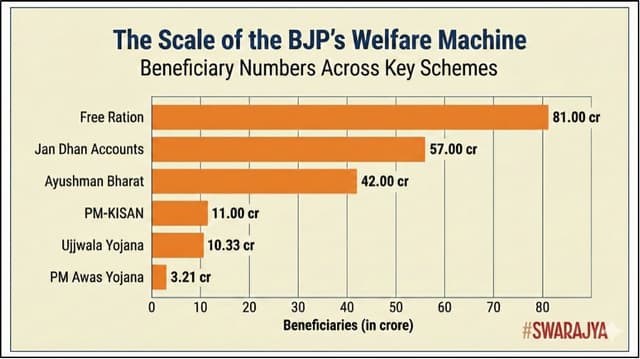
The numbers do really impress one. Since 2014, the Modi government has transferred over ₹48.69 lakh crore to beneficiaries through the Direct Benefit Transfer (DBT) system, plugging leaks and saving the exchequer an estimated ₹4.31 lakh crore. Over 10 crore women have received free LPG connections under the Ujjwala Yojana. Over 3 crore families have received newly constructed houses under the PM Awas Yojana. 81 crore people - more than the entire population of Europe - have received free rations. 11 crore farmer families have received direct cash support under PM-KISAN. Over 57 crore Jan Dhan bank accounts have been opened. Over 42 crore Ayushman Bharat health insurance cards have been issued.
The JAM trinity - Jan Dhan, Aadhaar, Mobile - has created a digital pipeline that connects the state directly to the citizen, cutting out the layers of patronage and corruption that defined the Congress system. Where the Congress machine needed a thousand middlemen to deliver a hundred rupees, the BJP machine delivers a thousand rupees with the press of a button. This is not a difference of degree; it is a difference of kind.
This has created a new political category: the labharthi, or beneficiary. This is a voter whose primary political identity is not their caste or their religion, but their status as a recipient of a government scheme. They see a direct, causal link between the Modi government and the improvement in their material lives - the gas cylinder in the kitchen, the pucca house they live in, the bank account that receives regular deposits, the food grains that arrive every month. As research from the Carnegie Endowment has shown, this new form of programmatic welfare has allowed the BJP to transcend traditional caste boundaries. Upper-caste voters have not punished the party for delivering benefits to Dalits and OBCs, and those very out-groups have, in turn, rewarded the BJP with their votes.
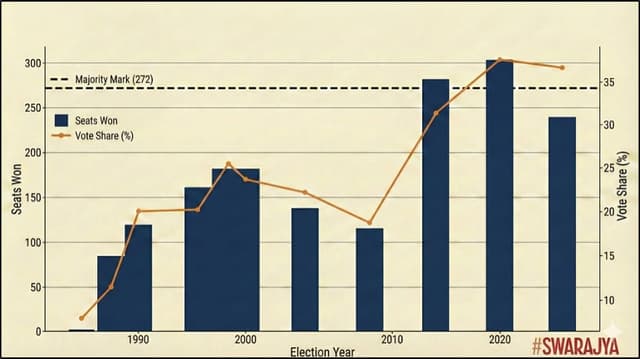
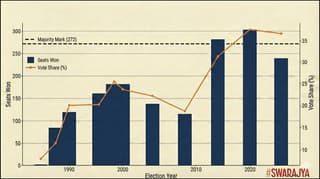
The trajectory is unmistakable. From 2 seats in 1984 to 303 in 2019, the BJP's rise tracks almost perfectly with its evolution from a purely ideological party to a welfare-delivery machine. The dip to 240 seats in 2024 does not contradict this thesis - it reinforces it. The BJP lost ground precisely in those constituencies where the welfare delivery was perceived to be inadequate or where local anti-incumbency overrode the labharthi effect. The machine works; the question is always whether it is working hard enough.
This is not vote-buying in the crude, old-fashioned sense. It is the creation of a new social contract. It is the systematic and efficient delivery of public services, which in a developing country is the most potent political message of all. The BJP has not abandoned ideology; it has fused its Hindutva cultural project with a powerful narrative of development and delivery. The machine is the message, and the message is that this government works.
The Alternative: JAUH Pro Max
For those who still recoil at this reality - the purists, the ideologues, the drawing-room conservatives who would rather lose with dignity than win with a welfare scheme - let us consider the alternative. What if the BJP had followed the path of the traditional conservative and eschewed machine politics? What would fill the vacuum?
The answer is clear, and it is terrifying: Jitni Abadi Utna Haq.
This slogan, popularised by Rahul Gandhi, is the logical endpoint of the politics of grievance and identity. It is a demand for the proportional division of the nation’s resources and power based on a communal headcount. It is a vision of India not as a unified nation-state with a shared civilisational identity, but as a loose confederation of caste and religious vote banks, each claiming its share of the spoils based on its share of the census.
We have seen this movie before. It does not end well.
As The Emissary argued in a powerful and widely-shared thread, the closest real-world parallel to JAUH is Lebanon’s National Pact of 1943. The Pact created a system of “confessionalism,” where political power was meticulously divided among the country’s Christian and Muslim sects. The President had to be a Maronite Christian, the Prime Minister a Sunni Muslim, the Speaker of Parliament a Shia Muslim, and so on. Sectarian quotas were extended to parliament, the civil service, and even laws governing marriage and inheritance.
For a time, it maintained a fragile peace. But as demographic shifts altered the balance of power - the Muslim population grew faster than the Christian - the system became a recipe for perpetual conflict. Sunni Muslims encouraged Palestinian Sunnis to settle in Lebanon to tip the demographic scales. Christian groups allied with Israel. The competition for proportional representation became a competition for demographic dominance. The result was a devastating 15-year civil war (1975–1990) that killed over 120,000 people, displaced a million, and destroyed one of the most prosperous countries in the Middle East.
As The Emissary put it: “This is Jitni Abadi Utna Haq at its end. Consigning India to a permanent caste war with each group at each other’s necks… A total marginalization of micro-minorities as larger groups crush them with impunity. A death of not just individual merit & efficiency, but also of India’s imminent rise as a world power.”
JAUH is the Indian road to Beirut. It is a demand that would institutionalise communal competition, incentivise demographic expansionism, and turn every policy decision into a zero-sum game between identity groups. It is the politics of national disintegration, dressed up in the language of social justice.
Faced with this choice, the BJP’s welfare machine is not just a tool for winning elections; it is a project aimed at preventing Indian balkanization. It tries to out-maneouver the JAUH politics of the INC and allow for the possibility of the productive forces of the country to march ahead.
No Apologies Needed
So, let the critics cry foul. Let them lament the death of ideological purity from their air-conditioned seminar rooms. Let them write long editorials about the "corruption of democracy" from the comfort of institutions built on the patronage of the very system they now decry. They are living in a fantasy world - a world where voters are philosophers, parties are debating societies, and elections are won on the strength of white papers.
The reality of democratic politics, from Tammany Hall to the folkhemmet, from the New Deal to the construction state, is that the machine wins. Not always. Not forever. But in a sustained manner, over decades, the party that builds the most effective apparatus for delivering tangible benefits to the largest number of voters will dominate. This is not a bug in democracy; it is a feature. It is, in fact, the mechanism by which democracy fulfils its most basic promise: that the government will serve the people.
The BJP has not corrupted this system; it has mastered it. It has built a machine for the 21st century, one that is more efficient, more transparent, and more national in its scope than any that has come before. Where the Congress machine divided and skimmed, the BJP machine delivers and integrates. Where the SAP's machine created dependency on a bloated state, the BJP's machine uses technology to create efficiency. Where Trump's machine is a personality cult without infrastructure, the BJP's machine is an infrastructure that amplifies the personality.
There is no need to be ashamed of this. There is no need to apologise. The only question that matters is not whether a party builds a machine, but what kind of machine it builds. A machine that divides and immiserates, or a machine that delivers and unites? A machine that wants JAUH pro max or a machine that prevents JAUH pro max and allows for economic growth by keeping malcontents at bay?
The BJP has made its choice. And for the sake of India's future - for the sake of keeping the Lebanonisation of India at bay - we should be glad that it has.
 Join our