Commentary
Why Hindu Anger Keeps Losing the Civilisational And Narrative War
Aravindan Neelakandan
Dec 29, 2025, 03:27 PM | Updated 03:27 PM IST

The disturbing video from Raipur, showing hooligans vandalising Christmas decorations in a mall during a bandh called by Sarva Samaj and allied Hindu tribal organisations, has understandably gone viral. Such acts of vandalism are indefensible. They shame us collectively and cast an unflattering shadow on India’s image, something the nation can ill afford in these globally polarised times.
Behind this needless display of aggression lies a deeper, more complex churn. Tribal communities, long exploited in colonial and post-colonial India and now agitated, find their anger being misdirected and exploited.
What began as a legitimate grievance against an organised, well-funded evangelical campaign unsettling the delicate fabric of indigenous faith traditions has, in some quarters, degenerated into reactionary street violence. This distortion not only weakens their cause but also blurs the constitutional and cultural coherence of the broader Hindu tradition, which, by design and by definition, embraces India’s diverse indigenous spiritual communities.


The tragedy unfolding in parts of tribal India bears an uncanny resemblance to the one chronicled in the acclaimed novel of Chinua Achebe’s Things Fall Apart.
Achebe’s Things Fall Apart, often hailed as the first great postcolonial African novel, is more than a story about one man’s downfall. It is a mirror held up to an entire civilisation at the precipice of rupture. Through the life of Okonkwo, the proud Igbo warrior who watches helplessly as his world unravels under the stealth of missionary evangelical onslaught and colonial power, Achebe captures the intimate anguish of spiritual demolition and cultural disintegration, the moment when a society’s sacred core, and through it its societal coherence, begins to fall apart.


A similar disquiet now stirs in India’s tribal heartlands.
The recent eruption of anger among sections of tribal society, sparked, co-opted, and ultimately misdirected, echoes the tragedy Achebe foresaw. In Things Fall Apart, the assault on the indigenous mind was subtle, moralised, and strategic. The same pattern repeats today through evangelical operations that exploit faith and fracture social unity. What was, in Achebe’s world, the slow and painful erosion of one man’s dignity has here assumed a collective dimension. Yet the endpoint could be eerily similar: a civilisational suicide born not of conquest alone, but of a people’s inability to recognise the deeper war being waged upon their spiritual foundations.
Every Hindu Sanghatanist who reads the novel will find a chilling reflection of himself or herself in Okonkwo’s fate. His defiance, though noble in intent, becomes counterproductive when not channelled through disciplined foresight. Achebe’s hero falls not because he lacked courage, but because his society failed to translate its courage into coherent strategy, narrative, and moral vision.
That, precisely, is the lesson we refuse to learn.
The strategic apparatus that undermined indigenous Africa has also been operating for the last three centuries in India and now functions with even greater sophistication across India’s tribal belts. Its psychological design is identical: provoke, record the reaction, and narrate the collapse as evidence of spiritual darkness and moral vacuum. And we, like Achebe’s protagonist, oblige, confusing outrage for resistance and rage for clarity.
The tragedy does not end with misplaced anger; it extends into how we remember. The same pattern that Achebe captured, the quiet capture of narrative after the collapse of coherence, plays out before our eyes in the memory politics of our own time.
Let us conduct a simple experiment. Search for Swami Lakshmanananda Saraswati on Google Images. The results are heartbreaking, not only for their grainy visual noise but for what they reveal about civilisational negligence. You will find blurry screenshots, graphic photos of violence, ruinous edits, and no coordinated attempt to preserve his legacy.
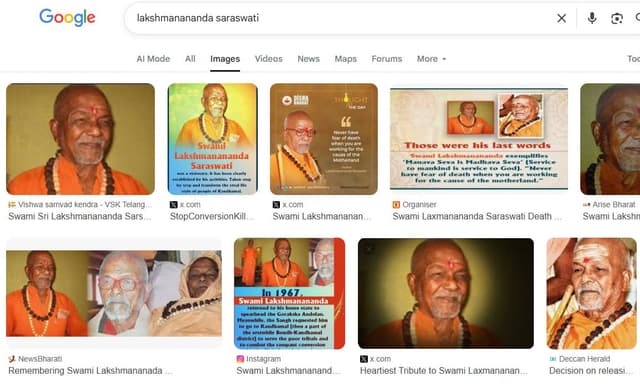

Now search for Stan Swamy. The contrast is humiliating. Here you encounter a carefully curated archive of ‘secular sainthood’: professional stencils, high-quality portraits, and global media layouts radiating moral authority and emotional appeal.


One side has elevated a narrative into an icon; the other has allowed a noble life of service and martyrdom to decay in pixelated anonymity.
This, too, is how civilisations die, not through loss of truth, but through loss of narrative.
The balidan of Swami Lakshmanananda was immense, yet we built no befitting institutional vessel, not even a digital one, to carry his memory forward. We relied on raw emotion and assumed truth would sell itself. Achebe’s warning resounds here: a culture that cannot represent itself with dignity becomes a subject of other people’s stories. In failing to empathise with our own suffering saints and heroes, we strengthen the very machinery that converts them, posthumously, into footnotes to be ignored or, worse, caricatures to be forgotten.
Few even know the full story of that dreadful night in Kandhamal. Around 130 tribal children, mostly girls, were at Lakshmanananda’s school, where they received food, education, and a sense of belonging to their ancestral dharma. When the gunmen arrived, they not only silenced the Swami but also murdered his devoted disciple Ma Bhakti Mayi, a motherly caretaker and guide to those children. She was shot just a few metres from the hostel, and the children saw her body riddled with bullets. Have you ever heard her name? Are there commemorations of her balidan anywhere?
The answer, heartbreakingly, is again no.
And this asymmetry of narrative power is neither new nor accidental.
We all know the Staines family, the Christian missionary and his family who were brutally murdered in Odisha. We know their names. We carry that guilt as Hindus, and rightly so, because that basic compassion and guilt is what makes one human.
But now try to recall this name without searching online: Shreema Nath Sharma.
Does it stir any memory? Most probably not.
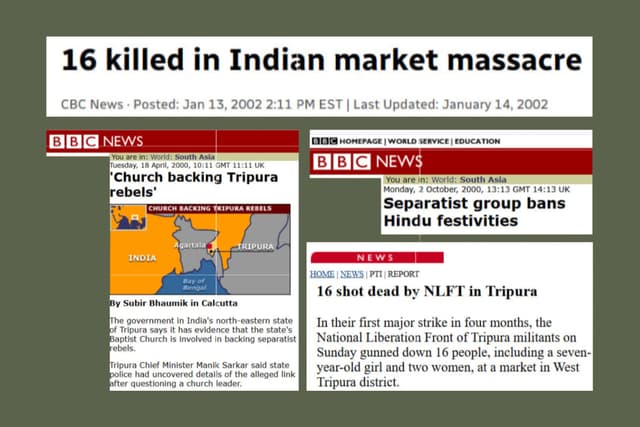

She was just seven years old when operatives of the Baptist Church backed NLFT opened fire in a Tripura marketplace on the eve of Makar Sankranti, a ‘heathen’ festival they had declared banned through what can only be called a Christian fatwa.
Shreema and her mother died that night, along with others, in what is today known as the Singicherra massacre. But their names never travelled beyond the first local headline, not even to a Wikipedia page. There was no international outrage, no commemorative art, no moral reckoning.
A vandalised Christmas decoration in a mall can summon diplomatic concern, but the riddled body of a Hindu child evokes silence.
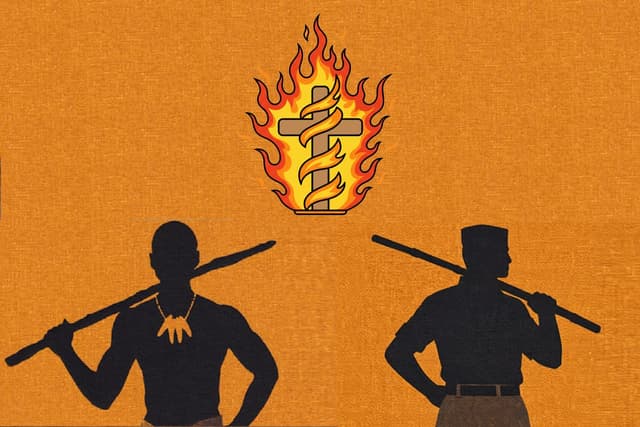
This selective compassion is not about majority or minority. It is about who controls the story. Achebe’s warning returns with fierce relevance: when a civilisation loses its narrative discipline, its pain no longer counts, and its fallen and sacrificed lives no longer matter. The same psychological machinery that re-scripted Africa’s fall now operates here, provoking reaction, recording it as proof of barbarity, and withdrawing sympathy from every act of dharmic self-defence.
A society that cannot remember its Shreema, honour its Swami Lakshmanananda and Ma Bhakti Mayi, or reclaim its imagery from the noise of neglect is already halfway to Okonkwo’s fate: undaunted, sincere, but narratively defeated.
A civilisation that wishes to endure must learn the grammar of both resistance and remembrance. It must know how to translate moral passion into disciplined narrative and cultural intelligence. If not, things fall apart once again, not in Nigeria, but in India’s own sacred heartlands.
 Join our