Culture
Bhajan Rockstars Of Kerala: How Nandagovindam Made Bhajans Cool Among GenZ
K Balakumar
Jan 26, 2026, 06:30 AM | Updated Mar 04, 2026, 04:02 PM IST
I have been here in a European country for a month now, and on Pongal a few days back, we were invited for an afternoon of religious songs and bhajans organised by a local South Indian diaspora group. Usually, in my experience, the events and songs would be dominated by Tamils and Telugus.
But this one turned out to be happily different as the songs had more verve than the standard bhajans chosen from a traditional oeuvre, and the participation also had an extra zeal and zing. The organisers later told me the main performers had been soaking in Nandagovindam Bhajans, the Kottayam-born ensemble now dominating Kerala's YouTube devotional circuit, and it showed.
Back in India and Kerala, Nandagovindam Bhajans, the Kottayam-born ensemble at the heart of this churn, has turned what was once a slightly musty corner of Hindu practice into a full-blown youth movement. Their rise is not just a music story; it is a quiet cultural reset in a state long seen as sceptical terrain for overt Hindu religiosity.
They started 26 years ago as a humble Karkidaka Bhajan Sangham, a neighbourhood group singing during the monsoon month. Over time, as invitations grew, the format evolved from intimate satsangs to more structured evenings, but the core remained: the sampradaya-style bhajans, clear diction, and a stress on collective singing rather than vocal heroics.
When some members moved to the Gulf, an informal UAE wing took shape, rehearsing on weekends and carrying the same repertoire to Malayali flats in Dubai and Sharjah. Today, their 'Bhajan Connect' sessions are immersive musical festivals that sell out venues from Kochi to Dubai, and even as far as Canada.
The Nandagovindam Bhajans story
Nandagovindam's meteoric rise is credited to their signature medley style. Unlike traditional recitals that can sometimes feel rigid or inaccessible to the uninitiated, this group blends classical Sopana Sangeetham (Kerala's indigenous temple music) with peppy folk rhythms and even nostalgic film melodies.
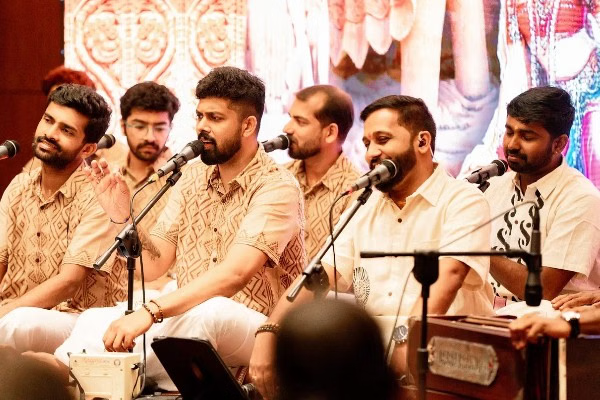
The inflection point came when Nandagovindam plugged into the digital ecosystem and decided that devotional music need not look sonically or visually dated. Their videos are shot with the care usually reserved for indie bands: tight frames, crisp sound, colour-coordinated kurtas, and a stage aesthetic that wouldn't be out of place at a college fest.
The performances are uploaded regularly, allowing families to make their songs the soundtrack of morning pujas, long drives or just background listening. Slowly, a recognisable 'Nandagovindam sound' took shape. It is melodic, unfussy, rooted in raga but not weighed down by classical stiffness.
A typical evening will glide from a rugged, old-school bhajan to an abhang, and then, almost slyly, into a beloved Malayalam film melody reimagined as a bhajan. Familiar tunes like Souparnikamrutha Veechikal or Enthe Kannan Vanneella appear in their concerts not as filmi detours but as vehicles for nama and simple, sing-along refrains.
Their breakout numbers, with hooks like Radhe Radhe or Govinda Govinda spaced just right, are tailor-made for crowds that have grown up on chorus-driven film songs and EDM drops. There is no guilt about borrowing that grammar. If anything, they lean into it so that the jump from playlists to prayer feels shorter.
Their hall of famers
Their most popular numbers have become digital anthems. The Nagabhooshitha Medley, a stirring Shiva bhajan that went viral on Instagram, sparked thousands of dance covers.
Their Ayyappa Mashups, the blends of tracks like Neela Neela Malayil and Samavedam, garnered millions of views during the Sabarimala season.
Radhathan Premathodaano, a crowd favourite that often turns their concerts into a sea of swaying fans, blends intense devotion with musical therapy.
At the heart of their performance is the ganjira and mridangam. In their Nagabhooshitha medley, the rhythm begins softly but quickly escalates into a complex, high-tempo beat by 04:20. This driving rhythm mimics the 'trance' elements of modern electronic music, which is a major draw for younger listeners who crave high-energy, immersive sounds.
The harmonium too serves as the melodic bridge. It provides a constant, drone-like foundation while weaving in classical ragas. You can hear this clearly during the transition into the Mahadeva Manohara segment at 1:44.
One of their most effective 'instruments' is actually the audience's hands. Nandagovindam structures their bhajans to include rhythmic clapping sequences. This turns the performance from a passive viewing experience into an interactive session, making youngsters feel like active participants in the ritual rather than just observers.
By keeping the content strictly traditional (stotras, keertans, and mantras) but updating the delivery with professional sound engineering and infectious energy, they have ensured that Hinduism's old traditions are thriving on the global stage.
Why is it working among the youth?
In today's fast-paced, stressful environment, Nandagovindam's work is vital. It offers a cultural anchor in a rapidly globalising society. By reclaiming public spaces for traditional arts, they are ensuring that Kerala's Hindu heritage isn't just preserved in museums or history books, but lived and celebrated in the streets.
Their performances act as a "cleansing of the land," as described by eminent lyricist Kaithapram Damodaran Namboothiri, providing a much-needed sense of peace and community identity.
Perhaps the most striking aspect of the Nandagovindam wave is the demographic of their fans. The front rows at their concerts are packed with teenagers and young adults. The group does not lecture; they jam. The vibe is less ritual and more spiritual concert, making it relatable for a generation that values 'authentic experiences.'
The collective energy offers a visceral connection that social media alone cannot provide. Many young listeners cite 'inner peace' as their primary reason for following the group. In an age of digital anxiety, the rhythmic, meditative nature of the bhajans doubles up as musical therapy.
For many Gen Z Malayalis, Nandagovindam has made it 'cool' to be rooted, letting them embrace heritage without feeling old-fashioned.
Bhajans, once the bhakti movement's street-level medium, had in Kerala's public sphere ceded space to film and light music, retreating into small, ageing circles. Nandagovindam's project has reversed that drift without turning pious or preachy.
The 'Bhajan clubbing' culture
'Bhajan Connect', their travelling series, captures this shift sharply. These are not sleepy temple gatherings with people drifting in and out. In places like Thrissur and Thiruvananthapuram, several hundreds of people sit from early evening till late night, singing full-throated from song lists shared in advance. The atmosphere is full of energy but alcohol-free, fashion-conscious but unselfconscious, religious but unthreatening.
This is why the trend is being seen as part of a wider 'bhajan clubbing' wave. In a Kerala marked by cultural dislocation and constant fights over temples, traditions and identity, walking into a bhajan evening becomes a low-friction way for Hindu youngsters to reclaim something they feel they inherited but never really inhabited.
The lyrics slip in stories of Krishna, Rama or Devi almost by osmosis, without the heaviness of catechism. There are no gatekeepers policing how to sit or clap.
At a psychological level, the format also answers a deep craving for community. A scroll-addled youth culture finds in a bhajan session a rare, single-focus immersion in a shared activity.
The repetition of nama, call-and-response patterns and rhythmic clapping create a 'spiritual high' without external stimulants, letting stress from academics, jobs and social-media performance briefly melt into a simpler identity.
For Hinduism in Kerala, this goes far beyond event head-counts. Once bhajans become cool again, they carry back into circulation the tunes grandparents hummed, phrases from shlokas and the emotional landscape of epics and Puranic episodes.
In a state where religious expression is often filtered through sharp political binaries, this soft, musical reclamation gives Hindu traditions room to breathe and grow in their own quiet, organic way. And when a Kottayam-rooted sound can shape a diaspora satsang thousands of kilometres away, it is a sign that Hinduism's older songlines, once fading into fuzzy nostalgia, have found a fresh circuit into the hearts and throats of a new generation.
 Join our