Culture
The Voice Of Saivite Temples: Othuvar Tiruttani Swaminathan's Sacred Journey
K Balakumar
Jan 26, 2026, 06:00 AM | Updated Jan 26, 2026, 12:55 AM IST
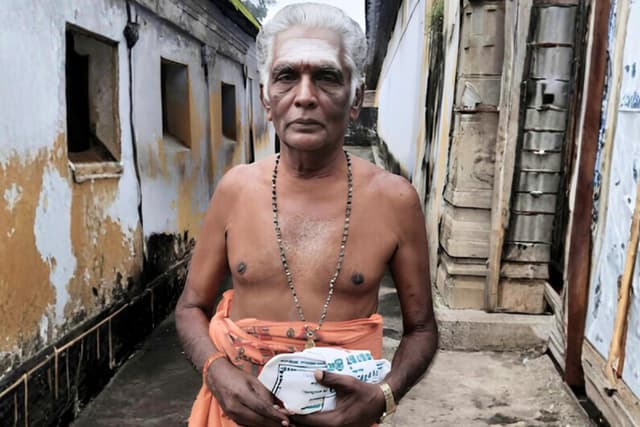
The boy who would one day become Tiruttani Othuvar Swaminathan did not grow up in a great Saivite establishment but in a modest Vaishnavite farming household in Alathur village near Thiru Karugavur. His original name was Sarangapani, and his first deep religious imprint was as a devout Perumal bhakta at the Papanasam temple, where his father Nagarathinam, a farmer, noticed that his seven-year-old son seemed unusually drawn to the divine.
What the father sensed as something special would, within a decade, take the boy away from his tradition, change his very name, and anchor him for life in the demanding but little-understood vocation of an othuvar.
Othuvars handle the sung Tirumurai component of Saivite worship, anchoring specific moments in every puja cycle. They sing, among others, Thevaram and Thiruvachagam during each kāla puja in front of the main Siva shrine, offer short hymns before or during the final ārati, and perform this as gāna upāsana complementing the priests' veda upāsana, making Vedic chanting and Tamil hymns a single integrated act of worship. When the sanctum curtains are closed for abhishekam and alankaram, they continue singing so the garbhagriha is filled with devotional sound. In larger temples, multiple othuvars share a roster so services from dawn to night always have a hymn-singer on duty.
A night with Madurai Somu that changed everything
The turning point for Sarangapani came one night in 1954, when the legendary Madurai Somu turned up at Papanasam for the Aadi ubayam and sang through the night in the temple. As the performance stretched beyond 3 a.m., Nagarathinam took his son to the maestro and explained the boy's restless devotional urge. Somu asked the teenager to sing, and Sarangapani chose Sinthanai Sei Manamey, then his favourite. The senior musician immediately recognised both the quality of voice and the inner fervour, urging the father to "put him into a voice-related activity."
That casual suggestion would reroute the youngster's life. He was admitted to the Thirukadavur pāṭśāla, where for five demanding years he immersed himself in learning Thevaram verses. From there he moved to Dharmapuram Adheenam for another two years of initiation, coming under the spell of Dharmapuram P Swaminathan, one of the twentieth century's towering othuvars, whose blend of scholarship and bhakti became the model he would emulate sedulously.
From Sarangapani to Swaminathan
Somewhere in those years, the academic-minded village boy disappeared and a new persona emerged. "All my interest lay in the Thevaram verses," he would recall. The pull of the Saivite saint-poets was such that he formally embraced Saivism at Dharmapuram and changed his name from Sarangapani to Swaminathan. The shift was a conscious decision to bind his life to the Tirumurai, particularly Thevaram and Thiruvachagam, which he still counts among his dearest offerings.
At 17, he took up his first professional posting as an othuvar at the Kunrakudi Devakottai Adheenam, drawing a salary of Rs 75. A few years later, he moved to Thirumangalam near Lalgudi, where the modest pay packet of Rs 125 and two kalam of paddy underlined a harsh truth. Othuvars carried an ancient ritual responsibility, but their economic worth in the modern temple ecosystem remained fragile. Yet the young Swaminathan stayed with the vocation, treating it as service rather than employment.
The making of 'Tiruttani Othuvar'
The decisive leap came in 1975, when the HR & CE Department advertised for an othuvar at the famed Tiruttani temple. By then, Swaminathan had behind him over a dozen years of temple singing, and his application sailed through. He joined Tiruttani on a salary of Rs 750, eventually spending 26 years there and acquiring the brand-like identity 'Tiruttani Othuvar Swaminathan'.
He would later recall older administrators such as HR & CE Commissioner Uthanda Ramar, who, even in the 1950s, consciously pushed Thevaram back into temple ritual, giving othuvars some institutional backing. But for the most part, he understood his work in non-bureaucratic terms. "I have been financially self-sufficient, but all my life I have seen othuvar as a service, singing praise of God." The daily routine, leading the Tirumurai at different kālams of worship, intoning verses that complete the arc of Saivite ritual, turned into a long, unbroken sādhana stretching across decades.
A global carrier of Thevaram and Thiruvachagam
If the temple platform rooted him, the latter half of his career also saw him stepping beyond Tamil Nadu's borders to carry Thevaram and Thiruvachagam to diaspora audiences. He travelled on invitation to Malaysia, South Africa, Singapore, Switzerland and Sri Lanka, often in the company of heads of Thiruppananthal and Dharmapuram Adheenams, offering full-fledged Thevaram recitals during Navaratri and other festivals.
Those journeys, recorded in scattered temple announcements and YouTube uploads, show him in his element. Standing before simple microphones in packed halls, rendering the offerings of Appar and Sundarar in the classical othuvar style, unhurried and unadorned, often introducing a pathigam with a brief, matter-of-fact explanation of the pādal petra sthalam it celebrates.
Thiruvachagam, which he calls one of his favourites, appears repeatedly in such recordings. Sivapuranam hymns in his voice have become staple references in online devotional playlists, drawing younger listeners to the text-heavy world of Saivite poetry.
High honours and a yearly tryst with Appar
Recognition followed, even if it never quite matched the depth of his contribution. Over the years he has been decorated with titles such as Kalaimamani, Thirumurai Kalanidhi, Pannisai Peraringnar and Thirumurai Rathna (in Malaysia), while also earning the status of an 'A' grade artiste of All India Radio. He is credited with releasing around 50 CDs dedicated to Thevaram verses, carefully curated to bring out different thematic and emotional strands in the Tirumurai.
Among the many stages he has graced, one in particular he regards as a personal highlight. In the 1970s, he was invited to sing at the Appar Kailaya Katchi on Aadi Amavasya at Thiruvaiyaru, arguably the most charged day in the calendar for Appar devotees. That first invitation turned into a tradition of its own. For over four decades, Swaminathan has returned to Thiruvaiyaru on that day to sing Appar's verses.
"I feel blessed to have sung the verses of Appar on this most sacred day at Thiruvaiyaru for such a long time," he says, with the quiet satisfaction of one who has come to see continuity itself as a form of grace.
Guru, campaigner, spokesperson for a great tradition
If the earlier decades were about performance, the later ones have been increasingly about transmission and advocacy. After retiring from Tiruttani, Swaminathan joined the VS Trust pāṭśāla at Chidambaram, shaping students who now serve as othuvars in Swamimalai, Thirunallar and Thiruvotriyur. For the past decade, he has been back at the Dharmapuram Adheenam pāṭśāla, teaching around 30 students not just the verses but the stories of the 63 Nayanmars, the legends of the pādal petra sthalams and the ritual logic that makes an othuvar central to temple worship.
The othuvar, he points out, is not an 'extra' cultural garnish but integral to the very definition of Saivite ritual. In many Agamic traditions, a puja without Tirumurai is considered incomplete. Yet across Tamil Nadu, many temples have dispensed with resident othuvars, and younger aspirants struggle with poor pay, lack of posts and a general underestimation of what their training demands.
As one of the most visible faces of the fraternity, Swaminathan has functioned, often unconsciously, as its spokesperson. When the occasional documentary, news segment or YouTube panel turns to the theme of 'othuvar tradition in crisis', he is among the first voices called. He speaks in the same plain, unaffected tone with which he explains a pathigam, stressing that institutional support, regular appointments and better remuneration are not about personal comfort but about ensuring that the chain from Raja Raja Chola's patronage to today's temple sanctums does not snap.
Still singing, still listening
Now in his late seventies, he cuts a frail figure, but the old discipline persists. "Till my voice remains intact, I will continue to sing the sacred verses and initiate youngsters into this service," he says. His days still revolve around teaching classes, attending recitals wherever he can, standing quietly in the audience when others sing Thevaram, listening like a beginner to the hymns that have structured his entire life.
On YouTube, new generations stumble upon his recordings. A majestic Sivapuranam here, a moving slice of Thiruvachagam there, a set of Thevaram pathigams rendered in the uncluttered othuvar style. Offline, his students carry his voice-prints into temples old and new, ensuring that the Tirumurai is still heard as lived, sung text rather than museum literature.
It is this continuum that the Padma Shri now acknowledges, not merely the life-achievement of a single artiste but the stubborn persistence of an entire tradition, a daily act of making Saivite temples ring with the words of the Nayanmars. In that sense, Othuvar Tiruttani Swaminathan stands as a bridge between scripture and sanctum, between older worlds of royal grants and the fragile modern economy of temple arts.
 Join our