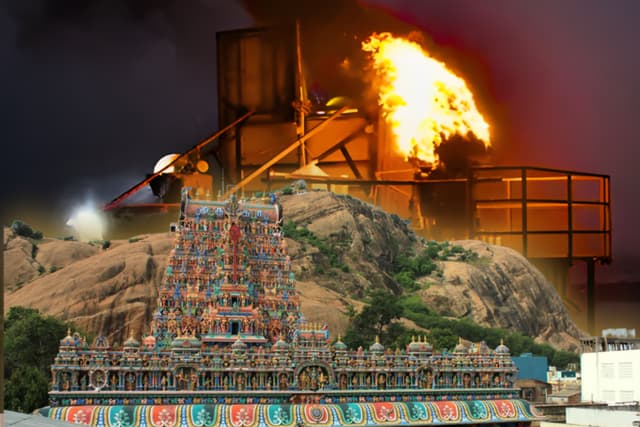
A stone pillar, a night-time oil lamp, a narrow ledge on a granite hill above Madurai, these are not the stuff of headline politics in most democracies. Yet in early December, the attempt to light the Karthigai Deepam at the Deepathoon on Thiruparankundram was transformed by state choice into a moment of constitutional consequence.
A judge enforced a title grounded in long-settled law; the state withheld police protection; central forces were asked to escort worshippers; the local administration used emergency powers to bar access; and, before the smoke of ritual oil had cleared, a parliamentary motion sought the removal of the judge.
For millions of believers this was not an abstract constitutional drama: it was the blunt, lived sense that a majority community's ritual claim could be administratively nullified and legally deferred for the sake of "order."
For a polity that likes to call itself secular and plural, the spectacle posed a raw question: can the majority be denied the peaceful exercise of its religious life because political managers fear unrest?
The sharper point is this: the Indian republic has always been obliged to treat both rights and order as co-equal obligations of the state. When the state uses public-order powers as a unilateral veto over the enforcement of legal rights, the result is not prudence but selective disenfranchisement.
The Deepathoon episode offers a textbook case: the High Court ordered the lighting at the site; the district administration invoked prohibitory powers to stop it; and the State's refusal to enforce a court order effectively converted the threat of disorder into a permanent bar on a religious act.
The Madras High Court's later direction permitting a hunger strike in Thiruparankundram under judicial supervision underscores another fact: the courts saw the devotees' claims as lawful and the administration's blanket refusal as overreach.
There are two stories one can tell about this chain of events. One is the liberal, managerial narrative: the state acted out of a fragile sense of peace, a desire to avoid communal tension, and it chose containment over confrontation. That story is meant to reassure: better a small sacrificial compromise than a riot.
The other story is darker and simpler: the majority was told to stand down; a ritual claim with legal underpinning was deferred because the political class preferred the path of least resistance, and when the courts insisted, those political actors moved to punish the judge.
The invocation of prohibitory orders after the court issued protection is not a neutral administrative choice; it is a technique of denial. It transforms enforcement into abdication and rights into something negotiable at the district collector's desk.
That denial matters because it is not incidental or novel. The Deepathoon sits on Thiruparankundram, home to one of the six sacred abodes of Murugan, a temple with layers of history, inscriptions, and devotional practice stretching back centuries.
The legal question involved title and ritual practice; the legal answer was hardly inventive. The judge relied on settled lines of precedent and the record of prior adjudication. The state's response, by contrast, was political: "we cannot maintain order," and therefore the court's instruction must yield.
This sort of administrative substitution, "we will not enable your lawful ritual because it is inconvenient", leaves a citizen's rights subordinated to the state's appetite for quiet. When the appetite for quiet is stronger in cases involving the majority's rites, the result is a durable inequality in the practice of religion.
The public felt it: a core rite deferred not for legal reason but for political expedience.
If institutional pathology is to be diagnosed, look at the parliamentary reaction. Democracy has instruments for resolving friction: appeal, review, legislation, public persuasion. Impeachment of a judge, with its extraordinary constitutional gravity, is not meant to be the political remedy for an unpopular judgement. It is designed for proven misbehaviour or incapacity.
That a sizable group of MPs moved to threaten removal for an order that a division bench later vindicated demonstrates the politicisation of judicial independence. The message to judges is unambiguous: enforce rights at your peril.
The practical consequence is chilling: judicial willingness to protect the rights of majorities whose practices the local state prefers to suppress will be diminished; the law will retreat to the safe and the non-controversial. If courts are to be intimidated into inaction where majority rituals touch contested space, the result will be juridical self-censorship, a slow hollowing of the very protection the Constitution is supposed to guarantee.
The irony is stark. Parties and coalitions that now sign impeachment notices have in past decades themselves been indifferent or even hostile to judicial autonomy when courts frustrated their aims. The record of political actors treating the bench as a partisan instrument when convenient, and as a problem to be neutralised when inconvenient, is long; the current episode only continues that practice.
Parties that once trafficked in a politics of judicial critique, sometimes righteous, sometimes tactical, now pursue the most extreme remedy short of criminal charges. If the instrument of impeachment can be turned into a political cudgel, the judiciary ceases to be a neutral arbiter and becomes an object of political management.
That vulnerability especially hurts ordinary worshippers: when judges shrink from decisions that affirm the majority's lawful rites, the ordinary citizen is the eventual loser.
We must be explicit about what this looks like on the ground. For the Hindu believer in Madurai who has watched the hill's contours for generations, the Deepathoon is not a bureaucratic fiction; it is a place of accumulated practice and identity. To be told that lighting the lamp is too politically risky to permit is to be told that your tradition is second-order in public life.
Denial of access to sacred sites under the banner of "order" normalises a hierarchy of claims in which some groups' ritual rights are securitised while others' are enforced. That hierarchy is illegitimate. It converts secular administration into a selective gatekeeper.
There is a moral argument here as well as a legal one. Secularism, in its best liberal form, is supposed to ensure equal treatment before the law, not the preservation of artificial inter-communal pauses at the cost of constitutional claimants.
If secular governance means that majority rites can be quietly suppressed because of the predicted wrath of disruptors, then what remains of equality? The state must confront mobs and enforce rights; otherwise, the state becomes the instrument that adjudicates which communities may practise freely and which must negotiate consent through a political process weighted against them.
Critics will say this line of argument flattens context: it fails to respect minority anxieties and the delicate choreography of communal coexistence. That is a straw-man. Reasonable statecraft weighs rights and risks; it does not use the risk of unrest as permanent veto power over lawful practice.
The state is judged not by its excuses but by its capacity to secure rights. Deny enforcement and you deny the right; provide protection, and you enable constitutional equality. The former is what happened at Thiruparankundram; the latter is what the High Court sought to secure, until the political reaction moved to delegitimise the very judge who tried to uphold that equality.
This is not merely a local grievance. The pattern, of majoritarian ritual claims deferred, of the state choosing avoidance rather than enforcement, and of political actors weaponising impeachment as remedy, erodes the compact that sustains plural democratic life.
It is a reminder that rights do not protect themselves: they must be enforced by institutions that are independent and courageous. If a judge can be threatened for enforcing a statute or precedent in favour of a ritual practice because it displeases political sensibilities, the Constitution's promise becomes conditional on political convenience.
That is the civic argument the country now faces. If we accept a politics where the majority's peaceful rites can be constrained by the state's fear of unrest, we accept a regime of differential citizenship by default. If we defend judicial independence against political reprisal, we defend the right of every citizen, majority and minority alike, to have their lawful claims adjudicated and enforced.
One protects institutions; the other protects temporary comfort. Which will define India going forward is the real contest: the lamp atop the hill is small; the principle it illuminates is vast.
Kishan Kumar is a graduate in Economics from the University of Delhi, currently working in the political communication space. He focuses on narrative-building, strategic messaging, and public discourse, with a strong interest in politics, policy, and media. He posts on X from @FreezingHindoo.
 Join our