Culture
Who Owns the Sacred? Gold Auction Divides Sri Lanka's Kataragama Temple
S Rajesh
Jan 13, 2026, 03:53 PM | Updated Jan 14, 2026, 12:39 PM IST
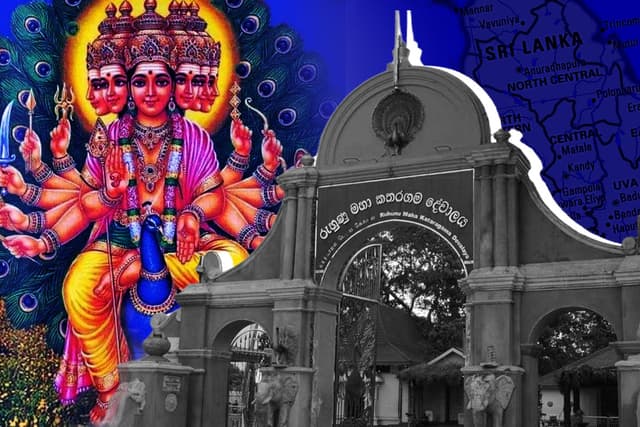
A plan by one of Sri Lanka's most revered multi-faith temples to auction off a large portion of its gold reserves has ignited a controversy that reaches far beyond questions of money. The Ruhunu Maha Kataragama Devalaya—sacred to Buddhists, Hindus, Muslims, and the island's indigenous Vedda community—has announced it will sell nearly 70 per cent of its gold holdings to support the government's 'Rebuilding Sri Lanka' fund.
What some hail as an act of national solidarity, others see as a troubling encroachment on religious autonomy, reopening long-simmering debates about identity, authority, and the ownership of the sacred.
The announcement came from Thilina Madushanka, the newly appointed Basnayake Nilame (chief custodian) of the temple, who took office barely a month ago. Speaking to media on 5 January 2026, Madushanka defended the decision as both a practical necessity—citing recent flood damage that threatened the temple's gold reserves—and a patriotic gesture during a time of national economic hardship.
"Some of the gold reserves at the Kataragama Devalaya were affected by the recent floods," Madushanka explained. "If, for some reason, part of that gold was carried away by the floodwaters, who would be held responsible? That is why I made this decision. At this time, even the government is facing major difficulties. We expected to help the government with its other projects."
The custodian has pledged full transparency, stating that the auction would be conducted under the supervision of the National Gem and Jewellery Authority at fair market value, with approval from the Commissioner General of Buddhist Affairs.
He has also clarified that only gold offerings made by devotees in recent years would be sold, dismissing viral social media claims that ancient artefacts dating back 2,000 years would be auctioned. Items bearing images of deities will be excluded from the sale.
A Temple of Many Faiths, A History of Tensions
Yet the controversy extends far beyond questions of flood damage and fiscal responsibility. The Kataragama temple complex—known in Tamil as Katirkāmam Murugan Kōvil—occupies a unique position in Sri Lanka's religious landscape.
For Sinhalese Buddhists, the deity Kataragama Deviyo is a guardian spirit of Sri Lanka. For Tamil Hindus, the same deity is Murugan or Skanda, the warrior god celebrated in Tamil devotional literature dating back to the 15th-century poet Arunagirinathar.
This dual identity has historically been a source of both remarkable interfaith harmony and simmering tension. The temple complex houses Buddhist shrines managed by Sinhalese authorities alongside Hindu shrines dedicated to Teyvāṉai and Shiva managed by Hindu priests.
For centuries, Tamil Hindu pilgrims from Sri Lanka and South India undertook arduous journeys on foot to worship at Kataragama, considering it amongst the most sacred Murugan shrines.
However, the balance of power at the temple has shifted significantly since the 1950s, with Buddhist influence growing substantially. The main shrine is now administered through the Buddhist governance structure, with the Basnayake Nilame—a position traditionally associated with Buddhist temple management—serving as chief custodian.
Critically, the decision to auction the temple's gold was made in consultation with the Commissioner General of Buddhist Affairs, not Hindu religious authorities, despite the temple's profound significance to Tamil Hindu devotees.
The Tamil Perspective: Sacred Offerings, Secular Appropriation?
For many in Sri Lanka's Tamil Hindu community, the announcement touches raw nerves that extend back decades. The gold in the temple's vaults represents not merely monetary value but the accumulated devotion of generations of pilgrims, who offered precious metals as acts of faith to Lord Murugan.
The prospect of these sacred offerings being converted to cash for government projects, however worthy, strikes some as a fundamental violation of religious trust.
The controversy must be understood against a broader backdrop of Tamil concerns about the treatment of Hindu religious sites in post-independence Sri Lanka. Tamil advocacy groups have long documented what they describe as a pattern of encroachment on Hindu temples and sacred sites, particularly in the Northern and Eastern provinces.
The Department of Archaeology has been accused of using excavation projects to claim land associated with Hindu temples, whilst Buddhist shrines have been constructed at sites historically significant to Tamils.
"We are saddened by the fact that it is some Buddhist monks who are leading the efforts to destroy Saivite and Tamil history," the Association of Hindu Priests in Muttur stated in response to a separate temple controversy, reflecting sentiments that resonate with the current situation. The Kataragama decision reinforces fears amongst some Tamil Hindus that religious properties associated with their community remain vulnerable to appropriation by majority institutions.
That guidance was sought exclusively from Buddhist religious authorities—rather than from Hindu bodies or through interfaith consultation—has particularly alarmed Tamil observers. How, they ask, can offerings made to a Hindu deity by Hindu devotees be disposed of without the consent of Hindu religious leadership?
The Case for the Auction: Pragmatism and Patriotism
Supporters of the Basnayake Nilame's decision present a starkly different narrative. They point out that Sri Lanka remains in the grip of its worst economic crisis in decades, with the 'Rebuilding Sri Lanka' Fund representing a crucial mechanism for national recovery. In this context, religious institutions contributing to the common good represents not appropriation but civic responsibility.
Madushanka himself has emphasised his personal integrity, noting that he has not taken any caretaker allowance or benefit from the temples under his administration for four years. "I have no intention whatsoever of committing fraud," he stated. "If anyone claims that I am trying to take temple property for myself, that is false."
The safeguards proposed for the auction—supervision by the National Gem and Jewellery Authority, approval from the Commissioner General of Buddhist Affairs, exclusion of deity images, and public announcements through social media—are presented as evidence of good faith. The clarification that only recent offerings would be sold, rather than ancient artefacts, is intended to address concerns about historical and archaeological significance.
From a pragmatic standpoint, defenders argue that gold sitting in temple vaults serves no religious purpose if it remains unused whilst the nation struggles. Converting these reserves to productive capital for reconstruction projects could generate tangible benefits for all Sri Lankans, including the Tamil community.
A Microcosm of Larger Questions
The Kataragama controversy ultimately reflects unresolved questions about religious pluralism, minority rights, and institutional governance that have shaped Sri Lankan society since independence. In a nation still healing from decades of ethnic conflict, the management of shared sacred spaces carries symbolic weight that far exceeds their material value.
Academic studies of Kataragama have noted that despite the appearance of ethnic harmony at the site, pilgrims are today likely to leave with a "sharp impression of the gulf that separates Tamil and Sinhalese people." Buddhists and Hindus may worship at the same shrines, but they often hold fundamentally different beliefs about the nature of the deity and appropriate forms of devotion.
The current controversy risks widening that gulf. Whether the auction proceeds as planned, is modified through interfaith dialogue, or is abandoned in the face of opposition, the episode has already exposed the fragility of consensus at one of Sri Lanka's most symbolically important religious sites.
As Sri Lanka navigates its path towards economic recovery, the Kataragama gold auction poses a fundamental question: can national interest and religious pluralism coexist, or must one inevitably yield to the other? The answer will resonate far beyond the temple walls, shaping the relationship between the island's communities for years to come.
S Rajesh is Staff Writer at Swarajya. He tweets @rajesh_srn.
 Join our