Defence
HAL Out Of AMCA Stealth Fighter Race. Here's Why It Matters
Swarajya Staff
Feb 05, 2026, 07:26 AM | Updated 10:43 AM IST
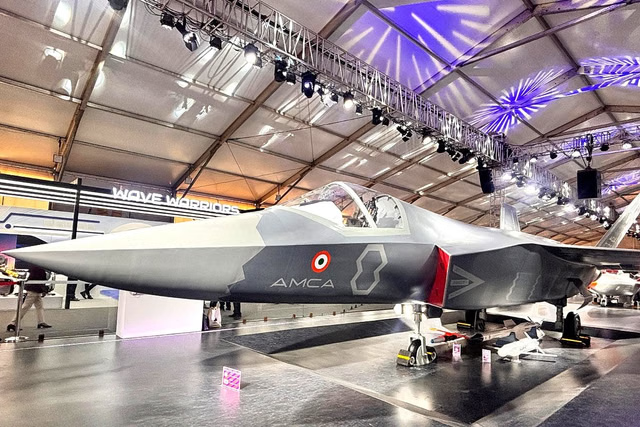
The Ministry of Defence’s decision to shortlist Tata Advanced Systems, Larsen & Toubro, and Bharat Forge for India’s fifth-generation fighter programme marks one of the most consequential inflection points in the history of the country’s military aviation sector.
For the first time since India began attempting indigenous combat aircraft, Hindustan Aeronautics Limited (HAL), the state-owned behemoth that has built every Indian fighter from the HF-24 Marut to the Tejas, has been left out of a frontline programme.
At one level, the news is procedural. The Advanced Medium Combat Aircraft, or AMCA, has entered the next stage of its long gestation, and the government has narrowed the field of potential industry partners.
At another level, it represents an unmistakable shift in how the government now views risk, capacity, and accountability in defence manufacturing.
Until recently, the AMCA was meant to follow a Strategic Partnership model that preserved HAL’s centrality while bringing in a private firm to assist with execution. That construct has now been abandoned.
With HAL out of the picture, the three shortlisted private players are competing to become the sole ‘Industry Partner’ to the Aeronautical Development Agency, the DRDO’s aircraft design arm and the programme’s technical custodian.
Whoever wins will not merely supply parts or assemble kits. The selected firm will co-develop five flying prototypes and a full structural test article, set up a dedicated production ecosystem capable of series manufacturing, and take the aircraft through flight testing and certification within a tightly defined eight-year development window.
The prototype phase alone is expected to cost around Rs 15,000 crore. Over the long term, the programme could yield orders for at least 120 aircraft, with production and lifecycle support stretching across two decades.
This structure immediately gives India a second fighter production line outside HAL, something it has never truly had in combat aviation. That has implications well beyond the AMCA itself.
India’s air force has long been hostage to single-line constraints, where delays in one programme ripple across the entire fleet. A parallel line introduces redundancy, resilience, and surge capacity, critical in a crisis where production tempo matters as much as platform quality.
Just as importantly, it relieves pressure on HAL, which is currently stretched across multiple high-priority commitments. The company is ramping up production of the LCA Mk1A, preparing for the LCA Mk2, delivering Prachand attack helicopters, and juggling upgrades and support for legacy fleets.
Allowing HAL to concentrate on these programmes, rather than adding another time-critical flagship fighter to its load, may be as much a capacity-management decision as a punitive one.
It also opens space in the pipeline. Over the next two decades, India will need more than one new combat aircraft programme. The naval TEDBF, expected to unfold on a timeline similar to the AMCA, is a case in point.
An ecosystem where multiple fighters are developed and built in parallel is no longer a luxury. It is essential if squadron strength is to be stabilised and India is to catch up after years of delay.
That said, HAL’s exclusion is not merely a redistribution of work. It is a reprimand. For decades, HAL functioned as the default integrator for every indigenous fighter effort, insulated from competition and consequences.
This time, the Ministry of Defence appears to have invoked hard metrics. Firms with excessively skewed order books relative to turnover, which is reported to be close to eight times in HAL's case, were effectively penalised. In plain terms, delivery delays and execution backlogs have finally translated into cost.
The signal is not limited to HAL. If a monopoly with decades of experience and political heft can be set aside on a programme of this importance, other defence public sector units will read the message clearly. Legacy status is no longer sufficient protection. Performance, capacity, and timelines now matter in a way they previously did not.
More broadly, the AMCA decision underscores a shift in government's industrial strategy when it comes to defence manufacturing.
By placing the country’s most ambitious aerospace programme largely in private hands, with ADA retaining design authority, the government is betting that competition and accountability will deliver outcomes faster than continuity and familiarity. The objective appears less about privatisation for its own sake, and more about breaking a closed loop that has historically blurred responsibility when projects slipped.
This is not without risk. None of the shortlisted firms has built a fighter aircraft end-to-end. Moving from components and subsystems to full platform integration is a steep climb, especially in stealth aviation. If execution falters, India would face further delays in acquiring a critical capability with no easy fallback available.
Yet the choice suggests that the government believes the greater risk lies in staying the course. With China already operating stealth fighters and Pakistan openly exploring similar capabilities, India’s margin for delay has narrowed sharply.
Whether this gamble pays off will only be clear years from now. But one thing is already evident. The era in which indigenous fighters automatically meant HAL fighters has come to an end.
 Join our