Defence
Why Screwdrivers Are Harmful To National Security
Prakhar Gupta
Dec 08, 2025, 01:56 PM | Updated 02:18 PM IST
.jpg?w=640&q=75&auto=format,compress&format=webp)
The Chief of Defence Staff General Anil Chauhan was recently criticised for asking defence manufacturers to show “more patriotism” and “not chase profits,” a line that deserved the backlash it received. But in the middle of that controversy, he made one intervention that should not be lost.
General Chauhan warned that several firms claiming 60 or 70 per cent indigenous content were inflating those numbers and that such misrepresentation had direct security implications. His point was straightforward. Companies were overstating how much of a system was genuinely Indian, and the gap between claimed and actual indigenisation was wide.
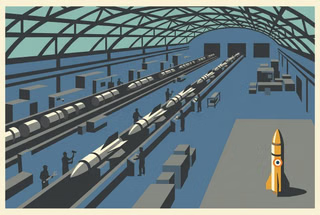
Mislabeling is the crude end of the spectrum. The more entrenched practice, one that has shaped Indian defence production in recent decades, and continues to thrive even amid the push for atmanirbharta, is screwdriver-giri. Kits shipped from abroad, assembled in India, painted in Indian colours and delivered as if they were national capability.
And none of this is happening behind closed doors. It has unfolded in plain sight, most visibly in India’s burgeoning drone sector. Several firms that secured defence orders by claiming high levels of indigenisation were later found to be assembling imported components, often of Chinese origin, while presenting the final product as locally built.
In multiple cases, procurement agencies were forced to cancel contracts, initiate audits, and introduce strict tracking of foreign-origin parts after discovering that the so-called “Indian” hardware was essentially a kit-assembly exercise.
This is not to deny that a genuine drone ecosystem is taking shape, or that serious players are pouring money into genuine research and development. But for every company making that long, expensive investment, there are half a dozen passing off screwdriver-giri as innovation, feeding off the appetite for quick success stories.
But this practice did not arise in a vacuum. The armed forces have long shaped an environment in which such arrangements thrive. Reluctance to support indigenous products from the early stages, an expectation of near-perfect performance from the first iteration, and procurement systems that reward mature foreign solutions over evolving Indian ones, all of these have reinforced the assembly culture.
When the best is demanded on day one, and the good is dismissed before it can mature, screwdriver ToT becomes the path of least resistance for industry.
This system creates an uneven playing field for firms that want to pursue real R&D. A company attempting to develop a niche technology faces long timelines, uncertain outcomes and high capital costs. Success is not guaranteed, and failure can sink the company’s finances or reputation. Meanwhile, a competitor can simply partner with a foreign OEM, import CKD or SKD kits, perform final assembly in India, and meet delivery schedules with minimal technical risk. The platform may look identical on paper, but the investment, risk, and knowledge creation are worlds apart.
The incentives are obvious. Investment in deep technology becomes commercially irrational for private players when procurement behaviour rewards integrators over innovators. No board will support a ten-year research programme when a three-year assembly arrangement can deliver revenue with far fewer unknowns.
Purchases based on screwdriver ToT do not create the industrial foundations that indigenous development builds. Assembly lines are not technology centres. They do not generate intellectual property, design authority or control over subsystem evolution. They do not equip Indian engineers with access to source code.
It leaves India dependent on foreign firms for overhaul, repair, upgrades, spare parts, diagnostics and configuration control. The country pays license fees and royalty premiums for production that is essentially clerical and adds little value. A large share of the budget flows outward. What remains in India is a workforce trained in integration, not innovation.
Indigenous programmes struggle to scale because their competitors deliver equipment faster by importing the subsystems that define the platform. Over time, Indian companies settle into roles as integrators. This does not bridge India’s core technological gaps. It locks them in.
Screwdriver ToT creates a public illusion of indigenisation. It allows governments to announce that a platform is being “built in India” even though the underlying technologies remain entirely foreign. The airframe or hull becomes the showcase, masking the fact that propulsion, sensors, data links, guidance, transmissions, optronics and materials come from abroad. India ends up with the physical shell of the system, not the engineering DNA. It is a form of industrial camouflage that flatters the political narrative without strengthening national capability.
A production line built on imported cores cannot withstand the tempo of conflict, or the pressures of geopolitics. India cannot surge production in wartime if critical sub-systems must be imported. Procurement lines that look efficient in peacetime stall the moment supply chains tighten. A crisis involving sanctions, export restrictions or geopolitical pressure would freeze production within weeks.
Screwdriver ToT has not proven to be a harmless halfway house on the road to self-reliance. It is a diversion that absorbs money and time while leaving India without the capability it needs desperately. The CDS’ concern about inflated indigenisation figures should not be treated as a minor observation. It is a window into a deeper structural problem that India has been struggling to confront in recent decades.
If the country wants real capability, it has to stop rewarding cosmetic indigenisation. Indigenous programmes require the patience and backing of the services, and those investing in true domestic development must be spared a lecture on patriotism and profits. Without that shift, India will continue to assemble platforms it cannot truly own, sustain or evolve, and mistake that for progress.
Prakhar Gupta (@prakharkgupta) is a senior editor at Swarajya.
 Join our