Economics
Breaking The Box: India's Uphill Battle Against China's Container Monopoly
Swarajya Staff
Feb 02, 2026, 12:36 PM | Updated Mar 04, 2026, 03:55 PM IST
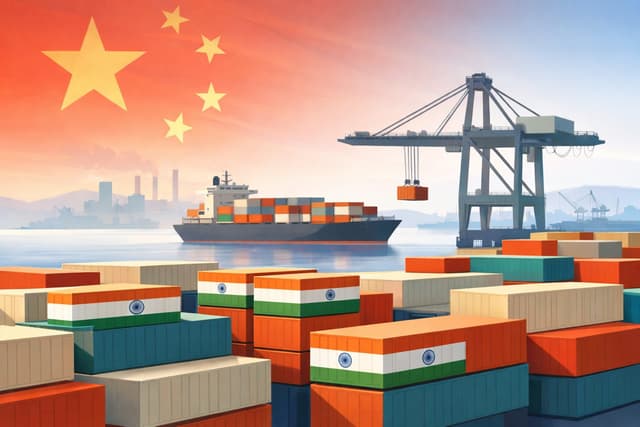
The humble shipping container is perhaps the most underappreciated invention of the twentieth century. These corrugated steel boxes, stacked on vessels the size of small towns, carry roughly 90% of the world's traded goods and have done more to flatten the earth than any diplomatic initiative or trade agreement. Yet for all their ubiquity, containers are made in remarkably few places, or more precisely, in one place: China. And that has become a problem.
China accounts for approximately 96% of global container production capacity. Three state-owned giants, China International Marine Containers (CIMC), Dong Fang International Containers, and CXIC Group, manufacture the vast majority of the world's boxes, with CIMC alone churning out a container roughly every three to four minutes. For decades this suited everyone well enough: Chinese factories offered unbeatable prices, reliable quality, and scale that made competition seem pointless.
Then came the pandemic. As consumer demand surged in locked-down Western economies and supply chains seized up, container shortages sent freight rates soaring. Shipping a box from Shanghai to Los Angeles, which had cost around $2,000, briefly touched $20,000. Indian rice exporters watched helplessly as goods sat in warehouses for want of boxes. The crisis laid bare an uncomfortable truth: the arteries of global trade ran through Chinese factories, and those factories answered to Beijing.
For India, the implications were acute. Nearly 99% of containers circulating through the country are Chinese-made. The Container Corporation of India (CONCOR), the public-sector giant handling the bulk of containerised rail freight, imports its entire fleet from China. When geopolitical tensions flared following the Ladakh border clashes in 2020, policymakers began to see container dependence less as an inconvenience and more as a strategic vulnerability.
The response has been ambitious. Under Atmanirbhar Bharat (self-reliant India), the government has launched a push to build domestic container manufacturing from scratch. An inter-ministerial committee has recommended production-linked incentives modelled on schemes that attracted investment in electronics and pharmaceuticals.
Braithwaite & Company, a Railways ministry undertaking, has begun capital investment at its Kolkata facility for 20-foot and 40-foot containers. CONCOR, which spends $28 million annually on Chinese imports, has placed orders with domestic firms. Bhavnagar in Gujarat is being groomed as a manufacturing hub.
India is not alone. Vietnam has emerged as a favoured destination for diversification, with new factories that could eventually produce a sixth of global annual output. American policymakers, spooked by reports that Chinese-made port cranes contain sensors capable of tracking cargo, have begun scrutinising maritime infrastructure. The Wall Street Journal reported in 2023 that automated cranes from Shanghai-based ZPMC could theoretically provide remote access to disrupt trade. Whether such fears are justified or paranoid, they have concentrated minds.
For India, the strategic calculus is straightforward. Exports are growing, manufacturing is expanding, and ambitions to become a credible alternative to China in global supply chains depend on reliable logistics. Maritime India Vision 2030 envisages $12-15 billion in port infrastructure, including mega-ports capable of handling the largest vessels. Cargo traffic at major ports reached 855 million tonnes in fiscal 2024-25. If India is to capture a greater share of global trade, and "China plus one" sourcing strategies suggest it might, it will need containers in abundance.
The trouble is that wanting to make containers and making them competitively are different propositions. China's advantages are formidable: decades of investment, massive scale, and generous state support have created an ecosystem India cannot replicate overnight. A 40-foot container costs around $4,200 at Shanghai versus $6,000 in India, a 30-35% gap few buyers will overlook. Chinese manufacturers benefit from vertically integrated supply chains, ready access to Corten steel (the corrosion-resistant alloy essential for maritime containers), and streamlined certification. In India, certification alone costs $55-60 per container.
Steel presents a particular headache. India does not produce A-grade Corten steel domestically in meaningful quantities, forcing manufacturers to import, often from China itself. Major steelmakers could supply the grades needed, but only with large orders and advance payments. For an infant industry, generating the volumes needed to unlock competitive pricing is a classic chicken-and-egg problem.
Then there is the question of buyers. Global shipping lines operate on long-term contracts with Chinese suppliers; switching costs are real, relationships matter, and quality concerns linger around new entrants. Chinese manufacturers have spent decades building portfolios of over 900 container types, from refrigerated units to open-top boxes. Indian firms are starting with basic designs and little track record.
None of this makes the endeavour hopeless, but it counsels realism. The domestic market offers the most plausible path forward. CONCOR alone projects a need for 50,000 containers in coming years; capturing this demand would give manufacturers the volumes to climb the learning curve and bring costs down. The government can help by reducing duties on Corten steel, streamlining certification, and ensuring public-sector buyers prioritise domestic sourcing even at a modest premium.
There may also be demand from abroad. Some international buyers, keen to reduce China dependence for geopolitical reasons, have approached Indian manufacturers willing to pay higher prices for non-Chinese boxes. Such "sympathy buyers" won't transform the market alone, but they suggest India's pitch, reliable supply from a democratic partner, resonates with procurement officers thinking beyond the next quarter.
The broader significance extends beyond boxes. India's container push forms part of a wider effort to build infrastructure underpinning modern trade. Sagarmala aims to modernise ports and develop coastal shipping; dedicated freight corridors will speed rail movement across the subcontinent; inland waterways are being revived. Together, these initiatives represent a bet that India can become not merely a manufacturing destination but a logistics hub, a country that moves goods as efficiently as it makes them.
Whether that bet pays off remains to be seen. China's grip on container manufacturing is unlikely to loosen quickly, and India's industrial policy has a mixed record at picking winners. But the pandemic demonstrated that supply chains concentrated in a single country are supply chains at risk. In a world of great-power competition, the ability to make one's own boxes is not trivial for a nation with India's ambitions. Delhi has recognised as much; the first steps have been taken. Now comes the hard part: building an industry that can hold its own against the most formidable manufacturing machine the world has ever seen.
 Join our