Economics
The Orange Economy: Concert Economy Reached ₹100 Billion In 2024 Despite Policy Gap, Says Economic Survey 2025-26
Diksha Yadav
Jan 29, 2026, 03:34 PM | Updated 03:53 PM IST
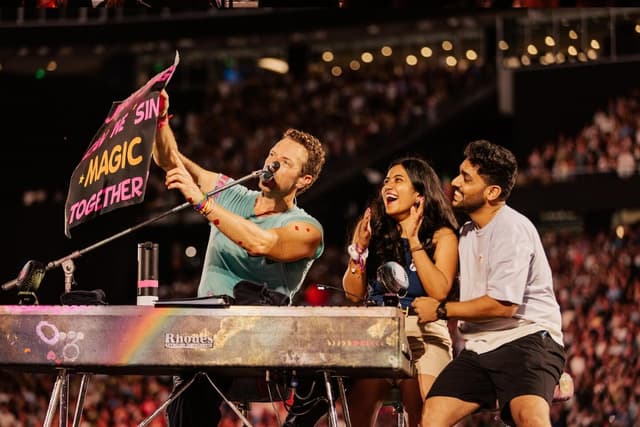
On a winter evening in a major Indian city, a stadium fills up hours before the first note is played. Hotels nearby are sold out. Ride-hailing prices spike. Temporary workers manage entry gates, sound equipment, lighting rigs, security cordons, food stalls and merchandise counters. By the time the crowd disperses, the economic footprint of that single concert has travelled far beyond the stage.
It is this ripple effect that the Economic Survey 2025–26 places at the centre of its discussion on the “Orange Economy”— an umbrella term for economic activity driven by creativity, culture and intellectual property rather than physical production. Box VII.6 of the Survey uses the concert economy as a concrete, measurable example of how ideas and experiences can now function as engines of growth.
Globally, the case is already well established. Live music today accounts for roughly one-third of total music revenues worldwide. In the United States, live music generated over USD 130 billion in economic output in 2019 and supported more than 900,000 jobs. In the United Kingdom, music tourism alone contributed £6.6 billion in 2022—around 0.3 per cent of GDP—with strong spillovers into hospitality, transport and retail.
UNCTAD estimates show that creative industries contribute anywhere between 0.5 per cent and over 7 per cent of GDP across countries, depending on the maturity of their ecosystems.
What makes the concert economy particularly attractive from a policy perspective is its multiplier effect. Ticket sales form only a fraction of the total value generated. Large live events create short-duration but high-intensity demand for hotels, local transport, food services, advertising, logistics, media production and urban services. They are also labour-intensive, generating employment across a wide skill spectrum—from stage crews and sound engineers to security staff, event managers and content creators. For younger workers and creative professionals, these value chains provide entry points that are difficult to replicate in capital-heavy industries.
India’s own concert economy, the Survey notes, is still nascent but scaling rapidly. In 2024, it crossed the ₹100 billion mark, driven by a combination of demographic and structural factors. A young population with rising disposable incomes, the spread of digital ticketing platforms, and improvements in urban infrastructure have collectively expanded the market for large-scale live events. Importantly, the spillovers are no longer confined to metros alone, with Tier-II cities increasingly featuring on touring circuits.
Yet the Survey is clear that India is capturing only a fraction of the potential upside. The constraints are not demand-side; they are institutional. Dedicated live event venues remain scarce. Payments to foreign artists are subject to complex foreign exchange and tax rules, discouraging international tours. Most significantly, organisers must navigate a thicket of regulation—often requiring 10 to 15 separate clearances from multiple authorities for a single event.
International experience suggests that the economic gains from live entertainment depend less on artistic supply and more on urban readiness. Predictable regulations, streamlined permissions, efficient crowd management systems, last-mile connectivity and coordination between city authorities and tourism bodies are decisive. Where these conditions exist, concerts and festivals become repeatable economic assets rather than one-off spectacles.
The Survey acknowledges this gap and outlines the beginnings of a policy response. The Ministry of Information and Broadcasting is working towards a single-window mechanism for live entertainment permissions, including coordination with state governments. If implemented effectively, this could substantially reduce transaction costs and uncertainty for organisers.
Beyond procedural reform, the Survey points to more ambitious possibilities.
Opening select heritage monuments for live events — under carefully designed conservation frameworks — could simultaneously monetise cultural assets and elevate India’s position in global touring circuits. Simplifying visa and foreign exchange permissions for foreign performers would address a long-standing bottleneck. Integrating live entertainment into tourism strategies and city branding exercises could convert concerts into deliberate demand-generation tools rather than incidental economic activity.
Looking ahead, the medium-term outlook for the Orange Economy appears favourable. Digital adoption has lowered entry barriers for creators and organisers alike. Content diversification and experiential consumption trends are reshaping how households allocate discretionary spending. Expanding connectivity — both physical and digital—is widening the geography of events. Advances in artificial intelligence, immersive media and virtual production are blurring the lines between live and digital experiences, opening new revenue models and formats.
What is significant about the Economic Survey’s treatment is not merely the data points, but the signal it sends. By formally recognising the Orange Economy — and anchoring it in a quantifiable, fast-growing segment like the concert economy — the Survey places creative industries within the framework of mainstream economic policy. The ₹100 billion milestone reached in 2024 is presented not as an anomaly, but as an early indicator.
The implication is straightforward. With relatively modest reforms — particularly around permissions, venues and cross-border facilitation — India could unlock high-multiplier growth that complements its traditional engines. Countries like the United States and the United Kingdom have already demonstrated that creative economies are not peripheral to growth; they are integral to it. The Survey suggests that India now has both the market conditions and the policy awareness to follow suit. The next step lies in execution.
Diksha Yadav is a senior sub editor at Swarajya.
 Join our